Category Archives: Ontario Health Coalition

Coalition hosts one-day briefing/summit on “ALC” issue

The Ontario Health Coalition is hosting a one-day briefing and summit on retirement homes and alternative level of care.

Ontario hospitals are presently under tremendous pressure to relocate “alternate level of care patients” — patients who are finished their acute care treatment but are not well enough to go home.

Increasingly they are being sent to retirement homes, which are ill equipped to provide the level of care many require.

The Coroner’s office has issued warning to the Ontario Hospital Association about inappropriate placements of patients to retirement homes.

The government requires retirement homes to abide by standards of long term care in order to accept such patients, but is it enough, and are these standards really being met?

How can we best protect the comprehensiveness and accessibility of Ontario’s health care system for those with chronic care needs?
How can we best protect patients, residents and staff from harm?

High-Level Briefing and Summit
June 20, 2011
Lillian H. Smith Public Library
239 College St., Toronto
Registration 9 am – 10 am, Adjournment 3 pm

Registration is $0-$10.

Sponsored by: Ontario Health Coalition; Alliance of Seniors/Older Canadians Network; Older Women’s Network.

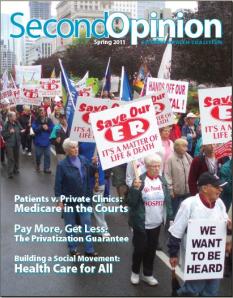
Second Opinion debuts

The Ontario Health Coalition has launched a new quarterly magazine – Second Opinion. 

The Spring 2011 edition debuted last week, featuring stories on legal challenges to private clinics, privatization, debunking spending myths and building a social movement around health care.  20,000 copies of the magazine are being distributed across Ontario.

Copies of the magazine are being sent out to OPSEU’s 22 regional offices next week.  While quantities are limited, any locals wishing bulk copies should e-mail Rick Janson at rjanson@opseu.org

Still waiting – Ontario Health Coalition releases home care report

Home care has to be the most tiered health care service in Ontario. Consider that many front line care providers are not on salary, but operating as independent contractors to agencies. The agencies in turn are contracted by the Community Care Access Centres. The Community Care Access Centres sign accountability agreements with the Local Health Integration Networks, which in turn report to the Ministry of Health.

That’s a lot of layers of bureaucracy to facilitate a home care visit.

The Ontario Health Coalition released a new home care report April 4th that suggests about 30 per cent of home care costs are administrative. That may be very conservative.

For the past 15 years the government has been trying to fit a square peg through a round hole as it tries to implement a system of competitive bidding for home care contracts.

The results of these competitions have been what the Toronto Star recently called “politically explosive” as often long-serving not-for-profit agencies lose out to less experienced for-profit companies. When that happens, all the workers who provide both professional and supportive care lose their job and patients lose continuity of care.

In 2008 when the VON and St. Joseph’s Home Care were eliminated from an active competition to provide nursing care in the Hamilton community, the outcry was huge. More than 1500 people came out mid-winter to a rally and effectively forced the government to once again extend a moratorium that had been in place since 2004.

Health Minister Deb Matthews has been coy about the issue – suggesting the government is in no hurry to resurrect competitive bidding. However, Matthews has neither ruled it out, making workers in the sector wonder if the mid-2012 expiry of their home care contracts will mean new competitions after the fall election is out of the way. The process takes about six months from tender to award to contract changeover.

And of course, while the Liberals are in no rush, competitive bidding was the brain child of the Tories, and would likely return competitive bidding even faster under a Hudak government.

While home care has been at the cornerstone of the McGuinty government’s efforts to empty hospitals of alternate level of care patients, the money has not followed. In 1999 home care represented 5.5 per cent of provincial health care spending. In 2010 it had dropped to 4.5 per cent.

According to the Ontario Health Coalition’s “Still Waiting” report from 2004 to 2010 overall funding for CCACs increased from $1.22 billion to $1.76 billion while clients increased from 350,000 to 586,000. In other words, funding went up by 40 per cent while the number of clients increased by 66 per cent.

In 2008 the government raised caps on individual service from 80 to 120 hours of service per month for the first 30 days and from 60 to 90 hours of service per month afterwards.

The raising of the caps, the increase in the number of patients, the lack of funding and the pressure hospitals have been under to empty beds has left many CCACs scrambling.

Reforms to competitive bidding were supposed to address problems regarding continuity of care, assessing quality, monitoring performance and addressing client and input and complaints. However, as the recent auditor’s report indicates, these are all still continuing problems in the sector.

To read the complete Ontario Health Coalition report, go to: http://www.web.net/~ohc/homecare2011finalreport.pdf

Watch OPSEU’s music video on home care at:
www.whatwillyoudo.ca

Event: Sarnia-Lambton health coalition presents dinner with Ross Sutherland

Ross Sutherland, author of False Positive: For Profit Labs in the Public Health Care System, is speaking Thursday, April 28 at the Wyoming Fair Grounds, Wyoming, Ontario.

Sponsored by the Sarnia-Lambton Health Coalition, the event also includes an update by the Ontario Health Coalition’s Natalie Mehra on upcoming provincial and federal health care election issues.

Cocktails start at 6 pm followed by the dinner at 6 pm. Tickets are $25. Call (519) 542-1895 or (519) 882-0357.

Health Coalition hosts two-day conference and action assembly November 6-7

Internationally respected health economist Robert Evans is the featured speaker during a two-day Action Assembly and conference hosted in Toronto by the Ontario Health Coalition November 6-7, 2010.

On Saturday the annual Action Assembly sets the direction for the Coalition for the coming year. With an election scheduled for October 6, 2011, the activities of the coalition will be critical in defining health care issues leading to that election. Saturday is also a time for local coalitions to share their accomplishments from the past year and to give updates on what is happening in their region.

On Sunday the OHC features a conference titled: Manufactured Crisis: The Myth of Medicare’s Unsustainability and what it means for Ontarians.

With the news reverberating with stories about out-of control health costs, a crisis atmosphere is being used to justify cuts, endless restructuring and delisting of clinical services Ontarians rely upon. But a closer look at the numbers shows a different story.

This conference will provide the information and a strategy to topple the myth of health care unsustainability.

Speakers for the two-day event include:

Dr. Robert G. Evans: Professor of Economics at the University of British Columbia, Evans is the founder of the University’s Centre on Health Services and Policy Research. Evans’groundbreaking comparative studies of health care systems and funding strategies have shaped policy in Canada and provided insight to governments and health agencies worldwide. An Officer of the Order of Canada, he has served as a member of the British Columbia Royal Commission on Health Care and Costs, and of the National Forum on Health. He is a Fellow of the Royal Society of Canada and an Institute Fellow of the Canadian Institute for Advanced Research, where he was director of the Population Health Program from 1987 to 1997. Evans is also an honorary life member of the Canadian College of Health Services Executives and of the Canadian Health Economics Research Association, and a member of the National Academy of Social Insurance (US). He is the first Canadian to win the Baxter International Foundation Prize for Health Services Research.

Dr. Pat Armstrong:  Professor in the Department of Sociology at York University,  Armstrong is co-author and/or editor on more than a dozen books on health care. She has also published on a wide variety of issues related to women’s work and to social policy. She has served as Chair of the Department of Sociology at York University and Director of the School of Canadian Studies at Carleton University. She was a founding partner in the National Network on Environments and Women’s Health, and is the Chair of Women and Health Care Reform – a working group on health reform that crosses the Centres of Excellence for Women’s Health. She is a site director for the Ontario Training Centre in Health Services and Policy Research. Professor Armstrong supports civil society organizations, serving on the board of directors of the Canadian Health Coalition and the Canadian Centre for Policy Analysis.

Other speakers include: Hugh Mackenzie economist; Dr. Duncan Etches and Joyce Jones, Intervenors, B.C. Court Challenge on single-tier Medicare; Hon. Roger Gallaway, LLB and former MP; Ross Sutherland, R.N., M.A.; Mike McBane, Coordinator, Canadian Health Coalition; Barbara Proctor and Kay Tod, RNs (ret) and Natalie Mehra, Director, Ontario Health Coalition.

The conference and action assembly take place at the Bond Place Hotel across from the Yonge-Dundas Square.

For more information and registration forms, go to www.ontariohealthcoalition.ca