Category Archives: Uncategorized

Ombudsman would be ideal party to resolve London’s toilet cleaning claims

Oh come on now. Attending question period at Queen’s Park can be an exercise in frustration as the opposition’s questions and the government’s answers seldom align.

You can ask anything you want, but it doesn’t necessarily mean the government will provide you with an answer that remotely addresses it.

Yesterday NDP Leader Andrea Horwath asked the Premier about an 80-year old patient at the London Health Sciences Centre who says he was told to clean his toilet.

Joseph Cummins was not just any patient – he is a retired professor of genetics at Western University and knows about hospital-acquired infections.

According to today’s Toronto Star, Cummins wandered out into the ward looking for someone to clean the bathroom he shares, at first finding no professional staff on the ward. Cummins admits to having had a mishap after being given a strong laxative and wanted to ensure it was cleaned up.

Continue reading

Even the wealthy can be impacted by the negative health effects of austerity

At first it was a mystery. How was it that during an excessively dry and hot 2007 summer that cases of West Nile disease had jumped in Bakersfield California by 276 per cent?

Dry weather is not normally associated with an abundance of mosquitos, which are transmitters of the disease from birds to humans.

Laboratories confirmed 140 cases in Bakersfield, a city of more than 800,000 in Southern California.

According to researchers at the University of California, aerial photography of the city showed something unusual – a high number of algae blooms in private swimming pools, hot tubs and ornamental ponds. One photograph showed 17 per cent of visible pools and hot tubs appearing green and likely producing mosquitos.

It turns out that Bakersfield was also at the epicenter of mortgage foreclosures, the downturn in the housing market leading to a 300 per cent rise in mortgage delinquencies.

Dr. William K. Reisen, a research entomologist with the Center for Vectorborne Diseases, had his team knock on the doors of these homes and found no one living there. The pools, hot tubs and water features were essentially abandoned and had become breeding grounds for the mosquitos.

The story, featured in a new book, The Body Economic: Why Austerity Kills by David Stuckler and Sanjay Basu, reminds us that we are ultimately all in this together.

Continue reading

Canada could have universal drug coverage without raising taxes – Morgan

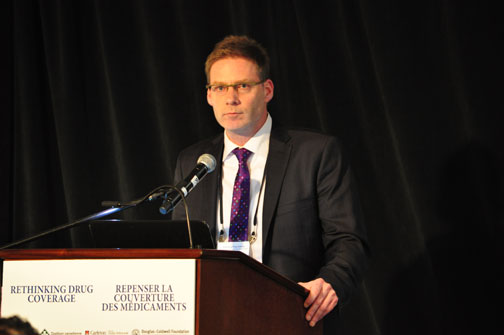
The UK's John Abraham on a panel with Carelton University's Marc Andre Gagnon.

The UK’s John Abraham on a panel with Carleton University’s Marc Andre Gagnon.

10 things we learned from last week’s Ottawa conference on drug coverage hosted by the Canadian Health Coalition and Carleton University:

1. The University of British Columbia’s Steven Morgan noted that if Canada were to adopt the UK’s public drug plan without any changes, it would “be enough to pay for universal Pharmacare in Canada at current rates. We would not have to increase taxes.” Carleton University’s Marc Andre Gagnon says Canada could save $10.7 billion on pharmaceutical costs with a universal drug plan. The question is not can we afford universal drug coverage, but can we afford not to?

2. We’ve reported in several posts on how Canada and the U.S. are outliers when it comes to a universal drug plan for our citizens. This has been the case for a very long time. The international panel noted many countries adopted universal access to prescriptions shortly after World War II. France adopted its social insurance system in 1945 while Britain was a few years behind in starting the National Health System in 1948, quickly adding prescriptions to it in 1952. More recent Scotland, Wales and Northern Ireland abolished all prescription charges, whereas England charges about 5 per cent co-pay on the cost of drugs in its Pharmacare program.

3. New Zealand has among the lowest drug costs in the world. They do this by placing a cap on total drug spending and making pharmaceutical companies bid on a share of that pie. The drawback is it does tend to slow the speed in which expensive new drugs become available, but does succeed in providing universal access to needed medications. There is a small co-pay of about $5 per prescription. There is no co-pay after 20 prescriptions are filled annually. There is practically no private coverage for pharmaceuticals in New Zealand. According to Matthew Brougham, former CEO of PHARMAC, New Zealand has been able to limit the increase in drug pricing over the last decade to 3 per cent per year compared to 9-10 per cent increases worldwide. While Canadian politicians claim they cannot afford to introduce Pharmacare, New Zealand adopted such a system precisely because the country was in dire economic circumstances.

4. The lack of universal drug coverage in Canada has not been for want of evidence or trying. Dr. Joel Lexchin of York University noted in his opening remarks that the Hall Commission recommended it in 1964, the National Health Forum did so in 1997, and it is now policy for both the federal Liberals and NDP. Lexchin says Canada’s Pharmaceutical policy resembles the U.S. health care system – some private coverage, some public, and a lot of people who have nothing. “This is not a pie in the sky scheme,” he said, noting Saskatchewan formerly had universal drug coverage.

Continue reading

Drug benefits vulnerable for even those receiving the best plans — White

Julie White (CURC) says private drug plans are insecure, inconsistent, and unfair. They also make cost control difficult from a public policy perspective.

Julie White (CURC) says private drug plans are insecure, inconsistent, and unfair. They also make cost control difficult from a public policy perspective.

OTTAWA – Julie White has a grown son who lives in Toronto and suffers from a condition that produces debilitating migraines one to three times per week.

Representing the Congress of Union Retirees of Canada (CURC), White told a Ottawa Pharmacare conference Saturday that by trial and error her son’s doctors found a set of drugs that would give him “an approximation of a normal life.”

The bad news is the drugs cost $5,000-$6,000 per year and are not covered by the Ontario government. When White lived in Vancouver, her son was able to get assistance on the costs from the BC government.

Now she pays for them personally out of her retirement pension income.

White is among the 20 per cent of pensioners who were able to carry their benefits into retirement, but these retiree benefits only cover her personally, not her parents, kids, nieces, nephews, neighbours or friends.

Despite what she calls her “Cadillac” plan, she is aware that as a retiree she herself is vulnerable to negotiations every two years over the contents and rules of that plan. During the present ideological attack on the wages and benefits of working people, retirees are feeling unease over the ability of unions to maintain these plans, particularly for retirees.

Continue reading

Federal health minister missing in action (again) during major conference on drug coverage

Jeff Connell (Canadian Generic Pharmaceutical Association) says Ontario spend $24 million more than they needed to by delaying adoption of the generic version of just one drug -- Crestor -- into the provincial formulary.

Jeff Connell (Canadian Generic Pharmaceutical Association) says Ontario spend $24 million more than they needed to by delaying adoption of the generic version of just one drug — Crestor — into the provincial formulary.

OTTAWA – Experts came from as far away as France, the United Kingdom and even New Zealand. Politicians from both the NDP and Liberals were there, as well as academics and policy-makers from across Canada. But Leona Aglukkaq, Canada’s Federal Minister of Health, couldn’t travel the few blocks from Parliament Hill to Ottawa’s National Hotel to participate in a national forum on pharmaceutical policy.

She might have been excused had her schedule not allowed her to come, but her letter to organizer Michael McBane stated “the subject matter of this conference has to do with health care delivery, which is a provincial and territorial responsibility.”

The question is, why is Aglukkaq so blatantly misrepresenting the Federal government’s responsibilities around both health care and pharmaceutical policy?

As we pointed out yesterday, the Federal government is the fifth largest direct provider of health care in Canada. They have a constitutional responsibility for health care to both First Nations and Inuit communities. They also have a responsibility to provide health care to specific groups within society, including veterans, refugees claimants, federal inmates, the Canadian Forces and the RCMP.

Forgetting even all of this, the Federal government also has a very specific role around pharmaceuticals, including approval and labeling of new prescription drugs as well as patent rights. They also regulate prices.

There is a sign here on Wellington Street that tells visitors the distance to both war and civilization, a reference to the two major museums. War is closer. Had the conference been about the war on drugs, rather than how to make civilization with a national Pharmacare program, the Feds might have actually been here. While the Federal Minister shows no interest in the savings that could be reaped from a national drug plan, the Federal government has been active in sending support to Mexico to fight the war on drugs.

This is not the first major conference on Pharmacare Aglukkaq has absented herself from. Representatives from industry, patient groups, labour, and even the Conservative-friendly National Citizen’s Coalition were in Vancouver earlier this year to discuss how we could better coordinate a national strategy to provide universal coverage to Canadians for prescription drugs.

Guess she had something else to do that week too.

Continue reading

Federal health funding scheduled to drop when it most needed — McBane

Michael McBane of the Canadian Health Coalition speaks to the Canadian Health Professionals Secretariat meeting Thursday. Seated next to him is NUPGE's Len Bush.

Michael McBane of the Canadian Health Coalition speaks to the Canadian Health Professionals Secretariat meeting Thursday. Seated next to him is NUPGE’s Len Bush.

OTTAWA – In the late 1970s it was Monique Begin, then Federal Minister of Health and Welfare, who suggested that citizens needed to mobilize into coalitions to make noise in society to get anything to work.

As Michael McBane, the present National Coordinator of the Canadian Health Coalition said Thursday, “governments are not likely to see the light first.”

In 1979 the Canadian Health Coalition began, with many of the provinces quickly following suit with their own coalitions, including the Ontario Health Coalition.

The first project the national coalition embarked on was a campaign to abolish extra billing by doctors. Charging user fees over and beyond those provided by Medicare, the campaign eventually led to a ban on extra billing as part of the new Canada Health Act passed in 1984.

Speaking before the Canadian Health Professionals Secretariat in Ottawa yesterday, McBane says that while some things have changed, we are still fighting similar “zombie” ideas that keep on coming back.

Today the coalition is again fighting extra billing by private clinics, this time without a federal government willing to enforce the principles of the Canada Health Act.

“We no longer have three parties that believe in Medicare,” says McBane.

Transfer payments from the Federal government to the provinces was originally intended to allow Canadians to access consistent national standards of health care regardless of where they lived.

The Harper government is clearly on another path.

Continue reading

Transferring hospital services to private clinics — a line in the sand

Code Blue in Ottawa: Marlene Rivier chairs a panel including (R-L) Maude Barlow (Council of Canadians), Mike McBane (Canadian Health Coalition) and Natalie Mehra (Ontario Health Coalition).

Code Blue in Ottawa: Marlene Rivier chairs a panel including (R-L) Maude Barlow (Council of Canadians), Mike McBane (Canadian Health Coalition) and Natalie Mehra (Ontario Health Coalition).

OTTAWA – Natalie Mehra says The Ontario Health Coalition is drawing a line in the sand when it comes to service transfers to private endoscopy clinics from The Ottawa Hospital.

Speaking at a “Code Blue” forum in Ottawa last night, the director of the coalition said the privatization of these hospital services were “unprecedented,” part of a series of changes that had become “divorced” from planning around patient need in the Ottawa region.

Mehra raised questions about the capacity of these private clinics to absorb 4,000 endoscopies, particularly when they were likely to lengthen wait lists.

Given endoscopies are going to be individually funded by the Local Health Integration Networks this year, funding normally allocated to the hospital for these procedures cannot flow from the LHIN to the private clinics given such clinics are outside the scope of the LHIN.

The transfer of endoscopies to private for-profit clinics also is in direct contradiction of the Ontario Health Minister’s commitment to transfer services to not-for-profit providers in the community.

Mehra also debunked the myth that the cuts to hospital services were merely part of a new reorganization of health care, noting the lack of funding support from Queen’s Park to home care over the last decade. Even with the recent funding increases, per patient funding is lower today than it was before the McGuinty Liberals took power in 2003.

Continue reading

Academics present evidence that austerity really does kill

Ontario is presently entering year two of its austerity program, convinced that it is the only way out of an economic problem that wasn’t even created here.

We have previously highlighted economic arguments that suggest austerity creates a self-defeating “fiscal drag” that compounds debt and deficit problems. Now a new book by a pair of academics on either side of the Atlantic argues that not only is austerity self-defeating, but it is also bad for your health.

In The Body Economic: Why Austerity Kills, David Stuckler and Sanjay Basu present a convincing analysis that austerity policies have made citizens involuntary subjects of a grand experiment in public health. If you recently lived in the UK, Greece, Spain or Italy, you’ve likely recently witnessed very different population health outcomes than if you lived in Sweden, Iceland or Denmark.

The authors argue that this is not the first time this austerity versus stimulus experiment has taken place. In the U.S. States that adopted the depression-era “New Deal” stimulus programs had much better health outcomes than those that refused to do so.

“Economic choices are not only matters of growth rates and deficits, but matters of life and death,” the authors write.

In their peer-reviewed study, the pair of PhDs state that investment in the right programs can not only alleviate human suffering, but can itself spur economic growth. For every $1 invested in public health programs, the net benefit to the economy is $3. By anyone’s standards, that’s a sweetheart deal. Yet ideology prevents us from seeing the evidence before us.

Continue reading

Lou Rinaldi must be stewing over Biron’s appointment as TSH CEO

Nobody can say Robert Biron didn’t know what he was getting into.

The former CEO of Cobourg’s Northumberland Hills Hospital has come to the big city, the next in line to take on the seemingly impossible task of fixing The Scarborough Hospital.

The good news is, unlike many of his counterparts at other hospitals, Biron will release the full details of $18 million in financial measures the hospital plans to implement to balance the budget.

The bad news is The Scarborough Hospital is still facing $18 million in cuts and fee hikes.

Biron is suggesting that there might yet be some flexibility in how the hospital tackles its deficit, telling The Toronto Star that “my first priority as we move forward is to reach out to these key stakeholders and hear about their concerns and suggestions about how we might move forward together to redefine health care delivery in Scarborough.”

Continue reading

Health care activists set to converge on Niagara-on-the-Lake July 24-25

July 24-26 the provincial Premiers will be meeting in Niagara-on-the-Lake for the last Council of the Federation meeting before the 10-year federal-provincial health accord expires.

What comes next is largely a mystery. The federal government has committed to increased transfers but appears disinterested in what the provinces do with that money.

Federal transfers will continue at the 6 per cent threshold until 2017 but eventually align with economic growth. No matter what, the federal government has committed to a minimum growth in the Canada Health Transfer of 3 per cent.

Whereas the last accord was about reducing wait times for key diagnostics and procedures, there is no consensus about whether there will be any national objective over the next 10 years.

Health care groups are already organizing for the Niagara meeting, plans taking shape for a shadow summit and rally July 24-25.

Continue reading