Right night, wrong time – Ontario Shores struggles with the idea of being public

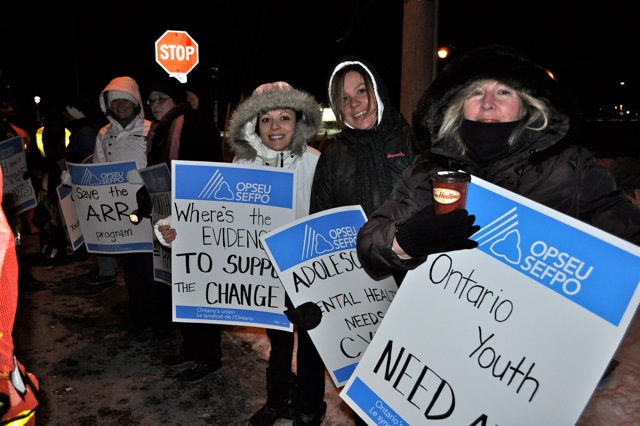
Workers brave the freezing cold to greet arriving board members at Ontario Shores. Most board members ducked the demo by arriving early.

Wednesday night OPSEU Local 331 set up a welcoming party outside of the Ontario Shores Centre for Mental Health Sciences. Standing in the freezing cold, the members hoped to give a package about cuts to the adolescent unit to board members arriving for their February meeting.

Problem was, the hospital told the union the board meeting was half an hour later starting than it really was. Only a handful of late arriving board members encountered the union picket line.

Ontario Shores has had issues with being a public hospital.

While the Ontario Hospital Association has called for greater transparency and has long established guidelines around open board meetings, Ontario Shores has been reluctant to sign on.

When we inquired about the board meeting, we were told that attendance was by invitation only. While they did extend an invitation to the union, we were given the wrong time despite the fact that the only in camera session on the agenda didn’t occur until the end of the meeting.

The hospital claims it wasn’t an error. The first item on the agenda, they say, was educational, and that the real meeting didn’t formally start until the agenda was adopted. Which raises the question, if the first item on the printed agenda was educational, how did they proceed with that item without first approving the agenda?

Arriving while the meeting was in progress, having to leave due to the in camera session, there was no actual time to informally speak to board members.

Ironically, the first item we missed on the agenda was a briefing about the hospital’s obligations under Freedom of Information legislation. Bill 122 will require hospitals to open up their files to Freedom of Information requests beginning January 2012.

Meanwhile, our Freedom of Information Request to the Central East LHIN still awaits an answer regarding any documentation to show some due diligence on their part as Ontario Shores radically changes the parameters of an important adolescent mental health program that serves youth from across Ontario.

To date the LHIN has maintained that the changes are within the hospital’s decision-making scope.

Ontario Shores maintains that the decision to change the delivery model for the Adolescent Residential Rehab program is based on best practices and evidence. However, we have been asking for documentation to support their claims since December.

Recently a meeting was offered to go over the evidence that they have so far denied us.

For more on this story, go to:
No Evidence, But Plenty of Runaround

NDP Leader Critical of Ontario Shores Decision

Last day for a haircut in London-St. Thomas

 Tomorrow will be the last day to get a hair cut for patients at the Regional Mental Health Centre in London and St. Thomas.

The hairdresser employed by the centre was among 20 workers let go last month due to fiscal restraint. Now staff are being asked to “assist patients by providing guidance to access hair salon services in the community.”

The Centre says “alternate arrangements are being finalized to address the need for patients who are not able to attend the community for this service.” Of course, they couldn’t say what those arrangements are.

For those who need assistance in getting their haircut, it will now require two staff to take them into the community, instead of one performing the service on site.

 The e-mail to staff at the Centre prompted a flurry of replies, most questioning the wisdom of this decision.

Writes one doctor: “She offered direct patient care to those who have been unable to gain access to community services due to mental illness, physical illness or poverty. Getting one’s hair done by Brenda had greatly helped the self esteem and sense of self worth of many of my patients as well as others. Just because Brenda is not able to prescribe prozac or olanzapine does not make her contribution to clinical care any less significant.”

Another doctor stated on the e-mail chain: “Our patients are already “marginalized” and stigmatized by the society at large. By taking away what little they do have we are also promoting, aiding and abetting this STIGMA ourselves. How can we then tell our peers in the non-mental health settings and the society at large to dispel this stigma?”

OHA Vice-Chair says Ontario needs health strategy

Janet Davidson uses her fingers to describe how thick her hospital’s accountability agreement with the Local Health Integration Network is. “If everything is important, then nothing is important,” she says. “Pick a few and drive it.”

Speaking in conversation with Saskatchewan health policy consultant Steven Lewis, the CEO of Trillium Health Care was featured January 24 at Longwood’s Breakfast with the Chiefs. Davidson is also the Vice-Chair of the Ontario Hospital Association, and will be Chair next year.

Davidson describes herself as  “a fan of better integration,” but had hoped Ontario’s regionalized model would have been better than it is.

“I don’t think we’ve allowed it to be what it can be,” she told the forum. Davidson said that the focus has been on structures. “We don’t need structures, what about incentives?”

When Davidson was the assistant deputy minister of health in Alberta, she said “Alberta created regions that wouldn’t talk to one another.”

“I think we have to spend more time understanding what it takes to get integration, cooperation and coordination,” she said.

Asked about PC Leader Tim Hudak’s promise to scrap the LHINs, she asked, “what are you going to replace it with?”

She said her LHIN was successful in reducing the alternative level of care (ALC) rates in hospitals to the lowest in the province. She said the effort could be taken further than hospitals, including long-term care and rehab. She also said consolidation of services within her region could not be possible without the LHIN.

Davidson questioned what the province’s health care strategy was. “Without a strategy on health it becomes difficult to know exactly what we are trying to do,” she said.

She gave Ontario’s diabetes registry as an example. While the province was trying to deal with the downstream effects of diabetes, at the same time it dumped upstream prevention through Participaction and gym class in our schools.

She also called for a greater hand in determining what health professionals were being turned out by Medical schools, but cautioned this would be difficult given there is no agreement among provinces.

In response to a question about whether hospitals should even try to be everything to everyone, Davidson said “anybody who comes in our door deserves the best quality we can give them.”

Dr. Michael Rachlis asked about the role of public health in a regionalized health system.

“Public health drives me bananas here,” she said. “The fact that public health is separate. They provide a perspective we just don’t have.”

Davidson said you can’t create a system where people are healthier without the involvement of public health. She spoke about the prevalence of C-Difficile in the community and the impact it is having on hospitals. “You have to have public health to resolve it.”

Saskatchewan’s Steven Lewis was asked about the role of small and rural hospitals and the province’s closure of 52 hospitals in the early 1990s.

Lewis said the hospitals closed by the province were very small – some as few as four beds. Every town of 15,000 felt they deserved a hospital. These closures “changed the political landscape forever, creating a rural urban divide that exists to this day.”

He said it comes down to capacity of the system, pointing out that small hospitals could do some things better. Decanting work upwards had two problems – larger hospitals tended to be high cost places, and patients often had difficulty navigating more complex environments.

To watch the Longwood’s video of this full presentation, go to:

http://www.longwoods.com/audio-video

CE LHIN tells Salvation Army to place closure plans on hold

The Central East Local Health Integration Network (CE LHIN) has asked Salvation Army Liberty Housing and Support to place their closure plans on hold.

OPSEU approached the CE LHIN and the Minister of Health’s office over last week’s unexpected layoff of the facility’s 11 staff. The union had argued that there appeared to be no process in place around the closure.

As a LHIN-funded health care provider, Salvation Army would be responsible for bringing forward an integration proposal to the LHIN. An integration proposal can mean closure of a service or transfer of those services to another provider.

In this case, no integration proposal was brought to the LHIN.

The LHIN also has the power to reject an integration proposal if they feel it is not in the public interest.

This week the LHIN dealt with a similar case – the Oshawa-based United Survivors Support Centre was facing closure. Services by the Centre were redistributed to Durham Mental Health Services and the Canadian Mental Health Association – Durham in an integration decision on Wednesday.

“While there is no guarantee that the service will not still close, at least there is now an opportunity to rationally look at these services and seek a way to either save them or relocate them to another provider,” said OPSEU President Warren (Smokey) Thomas.

Any integration proposal brought forward to the LHIN is required to include a human resources adjustment plan.

Four more consultation roundtables set up on rural and northern health care

Four more round table consultations are taking place on Ontario’s rural and northern health care panel report. 
 
The first two consultations have already taken place in New Liskeard and Burford.  Reports from members of the Ontario Health Coalition suggest that these consultations are heavily moderated.  The OHC encourages attendees to think about the key points you would like to make beforehand and to be insistant about having your voice heard. 
 
Registration for these events is encouraged, but are NOT mandatory.  Those who wish to register can do so by calling 1-800-503-8654 or by completing the online form at http://www.health.gov.on.ca/en/public/programs/ruralnorthern/register.aspx To view the government’s report, go to: http://www.health.gov.on.ca/en/public/programs/ruralnorthern/consultations.aspx
Our Diablogue post on the committee report can be found at
 
Upcoming Roundtables
Shelbourne:
January 31st, 7:00 – 9:30 pm
Centre Dufferin Recreation Complex, Poolside Room, 200 Fiddle Park Lane
Please register by January 27th
 
Hanover:
January 31st, 11:00 – 3:30 pm
Hanover Regional Aquatic Centre, Lion’s Den Room,  269 7th Avenue
Please register by January 27th
 
Drayton:
February 1st, 1:00 – 3:30 pm
PMD Arena, Banquet Hall, 68 Main Street
Please register by January 29th
 
Petrolia:
February 2nd, 1:00 pm – 3:30 pm
Lambton Central Collegiate & Vocational Institute, Gymnasium,
 4141 Dufferin Avenue
Please register by January 31st
 
Haliburton
February 8th, 1:00 – 3:30 pm
Legion Hall, 719 Mountain Rd.
Please register by February 4th
 
Orillia 
February 8th, 7:00 – 9:30 pm
Soldiers’ Memorial Hospital, Dr. Brian McGugan Education Room,
17 Colborne Street West 
Please register by February 4th
 
Renfrew
February 7th, 10:00 am – 12:30 pm
Mateway Activity Centre, Mateway Hall
1 Mateway Park Drive
Please Register by February 4th
 
Dryden
February 10th, 1:00 – 3:30 pm
Eagle’s Landing Golf & Curling Club, Dining Room 
500 Sandy Beach Road
Please register by February 7th

LHINs grapple with consistent approach to community engagement

The 14 Local Health Integration Networks (LHINs) are grappling with a common framework for community engagement.

The issue came to the Central East LHIN January 26th where board members wrestled with the idea of community empowerment versus the LHIN’s own legislative responsibilities.

James Meloche, a Senior Director with the LHIN, raised as a positive example the citizen’s jury model used by Northumberland Hills Hospital during its reorganization last year. Northumberland Hills used a random selection of local citizens to give advice on changes to the hospital.

Many in the community felt that the group had been manipulated by the hospital and that they hadn’t represented the significant dissent in the community towards cuts proposed by the hospital.

Meloche said that while the LHINs were instructed to come up with a common framework, there would still be flexibility for the individual LHINs to determine their own processes. “The paint will never be dry on how you operationalize this,” he said.

Board member Stephen Kylie said the idea of a Citizen’s Jury bothered him, that it may be viewed by the community as elitist.

Foster Loucks, Chair of the Central East LHIN, said he was concerned about the absence of reference to government relations or the involvement of labour, including union and non-union employees. Loucks said the framework appeared too focussed on health care providers and stakeholders.

Loucks also said it was important to communicate how the information shared in these consulations would be used in the decision-making process.

Meloche said the drafters of the framework “didn’t have a heavy dose of realism.”

He also spoke of the need of health care providers to do their own consultation. “We cannot be the only community engagers in the system,” he said.

The LHIN postponed any endorsement of the draft framework to their next meeting in February.

Peterborough still in deficit, quality indicators paint less than rosy picture

The CEO of the Peterborough Regional Health Centre appeared before the Central East LHIN January 26 to give an update on the controversial “Hospital Improvement Plan” (HIP).

While much of his last presentation dealt with financials, the expectation was that this visit was going to be more about the impact of the HIP on quality of care at the hospital.

CEO Ken Tremblay presented what was the worst-kept secret: Peterborough was going to end the year $5 million in deficit despite small surpluses in the last two months of 2010. Much of this deficit was associated with one-time restructuring costs, he said.

The community has been concerned that cuts at the hospital are impacting on quality of care.

Peterborough scored 110 on their Hospital Standardzied Mortality Ratio – an indicator that preventable deaths are about 10 per cent above average (score of 100).

The HSMR compares the actual number of deaths in a hospital with the average Canadian experience, after adjusting for several factors that may affect in-hospital mortality rates, such as the age, sex, diagnosis and admission status of patients. The ratio provides a starting point to assess mortality rates and identify areas for improvement to help reduce hospital deaths.

Tremblay failed to spend much time on quality issues, suggesting the data was up on the hospital’s web site.

In fact, the PRHC “performance dashboard” has considerable red on it – an indicator that the hospital has not improved its performance towards established targets. As an interesting footnote, there is no colour indicator on the dashboard to show where performance had actually declined. The hospital is showing poor performance on a series of indicators ranging from length of stay and alternate level of care occupancy to hand washing and rates of MRSA and C. Difficile.

A year after the HIP was introduced the hospital is still in the process of layoff. To date 145 full-time equivalent positions have been deleted through early retirement, voluntary exits, transfers and natural attrition. 19 FTE layoffs have been accepted, while 17 FTE layoffs had to be rescinded. There are 38 FTE layoffs still in process.

Tremblay acknowledged the irony that this was taking place against a backdrop where the hospital was struggling to recruit part-time workers and some specialized positions.

One of the difficulties the hospital has is recruiting when staff morale is low. Its online presentation shows that only 29.9 per cent of PRHC’s staff responded positively to five composite questions that make up something called the “Organizational Commitment Composite.” The average of hospitals using this tool scores at 55.1 per cent.

Tremblay said he did have success in reducing overtime by 62 per cent and absenteeism was down to an average of 10 days per year. This he credited to the hospital’s wellness program.

Community groups have alleged that patients are being discharged from the hospital before they are ready. The online quality survey has no data on 30-day repeat visits to the hospital.

Tremblay did say they closed 20 beds last October.

Tremblay appeared irritated about a letter in the Peterborough Examiner stating $24 million in funding was clawed back in 2010, and a further $14 million in 2009. Tremblay said the hospital had not earned the money and had to give it back. “Clawback would be an incorrect term,” he said.

After Tremblay had left, acting LHIN CEO Paul Barker was critical of other LHINs for advocating financial bailouts before the hospitals had gotten their house in order.

“We have been consistent in our message to find ways to be more efficient with as little impact on care as possible,” he said. “We have always gotten all the way there on our own.”

He said Peterborough had not been underfunded, but had “not been operating in a proper way.”

Claiming he was speaking personally, he criticized the province for giving the Niagara Health System $15 million last year only to come back to projected deficits for this year and next.

He said hospitals in the Central East LHIN accepted their responsibility and were mindful of risks to quality.

Barker said that when the Minister of Health recently toured Peterborough Regional, she said “this is a place we want to make investments.”’

Tremblay is next to appear before the LHIN in April.


Ontario has yet to deliver on nursing home staffing standards

In today’s Toronto Star Christina Bisanz, chief executive of the Ontario Long Term Care Association – which primarily represents for-profit nursing homes – said Ontario leads most provinces in improving the quality of long term care thanks to new legislation aimed at making care uniform. Bisanz says that includes legislated minimum staffing levels. Oh yeah? That would be news to us.

For some time OPSEU has been among those calling for a minimum staffing standard of at least 3.5 hours of direct care per resident per day based on average acuity.

The call for 3.5 hours was recently reinforced by a new report from the Institute for Research on Public Policy. The IRPP report notes there is a significant quality gap between for-profit and not-for-profit long term care homes.

The report’s authors, Magaret McGregor and Lisa Ronald, write in Monday’s Globe & Mail: “We have reviewed Canadian and U.S. research evidence on the link between ownership and care quality and concluded the contracting out care to private, for-profit facilities is likely to result in inferior care compared to the care delivered in public and non-profit facilities.”

The authors say studies have consistently found for-profits have lower nurse staffing levels compared to their not-for-profit counterparts. If we had a minimum standard of care that was applicable across the province, then Bisanz might begin to have a point.

The OLTCA has in the past called for a minimum of three hours of care per resident per day. In 2008 they were quick to point out that Ontario facilities offer residents about 2.6 hours of care per day, while in the rest of the country that average varies between three and 3.5 hours of daily care.

Did the OLTCA actually forget the Ontario government has still failed to deliver on what everyone from the Ontario Mental Health Association to the Ontario Health Coalition has been asking for – a minimum staffing standard that reflects the needs of Ontario’s long term care residents?

To read McGregor and Ronald’s full study, go to

http://www.irpp.org/pubs/IRPPstudy/2011/IRPP_Study_no1.pdf

Tell us your home care story

Tell us your home care story. Stories have been circulating about the difficulties Ontarians are having accessing home care. And when they finally do, quality care is challenged by the lack of resources front line nurses, therapists and support workers are given to get the job done.  OPSEU has set up a web site to collect these stories. We’ll publish the best comments and eventually forward it all on to the Health Minister. Whether you are a patient, a family member of a patient, or a worker in the system, please help us tell an important story. You can do so anonymously — we will confirm your comments by e-mail.

Go to www.whatwillyoudo.ca and click on Tell Your Story.

Some recent stories that we have received:

“I am a CCAC Case Manager.  I have been doing this job for over 15 years and only recently am concerned for the community I serve.  The CCAC funding is not adequate.  We are having to turn away seniors for simple things like bathing because we are nearing our budget for the year.  I have never seen anything like this in the 15 years I’ve worked here.  I feel we are leaving seniors at risk just because they don’t reach a certain ‘score’ determined solely by my CCAC. I think everyone has a right to have a bath regardless of age, or whether the disability is acute or chronic.  This is not happening and the Ministry needs to look at what is really happening as there is great disparity within Ontario.”

— CCAC Case Manager (name withheld by request)

“My mother is 70 years old and had hip surgery last summer. She had complications and was in the hospital almost six weeks. She required some care afterwards and VON had to take samples of her blood. My mother who was unable to drive at this time was told by the VON she had to transport the blood to the hospital lab herself. How was she going to do this? I was working out of town and so was my spouse the days her blood was drawn. I returned to town after the lab closed so my mom who is financially challenged had to pay a taxi to take her blood to the hospital. This wasn’t an issue before Mr. McGuinty took over and made all the cuts to Health Care.”

– Stella Morgan

Mental health crisis deepens as agency shuts down 29 more beds for individuals with mental illness

TORONTO – On Friday January 21, employees at Liberty Housing Support Services (LHSS) were notified that the agency was shutting its doors on March 31.

Eleven supportive housing workers providing rehabilitation services and transitional housing to people struggling with mental illness were told that the agency was closing due to financial constraints. Staff reacted in disbelief. The occupancy average was almost always at capacity and the need for service high. 

The permanent loss of 29 beds comes at a time when provincial mental health recommendations call for more supportive housing for people with mental illness. LHSS has a contract partnership with the Centre for Addiction and Mental Health (CAMH) to provide five beds for clients upon discharge.

“At some point someone has to have the courage to stop the hypocrisy” said Warren (Smokey) Thomas, president of OPSEU. “We have government officials and mental health professional lining up to denounce the reality that people with mental illness end up in our shelters and in our jails and yet, the government stands by as mental health programs are being eliminated across this province.” 

The closure follows on the heels of recent layoffs at the Regional Mental Health Centre in London and St. Thomas as well as job cuts at Whitby’s Ontario Shores Centre for Mental Health Sciences.

Last year the Select Committee on Mental Health and Addictions produced its final report for the provincial government. One of its recommendations stated that additional supportive housing be created to support long-term and transitional needs for people with mental illness and addictions.