Privately financed hospitals squeeze UK’s National Health Service

Figures obtained by the BBC indicate that hospitals built under private finance initiatives (PFI) will cost the UK £65 billion ($105.7 billion Canadian) over the lifetime of the contracts. With declining funding levels, there is concern that the fixed costs of paying for these massive contracts will overwhelm the UK’s National Heath Service (NHS). Some local NHS trusts say the annual payments will exceed 10 per cent of their funding.

The same projects were originally valued at £11.3 billion ($18.3 billion Canadian) when they were built. However, these contracts do include such ancillary services as cleaning, maintenance and food services.

The BBC reports that the situation has prompted calls for the NHS to try and renegotiate the deals to help it cope during the present squeeze on public spending.

Like Ontario, the Trusts also find themselves paying for these contracts at a time when the government is trying to move services out of the hospitals.

Dr. Mark Porter of the British Medical Association told the BBC “now the financial crisis has changed conditions beyond recognition, so trusts tied into PFI deals have even less freedom to make business decisions that protect services, making cuts and closures more likely.”

Ontario continues to enter into similar public-private partnership (P3) hospital projects, leaving the province with less flexibility in allocating health spending.

Consultation needs to be better defined in LHIN Act

There is no question the Ontario government spent much political capital framing the Local Health Integration Networks (LHINs) as local decision-making bodies that would be informed by local needs and priorities, made in and by the community.

Ontario Ombudsman Andre Marin’s report “The LHIN Spin” makes clear that the legislative underpinnings never supported that rhetoric.

One of the central problems is that the obligation to consult the public is very weakly defined in the Local Health System Integration Act (LHSIA).

The Act does suggest ways in which consultation can take place, but there is no minimum established.

Further, as OPSEU’s own 2008 legal challenge demonstrated, there is no obligation to consult anyone provided the “integration” decision is agreed to by the provider(s) and the LHIN (see page 9 of the Ombudsman’s Report). It is only when the LHIN challenges a voluntary integration, or unilaterally orders one, is there any real opportunity for the public to review the details and offer an opinion.

Given the LHIN is also the funding body, the chances of a provider pushing through an integration the LHIN disagrees with is fairly remote. All the incentives are towards coming to agreement – and subsequently keeping everything deep under wraps.

The LHINs maintain they only have a responsibility for community engagement at a systems level, or what they often refer to as the “10,000 foot level.” They say community engagement on specific restructuring plans is supposed to be the responsibility of health care providers, such as hospitals, not the LHIN.

The Ombudsman writes: “It is one thing to engage in blue-sky thinking and philosophical debate about the future of health care in general. It is quite another when concrete proposals have been put forward which may have a direct and significant impact on the services available to citizens in the foreseeable future.”

In OPSEU’s court case, Rouge Valley Health System had kept the transfer of mental health beds from Ajax to Scarborough secret until the hospital board officially passed it. Three days later the LHIN rubber-stamped it. There was no public consultation beforehand by either party despite its very real impact on mental health patients in the West Durham region. Not even the LHIN’s mental health advisory group was aware of it.

Further, documents revealed in the case indicated the LHIN had been meeting in closed-door meetings with Rouge Valley to discuss this issue for months beforehand.

In the wake of public outrage over having being left out of the decision-making process, the LHIN held public consultations after the fact. When the results of those consultations were presented back to the LHIN board, there were some expressions of regret. The staff was quick to jump in and remind them that the decision had already been made. Oh well.

Given the distance between sites of a single hospital corporation can be considerable – for example, it takes about an hour to drive from the Walkerton site to the Kincardine site of the South Bruce Grey Health Centre – the government recognized the problem we raised in court and placed an obligation on the hospital to consult when transferring services between sites. This was later embedded in the accountability agreements between the LHINs and the hospitals, however, there is little evidence to suggest that this is common practice or that this is happening in any meaningful way.

Under LHISIA the government is obligated to review the LHIN legislation after five years. Instead the Premier has ignored his own legislation and is now talking about doing so after the election. At one point he openly mused about not having a review at all until he was reminded it was a legislated requirement.

The LHINs have damaged their brand across much of the province. The Ombudsman’s report only echoes sentiments that were already out there in communities like Niagara and Hamilton. It will be difficult for any LHIN to engage in consultation now and be taken seriously by the community.

However, if the McGuinty government chooses to try and fix the problem, they may want to begin by following the Ombudsman’s recommendations to better define the consultation requirements and to enforce and enhance rules on transparency. They may also want to broaden the requirements to include voluntary integrations. More on this to come.

LHIN excludes public from August board meeting despite Ombudsman’s report

It’s hard to fathom the Central East Local Health Integration Network.

A week after the Ombudsman’s report criticizing inappropriate closed-door sessions at the Hamilton-area LHIN, the CE LHIN has decided to hold its August board meeting entirely in camera. While they call this a “special meeting,” there is no other open board meeting scheduled for the month.

Before the board can do this, a motion to exclude the public must clearly state the nature of the matter to be considered at the closed meeting and the general reasons why the public is being excluded.

On the CE LHIN web site it states: “Please be aware that the Board will enter into an in-camera session as per Section 9(5) of the Local Health System Integration Act (LHSIA). A report on the closed session will occur at the open Board meeting scheduled for September 22, 2010.”

Section 9 (5) of LHSIA states that a location health integration network may exclude the public from any part of a meeting under a number of specific circumstances. These range from matters of public security to discussions of litigation. The LHIN does not offer which of these reasons it is using to exclude the public.

At the end of each LHIN board meeting Chair Foster Loucks usually invokes Section 9 (5). Despite OPSEU attending many CE LHIN meetings, we have never witnessed any debate on this, nor have we been given any general reasons for excluding the public. Often, the closed sessions don’t even have a heading on the agenda beyond “closed session.”

Does this satisfy the requirement to “clearly state the nature of the matter to be considered” or provide “the general reasons why the public is being excluded?” Not likely.

The CE LHIN must have read the Ombudsman’s Report. It’s only 40 pages. We know the Ministry and the Hamilton Niagara Haldimand Brant LHIN have had a preliminary draft since 2009. The final report has been public since August 10. (OPSEU President Smokey Thomas comments on the issue this month:  http://www.opseu.org/presidentsmessage/aug-16-2010.htm )

It is possible that the entire August board meeting is dealing with appropriate confidential issues permitted under LHSIA. However, we don’t know that. We have no clues as to what will be discussed, even in the broadest terms.

Coming on the heels of the Ombudsman’s Report, the optics are terrible. One has to question whether this is a case of really bad timing, or whether like the HNHB LHIN, the CE LHIN is showing some level of defiance to Ontario Ombudsman Andre Marin’s report?

OPSEU calls for disclosure, consultation on London Regional Mental Health Centre plan

 OPSEU has written to Health Minister Deb Matthews over the reduction in mental health beds proposed for London’s Regional Health Centre (St. Joseph’s Health Care).

The aging facility is being replaced by two public-private partnerships (P3s) in London and St. Thomas which will offer far fewer beds. The plan also calls for 50 beds to be transferred to Cambridge this fall and another 59 beds to Windsor next year. The new P3 facilities are scheduled to open in 2015 with a 156-bed London Parkwood site and an 89-bed forensic unit in St. Thomas. London and St. Thomas presently have 450 beds.

While the new London hospital will have the ability to add on 12 more beds, there are about 80 fewer beds in the scheme. The province has already reduced the number of mental health beds to below per capita levels recommended by the Health Restructuring Commission.

While the hospital has given OPSEU an outline of the bed changes, no detailed plan has yet to be released to the public.

The union is concerned that given this represents an integration decision by the South West Local Health Integration Network (SW LHIN), that families, patients, staff and other stakeholders be given an opportunity to provide input on the plan.

This also represents another region of the province where mental health beds from one community are being taken to address the needs of another. In North Bay OPSEU is fighting to retain 31 mental health beds that will transfer to Sudbury when the North East Mental Health Centre moves into its new P3 facility.

“We ask that if additional mental health beds are needed in communities such as Sudbury, Cambridge and Windsor, that new funding be granted to meet these needs,” OPSEU President Warren (Smokey) Thomas wrote in the letter.

 The union is also calling on a moratorium on further cuts to mental health beds given most mental health centres are at or near capacity.

Founding Chair of Canadian Health Coalition passes away

Jim MacDonald, the founding chairperson of the Canadian Health Coalition passed away July 5 at age 91. MacDonald organized the first S.O.S. Medicare Conference in 1979 which led to the formation of the Canadian Health Coalition. “We fondly remember Jim’s Cape Breton wit and his visits in his retirement years to the CHC office,” the CHC said in a communiqué today. MacDonald has also served for many years as coordinator of Social and Community Programs for the Canadian Labour Congress. In 2007 he was given the “Spirit of Tommy Douglas Award” from the Douglas family during S.O.S. Medicare II in Regina.

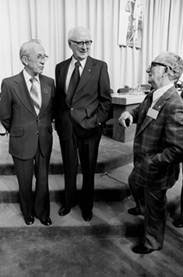
Jim MacDonald (far right) with Tommy Douglas and Justice Emmet Hall in 1979.

Hamilton-Niagara region loses 181 complex care beds in faulty “right-sizing” plan

Fifty-eight more complex care beds are scheduled to close after the Hamilton Niagara Haldimand Brant Local Health Integration Network (HNHB LHIN) approved a plan that will take “continuing” out of “complex continuing care.” That brings to 181 the number of complex care beds that have been cut since last December.

Under the new plan complex care patients will be limited to those seeking between 45 and 90 days of care, including those seeking end of life care.

The HNHB LHIN claims it is right-sizing the number of beds based on a formula that takes into consideration the number of alternate level of care (ALC) patients occupying the beds, an adjustment for population growth, a calculation of unmet need, and an assumption that 92 per cent of the beds will be occupied at any one time. The task force does not give us the data in which they made these calculations.

Instead of looking at average occupancy to determine present use, the LHIN task force simply took a one-day snapshot which indicated 590 complex care (CC) patients were occupying beds. These patients fit the new definition of complex care, and therefore would not include ALC patients.

At present there are 686 beds available. 590 patients represent an 86 per cent occupancy rate – considered by many health administrators to be full occupancy. Yet somehow the report also claims between 35 per cent and 38 per cent of the beds are occupied by ALC patients. How could that be, given it adds up to 121 to 124 per cent?

At 92 per cent occupancy, CC patients would occupy 577 beds based on the new target of 628 beds – that’s 13 beds less than their one day snapshot. In addition, if they calculated for a five per cent unmet need, based on 590 patients, they would need to find an additional 29.5 beds. They claim their calculations also include population growth. Unless “growth” was negative, this definitely does not add up.

The task force neglects to report on what the average length of stay presently is for a complex care patient. Given they knocked “continuing” out the title, one would expect many of these patients to be long-term. What happens to these patients is never defined.

How the LHIN and the hospital determine which CC patients are ALC is an interesting question, given new criteria for overall admission to CC includes completion of the acute phase of illness, completion of the major portion of diagnostic tests, and the fact that the patient is no longer requiring acute daily medical intervention by a physician. This is very similar to the definition of ALC.

The report also redistributes beds by sub-region within the LHIN. The biggest loser would be the Niagara region, which would lose 41 beds. This compounds other losses under the Niagara Health System. Hamilton would lose 24 beds and Brant would lose 18 beds. Burlington would gain 23 beds while Haldimand-Norfolk would gain two beds – just months after cutting 10 complex care beds.

The plan also envisions a greater role for the Community Care Access Centres, which are to provide assistance to hospitals in placement of individuals currently designated ALC into more appropriate settings. However, with no new long term care beds and home care at capacity, it is unclear where the CCAC would be placing these individuals.

The task force needs to give us the complete formula on how they made their calculations. A back of the napkin calculation would suggest there is a reason the numbers have not been filled in on the report – it’s because they don’t add up.

OPSEU supports call for Niagara Health System investigator

OPSEU supports the call for an investigator to conduct a public review into the Niagara Health System:

The Honourable Deborah Matthews
Minister of Health and Long Term Care
80 Grosvenor St.,
Toronto, Ontario
M7A 2C4

June 22, 2010

Dear Minister Matthews:

The Ontario Public Service Employees Union represents about 650 health care professionals at the Niagara Health System (NHS).

 We are writing to support the widespread call for a Ministry-appointed investigator to conduct a public review into the operations of the NHS. Given emerging evidence from Port Colborne and Fort Erie, where the closure of emergency rooms have led to a number of unintended consequences, we would also ask that a moratorium on ER closures be extended to all Ontario hospitals.

 The Niagara community has lost confidence in the hospital administration and in an unworkable “hospital improvement plan.”

This March the Ontario Health Coalition facilitated a high-profile panel to travel the province and listen to concerns about the public health system by community members. These community members included municipal leaders, health care professionals, clergy, agricultural organizations, seniors, patients and their families. Nowhere in Ontario was the evidence as compelling as Niagara.

Many of the witnesses presented personal evidence alleging they or their family-members failed to receive appropriate care, including preventable death. In addition to the Coroner’s Inquest into the death of Niagara teen Reilly Anzovino, the NHS admits there is an additional investigation into the death of a patient from septic shock resulting from an infected leg wound.

 In addition, we are awaiting the release of the ombudsman’s report into the decision-making process surrounding approval of the plan by the Local Health Integration Network.

 While the hospital continues to cut beds, the halls are filling up with patients on stretchers. Not only are these patients in an inappropriate environment, but families are reporting that they are not receiving basic hospital amenities, such as meal service.

 Other serious concerns have been raised around the decline of mental health services, wait times, continuity of care, lack of functioning EMS protocols, and the absence of enabling conditions prior to cuts to service.

 Even with additional funding, Niagara remains deeply in debt and in the eyes of the community, severely dysfunctional.

We would urge you to act now.

We look forward to your earliest possible reply.

Sincerely,

(Signed)
Warren (Smokey) Thomas
President, Ontario Public Service Employees Union

Take a lawn sign, save a hospital

The Peterborough Health Coalition is presently organizing a lawn sign campaign to pressure MPP Jeff Leal to do more to prevent cuts to the local hospital. The proposal going to the Central East Local Health Integration Networks includes cuts to the equilvanet of 183 full-time jobs from the hospital.

You can make a difference. A lawn sign crew will bring the sign to your door and put it up for you.

 If you live in or around Peterborough, join the campaign. You can arrange a lawn sign by leaving a message at 705-742-9286 or by e-mailing the Ontario Health Coalition at ohc@sympatico.ca.

Smitherman resurrects firemedic idea despite disastrous response in Owen Sound

In an emergency situation, would you prefer a paramedic who has had two years of appropriate training, or a firefighter with several weeks of medical first aid training?

Former Health Minister and Toronto Mayoral candidate George Smitherman is advocating an amalgamation of the city’s ambulance and fire services.

He claims that such a merger would save money and improve services, but he has no evidence to back up these claims. Instead Smitherman is relying on a paper long in rhetoric and short on data to make his case.

The paper, put together by Ontario’s Fire Chiefs and unions, is advocating for dual-trained and licensed firefighter-paramedics, with fire trucks often attending an emergency instead of ambulances.

Several questions come to mind:

Are all fire fighters to receive the same degree of training as paramedics, and who will pick up the cost? Similarly, are trained paramedics expected to go out and fight fires? These are very different functions with very different training requirements.

Regardless of who is the first responder, an ambulance is still required to transfer the patient to hospital and the paramedic is required to treat and care for the patient according to provincial protocols and standards. It is the paramedic who is responsible for all patient care on the scene.

Unlike many new ideas that have saved lives – including the widespread distribution of defibrillators in the community, citizen CPR, improved dispatch protocols that assist at the scene prior to the arrival of ambulance – this idea is more about saving money.

Ever since the firefighters produced their paper, OPSEU’s paramedics have been trying to arrange a meeting with Rick Bartolucci, Minister of Community Safety and Correctional Services. It seems the Minister, having been promised savings from the Fire Chiefs, would rather not hear about the down side of this proposal.

There is no question that paramedics are stressed by years of underfunding and underresourcing. The answer is in providing more crews and resources, not having lesser trained firefighters do the job.

In 2000-01 the idea of the firemedic was raised in Owen Sound. When the facts were assessed, the public overwhelmingly objected to the plan. The Mayor subsequently lost the next election – something George Smitherman should keep in mind.

Compounding HR errors at South Bruce Grey Health Centre

Human resources is fraught with minutia. Given the complexity of administering a public hospital, it is understandable when occasional errors occur in human resources. However, when a hospital makes an error, it is usually not a good idea to compound it, as was recently done at the South Bruce Grey Health Centre. Recently a part-time staff member had two-weeks of scheduled work cancelled due to a lack of inpatients at her small community hospital, one of four locations that make up SBGHC. Two-weeks triggers eligibility for Employment Insurance, which she applied for. When the hospital provided her employment record, she noticed that it indicated a wage rate far below what she actually earned. Without the correct amount, she had to return with a pay stub to verify her correct earnings. When EI further checked with the hospital’s human resources department as per the staff member’s eligibility, the hospital was adamant that this position never had days cancelled. The claim was not only denied, but the staff member said she felt she was being accused of fraud. She had to persuade EI to call her direct supervisor at the hospital site to confirm that she did, in fact, regularly get cancelled days when the inpatients were too few. Local union executive members say this is the kind of treatment they regularly get at the hospital. No apology was forthcoming from the hospital. OPSEU, in conjunction with the Grey Bruce Labour Council, the Ontario Health Coalition, and the Friends of the Kincardine Hospital, are presently campaigning to draw the public’s attention to the shortcomings of the hospital, including failed labour relations and poor staff morale.