Category Archives: Health System

Will the new health accord include a privatization clause?

Will the federal government insist the provinces “experiment” with for-profit delivery of health care as part of the next Canada Health Accord?

Colleen Flood says there is “some talk” that this may be a new condition. Flood, Canada Research Chair in Health and Law Policy at the University of Toronto, told Canadian Business magazine that it “may be a condition that the feds actually put on the transfer, the condition of experimenting with private for-profit delivery within the context of a public system.”

The idea wouldn’t be entirely new – the Harper government set a similar proviso to new infrastructure projects requiring federal funding. The Conservatives set a condition requiring the provinces to examine the “viability” of public-private partnerships on any infrastructure projects seeking at least $50 million in federal funding.

The idea of embedding the new health accord with a privatization clause may be disturbing to Canadians. Canadian values have long rejected the idea that health care is a business venture rather than a “moral enterprise.” Will that belief apply to private for-profit delivery of publicly funded health services?

The problem is the feds appear ready to dash into this without any evidence to support it.

The Romanow Commission found no advantage to the delivery of public health care services by private for-profit entities. In the US, an influential 2002 meta-analysis by P.J. Devereaux concluded that for-profit ownership of hospitals and kidney dialysis clinics led to poorer outcomes and higher mortality rates. A BC study of for-profit versus not-for-profit long term care homes came to similar conclusions.

At a recent conference held by Students for Medicare, Dr. Michael Rachlis said Canada’s health care costs rose faster in the private sector. Governments were far more successful in restraining rising health costs in the public sector. Hospital and physician costs have been amongst the slowest to rise.

Once that pandora’s box is opened, can it be closed again?

Critics suggest that private delivery is not the edge of the wedge towards full privatization. They suggest that Canadians would never accept an Americanized system. However, we have already seen delisting of services, something anticipated to increase. Delisting is the ultimate privatization. When the McGuinty government first came to power in 2004, physiotherapy and eye examinations were among health services to be delisted.

Following public uproar a compromise was reached where hospitals were left performing publicly-funded outpatient physio. That didn’t last long — over the last eight years these services have slowly dried up as individual hospitals have stopped offering outpatient rehab services.

Now we are seeing less subtle forms of privatization, such as the recent news that the Scarborough Centenary Hospital – part of Rouge Valley Health System – is charging “alumni” in its cardiac rehab program $500 a year to continue on with the program.

The attack on our public Medicare system will likely not be a full frontal approach. That would be too toxic for any politician. It is more likely we will see the system eroded by increments, making way for greater opportunities by the private sector.

How the federal government proceeds will be watched closely by all who value our Medicare system.

New site allows Ontarians to define health care issues

The Ontario Health Coalition is using social media to allow Ontarians to define their own health care issues in the coming provincial election.

The new “pledge” web site has been up for less than a day and already comments are flooding in on the three-phase on-line project.

Phase 1 of the project invites Ontarians to visit www.votehealthontario.ca and share what they believe to be the key health care issues and experiences. Phase 1 takes place through the month of June.

Phase 2 invites Ontarians to return and vote for their priorities from a summary list generated from Phase 1. This will take place in July and August.

Phase 3 the Coalition will ask Ontarians to take a pledge to help make these priorities key health care election issues. Candidates will be able to see how many people in each electoral riding have taken the pledge. If thousands of Ontarians join in, political parties will be compelled to make clear commitments on these issues. This last phase takes place in late August and early September.

“Lip service to health care is not enough,” says Natalie Mehra, Director of the Ontario Health Coalition. “Ontarians need clear commitments on the key issues that matter in our communities.”

Make your priorities known now at www.votehealthontario.ca

PC Platform: Tim Hudak wants you to compete for the job you have

Tim Hudak is no longer the mystery man. The question is, now that his Ontario Progressive Conservative (PC) platform is out there, will it matter?

Hudak has made it clear that he intends to make public sector workers a target, including workers in health care.

“We will introduce initiatives requiring public sector unions to compete for government contracts, where appropriate,” the Tory Changebook states. “If another organization – whether a non-profit group or private business – can provide better value for money, taxpayers deserve to benefit.”

The platform goes on to suggest support services “like food preparation or laundry” in our “public institutions” are a prime example where he expects these competitions to take place.

If you are spared the competition, you may not have your next contract fairly arbitrated. Hudak plans to challenge the independence of the arbitrators, claiming recent awards have been “excessive.”

“We will require arbitrators to respect the ability of taxpayers to pay and take into account local circumstances,” the document states.

Changebook claims the Tories will “bring public sector paycheques in line with private sector standards.”

Specific to health care, Changebook makes the same promise as the McGuinty Liberals when it comes to funding – reduce increases to three per cent per year.

Hudak promises a review of all agencies and commissions, but would axe the LHINs before that even takes place. He would not replace the LHINs, which raises questions about how health care planning, local funding, and community engagement will take place. He says he will redirect the $70 million per year from closing the LHINs into front line care. At present Ontario spends $47 billion on public health care.

The Tories say they will add 5,000 new long term care beds and increase investments in home care to “give families more control over services.” That includes the ability to stay with the provider they have now, or pick a new government-funded home care provider who better meets their individual needs. Given the Tories have supported competitive bidding in home care, it is unclear whether an individual will be able to maintain their provider after they have lost the CCAC contract. While the Tories promise to increase investments in home care, they also promise to find savings at the CCACs.

Hudak says he will clamp down on fraud, but the only specific promise is to demand that people using the old red and white health cards also present another form of government-issued identification, such as a driver’s license or passport.

Unlike the Federal NDP, which promised more doctors and nurses, the Tories only claim to add to the number of doctors by increasing residency placements for medical students from Ontario who have pursued their education outside Canada. They call upon doctors, nurses, nurse practitioners, and physician assistants to work collaboratively, particularly in underserviced areas. There is no mention of the other health professions integral to the public health system.

Like the McGuinty Liberals, the Tories vow to be as obsessive about measuring health outcomes and “introducing a rigorous system of patient satisfaction.” Do we read that as even more patient satisfaction forms to fill out? And how does this square with the promise to reduce bureaucracy?

The Tories say they will make it law that the province cannot raise taxes without a clear mandate. Unfortunately, it is silent on needing the same to cut taxes, particularly for corporations.

They also promise to expand the scope of Freedom of Information, but it is not clear how.

The Tories have already come under fire for their spending commitments and tax cuts. The normally conservative Ottawa Citizen called it the “common nonsense revolution,” comparing Hudak’s plans to reckless debt run up by U.S. President George Bush. “Unlike Bush,” writes Citizen editorial board member Ken Gray, “Premier Dalton McGuinty has required Ontarians to pay for the services they receive for which his government has been dubbed ‘tax and spend’ by people who would rather spend, borrow and pay interest.”

“Hudak’s election platform is the kind of document that made Greece the model of fiscal prudence it is today,” writes Gray.

Rouge Valley doubles parking costs for cardiac rehab patients

Where do you draw the line when it comes to user fees at hospitals?

At Rouge Valley Health Centre participants in the cardiac rehab program are upset that the hospital is changing the rules on parking. Whereas it used to cost $8 per day for cardiac rehab patients, it will now double to $16 per day.

This is on top of $500 per year they pay to continue in the program past six months. That $500 does cover access to the hospitals indoor track and exercise machines, but it also covers access to a dietician, stress tests, and other health-related activities. The hospital will likely argue that the $500 covers the exercise portion, but given it charges for the entire program, this would appear to be a direct violation of the Canada Health Act.

Recently Rouge Valley’s cardiac rehab program merged with Lakeridge Health’s program. At Rouge they charge beyond the six month period. At Lakeridge it is covered. The question is, are they also going to merge policies, forcing patients in Durham to now pay for what was once covered?

Under the Canada Health Act, hospitals are not allowed to charge for health services.

The cardiac rehab program is a successful model that dramatically reduces the mortality rate for patients who are coping with heart disease. By placing a fee for these services and doubling parking fees, this discourages patients of limited means from continuing on with the program. With parking, continuing past six months means a cost of $1300 per year. Given many of these individuals are elderly and on a fixed income, this is a hefty price to pay.

For those who come three times a week for cancer treatments, this change in parking fees also means a jump to $52 per week.

The government talks a good line when it comes to preventative care. But if hospitals are going to place considerable obstacles to participating in preventative programs like this, then it will cost us all much more in the long term.

Rouge Valley should not be trying to balance its budget on individuals battling heart disease and cancer.

September rally to demand health care commitments

Public health care usually ranks at the top of voter priority issues. It is also an issue that politicians are reluctant to talk about during the heat of an election. All three parties carry health care baggage from their time in government.

The Rae NDP government accelerated the privatization of community labs and created Rae days which increased overtime costs in hospitals. The Harris/Eves Tory government froze health care funding and introduce the disastrous policy of competitive bidding to home care. The McGuinty Liberals have closed ERs and pressured hospitals to empty hospital beds without providing sufficient alternate care in the community.

The Liberals and Tories are now promising to reduce health care spending increases to three per cent per year. Tim Hudak wants to eliminate the LHINs but offers no replacement for planning, funding, and community consultation. He also wants to contract out support services in our hospitals. The NDP have yet to reveal their health care platform. All this is taking place as governments prepare for a new age of austerity.

Regardless of the baggage they carry in to the election, voters need to demand a vision of where health care is going from all parties. It’s not just about shovelling funding into the system.

The Ontario Health Coalition is hoping that enough people show up in the streets of Toronto September 13th to send a message that political candidates cannot ignore. During this election we really do want to talk about health care.

The rally to safeguard public health care is being scheduled at Queen’s Park on Tuesday, September 13 at 12 Noon. While most rallies are aimed at the government of the day, this rally is a message to all parties that it is time for improved and equitable access to comprehensive health care across all of our communities.

Health care workers may want to schedule their shifts to be able to come to Toronto on that date. For workers along University Avenue and near Queen’s Park, the rally offers an ability to come out during lunch time and cheer the rally on.

Watch for more details in the coming months.

Meanwhile, please download the attached rally poster and share it with anyone you know who is interested in defending our public Medicare system.

Coalition hosts one-day briefing/summit on “ALC” issue

The Ontario Health Coalition is hosting a one-day briefing and summit on retirement homes and alternative level of care.

Ontario hospitals are presently under tremendous pressure to relocate “alternate level of care patients” — patients who are finished their acute care treatment but are not well enough to go home.

Increasingly they are being sent to retirement homes, which are ill equipped to provide the level of care many require.

The Coroner’s office has issued warning to the Ontario Hospital Association about inappropriate placements of patients to retirement homes.

The government requires retirement homes to abide by standards of long term care in order to accept such patients, but is it enough, and are these standards really being met?

How can we best protect the comprehensiveness and accessibility of Ontario’s health care system for those with chronic care needs?
How can we best protect patients, residents and staff from harm?

High-Level Briefing and Summit
June 20, 2011
Lillian H. Smith Public Library
239 College St., Toronto
Registration 9 am – 10 am, Adjournment 3 pm

Registration is $0-$10.

Sponsored by: Ontario Health Coalition; Alliance of Seniors/Older Canadians Network; Older Women’s Network.

US targets corporate executives for Medicare fraud – what about Canada?

Medicare fraud in the United States is estimated to be as high as $60 billion per year. Now Washington is stepping up enforcement by going after individual health care executives in addition to the corporations they work for.

Should the executive be convicted, they can also be banned from doing business with government health programs.

In the past corporations have just paid the fines, and in some cases, simply passed on these costs to their client base.

“When you look at the history of health care enforcement, we’ve seen a number of Fortune 500 companies that have been caught not once, not twice, but sometimes three times violating the trust of the American people, submitting false claims, paying kickbacks to doctors, marketing drugs which have not been tested for safety and efficacy,” Lewis Morris, chief counsel for the inspector general of the Department of Health and Human Services told Associated Press.

With growing privatization in the delivery of public health care in Canada, there is some question as to the size of Medicare fraud here. The Canadian Health Care Anti-Fraud Association estimates health care fraud in Canada represents anywhere from two to 10 per cent of health care costs. The question is, where are the prosecutions, especially at a time when health care spending is so tight?

Sustainability panic unwarranted says Rachlis

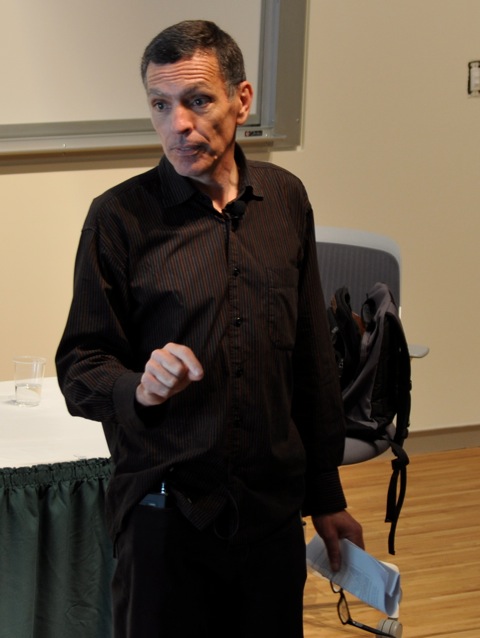
Dr. Michael Rachlis speaking to the Students For Medicare conference May 28.

Dr. Michael Rachlis wonders about the credibility of the scary health care scenarios painted by former Bank of Canada Governor David Dodge and TD Economics’ Don Drummond.

Dodge and Drummond have authored reports suggesting that health care spending will not be sustainable unless dramatic changes take place.

Speaking to a Students for Medicare conference May 28th, Rachlis questions the ability of Dodge and Drummond to do 20 year projections when “they don’t even have this year right.”

As a percentage of our total economy, public spending is up by 0.6 per cent since the last recession in 1992. Private spending – through private insurance and out-of-pocket health expenditures – is up by 0.9 per cent.

Rachlis has been particularly critical of Dodge, who appears to be deliberately ignoring data from 2010 which shows health care spending in decline relative to the size of the economy.

While Drummond and Dodge have suggested solutions may emerge in greater private involvement, Rachlis says the numbers show that public spending is much more controllable than private.

“In a multi-payer system companies can take advantage of the fact that people will have less purchasing power,” he said.

Looking across Canada, Rachlis says that if Alberta were a country it would be spending less than any other industrialized country in the world.

“Yet they are screaming they don’t have health care sustainability either,” he says.
“In Quebec their spending has remained flat for 30 years, and yet they are subject to the same hysteria.”

Even as a percentage of government program spending, there is little to suggest that health care costs are unsustainable – most of the growth related to a shrinking revenue base through tax cuts. In the early 1990s government spending accounted for 53 per cent of the economy. Just prior to the recession it was below 40 per cent. Government revenues has fallen by 5.4 per cent relative to gross domestic product (GDP) in the last decade, adding up to a loss of $90 billion.

“None of that money has gone to any of you in the room,” he says.

With half that amount we could implement pharmacare, national child care, deliver free university tuition, and still buy the fighter jets.”

“We have made a choice, but not a deliberate choice,” he said.

Both Dodge and Drummond show a sudden surge in their charts where the spending line heads 45 degree upwards, consuming between 70 and 80 per cent of provincial program spending.

Rachlis says he doesn’t understand how they arrive at this figure. Since 2003 spending as a percentage of overall provincial program spending has remained flat at about 39 per cent across Canada.

Rachlis warns that Tony “Huntsville Gazebo” Clement is promising to cut public spending further, even though Canada and the US spend almost equal amounts on public services as a percentage of the size of their economies.

“The Canadian public sector has never been smaller than the American,” he said.

Dispelling the myth that aging will escalate costs, he says aging “is like a glacier, not a tsunami.”

While health care spending is hardly out of control, Rachlis believes there are better ways to organize our present system to make it more effective.

“Our system was designed for acute illness. Our main problem is chronic disease.”

Canada also lags behind most developed countries in advanced electronic health information capacity.

“You grow up with computers and you get to health care and you are dealing with pieces of paper,” he says.

Canada also does badly in after hours care to see a doctor or nurse, and especially long waits to see a specialist.

“The original vision of Tommy Douglas was perfect,” he says. “Due to compromises, we never followed through.”

Rachlis says the solutions are in integrated health care delivery, group medical practice, and democratic governance.

He warns that the present Federal government is intent on getting out of health care altogether, leaving it to the provinces.

The 2004 Health Accord gave very little guidance on how Federal money would be spent, it being about more funding than how the system would be organized.

“If we are prepared to think outside the box, we can fix Medicare through innovation,” he said.

The first stage of Medicare was to eliminate financial barriers. The second stage was meant to deliver services to keep people healthier.

“That’s the real road to sustainability,” he said.

Statistical recovery, human recession — McNally

We are in a statistical recovery but a human recession, says author and academic David McNally, speaking May 28 at the Students for Medicare conference in Toronto.

While the statistics show economic growth, jobs, personal income and public services are failing to recover.

“Medicare and public health care are one of the key social justice issues of our age,” says McNally. “We are in an entirely new historical moment.”

He says there is a more subtle set of strategies to undermine public health care, including privatization. It comes at a time when we need health care the most.

According to the Ontario Medical Association, Canadians are spending less on food, exercise and pharmaceuticals – three areas that will impact on the delivery of public health care.

McNally said that public services are now under one of the most unrelenting attacks in several generations, leading to what some are labelling “the age of austerity.”

These attacks on public services are having an impact on countries such as the UK where they are about to fall back into recession.

Whereas government had previously told us that programs such as universal child care or national pharmacare were not possible, it suddenly became possible to use enormous sums of money to bail out banks and other corporations, he says.

McNally estimates that the worldwide cost of the bailouts and stimulus – largely to construction firms – is $21 trillion, or about a year and a half of the entire economic output of the United States.

“When it comes to bailing out capitalist institutions, the cupboards are not bare,” he said.

“It tells us a lot about global elites and their governments.”

The age of austerity effectively found its beginnings at the Toronto G20 summit, where governments decided to direct belt tightening at public and social services. That belt tightening does not apply to police, military and prison building, tools governments will use to stifle unrest from these policies.

McNally says the process has already begun, pointing out that Latvia has fired 30 per cent of its teachers, Ireland has cut public sector wages by 15 per cent. Greece has cut public pensions. In the U.S. the State of Michigan has closed half of its schools, taking the average class size up to 60 students. California has cut health insurance for 900,000 children. Arizona scrapped all public health insurance for children.

Ontario is not exempt, noting the province has already cut the special diet program for individuals on social assistance.

While this is taking place, corporate taxes are being cut internationally.

McNally points to Mervyn King, Bank of England Governor, who has expressed surprise that there is not greater anger over the price of the economic crisis being paid for by the very people who did not cause it.

Instead governments are creating myths about out of control costs, blaming public employees.

This statistical recovery overlooks an unemployment and underemployment rate in the US that is more than 17 per cent. Among black and Latinos, it is between 24-25 per cent.

“Half of U.S. school –age children will be reliant on food aid at some point in their childhood, and among African-American children it will be closer to 90 per cent.”

The “Great Recession” has driven 64 million more people into poverty world-wide, many affected by spiking food prices created by speculators. 47 million will be driven into conditions of absolute hunger.

McNally says we are only in the first phase of this new age. Quoting Naomi Klein, he says governments are using the shock doctrine to push through this roll back of social programs.

The goal, he says, is a lower wage economy, low tax, and a low cost investment climate.

McNally compares the present era to the 1930s. People forget that while there were great changes in the 1930s, these didn’t happen until the latter half. Under Canadian Prime Minister “iron-heel Bennett” life was miserable for many Canadians until a coherent social movement forced changes.

He says there is hope in social movements, but this is a process that will take time.

“We need to think about a longer horizon that next week or next month,” he says, certain that the “last laugh will not belong to the Stephen Harpers and Rob Fords of this world.”

David McNally is author of Global Slump: The Economic and Politics of Crisis and Resistence. He teaches at York University in Toronto.

David McNally speaking at the Students for Medicare conference May 28.

Peterborough’s ALC solution may be within its walls

When Stephen Kylie sat on the board of the Central East LHIN, he recognized that alternate level of care patients were unable to exit the Peterborough hospital for lack of services in the community, particularly long term care beds.

Alternate level of care patients are individuals who have completed their acute care but are unable to go home without other forms of care in place. That usually means either a nursing home bed or home care, two options that have been in very short supply in the Peterborough-area.

The LHIN reported that among the 260 “clients” awaiting placement in the region, including a substantial number at the Peterborough Regional Health Centre, less than 10 per cent had homes to return to.

Kylie likely thought, as his term expired on the board, that the LHIN would come back with a recommendation for more beds in his area.

Instead the LHIN is looking at a more broad-based solution aimed at keeping frail seniors in their homes. For most of the 260, this is coming too late.

There is no question that frail seniors would prefer to stay in their homes, but the infrastructure to allow them to do so has been largely absent. While the government has been focused on moving patients out of the hospital, funding for home-based solutions has been woefully inadequate.

During the meeting the LHIN stated that it was going to return to both Peterborough and Lakeridge Health to try the Home First program again.

Home First insists hospitals send patients home for as long as possible with community supports. These supports are often in place until a nursing home bed can be found. Under Home First, transferring patients from hospital directly to a long term care home is to be considered only after all other community options are considered. In the Central East, you don’t have to consider for very long.

In some regions, those waiting at home for a nursing home bed have been frustrated by the priority hospital patients are receiving in long term care placements. This has been particularly hard on spouses who want to be reunited in the same nursing home.

Given the LHIN had just received a presentation describing how inadequate local resources were, board member Samantha Singh was surprised to see the LHIN was again leaning on hospitals to send their alternate level of care patients home first.

“Is this happening before supports are in place?” she asked at the May 25th LHIN board meeting.

The truth is, the Ministry and LHIN often approve changes to service, ending one method of delivery before another is ready to accommodate the patients.

The classic case is mental health services. For years the government divested services from the psychiatric hospitals under the promise that these services would be re-established in the community. The hospitals were eventually cut to the targets established under the Health Restructuring Commission, but the community-based services never received the funding they were supposed to get. The split was supposed to be 60 per cent community-based funding, 40 per cent institutional-based funding. Today those numbers are reversed.

When Northumberland Hills Hospital closed its diabetes clinic, local residents were promised that these services would be re-established in the community. While the government did improve funding for the nearby Port Hope diabetes clinic, it has never been able to replicate the services that were once provided in the hospital.

So what happens when these services fail patients? They end up back in hospital. And then the hospital gets a visit from the LHIN telling them to get those patients home again. It doesn’t take a genius to figure out the circular nature of this.

The LHIN heard an excellent presentation on how to provide supports for frail seniors in their homes. However, from presentation to reality is a long way to go – especially if there is not sufficient funding to make it happen. You can’t just turn on or turn off a community-based service. Samantha Singh appeared to understand this.

The Health Restructuring Commission made its recommendations in the late 1990s. At least half of the promised mental health community supports are still absent, and for adults, it will be for at least the next three years as the government has decided to focus on children’s mental health.

Paul Barker, one of the CE LHIN’s Senior Directors, said that community agencies can be ramped up and down much more easily than establishing long term care beds. And once you establish those beds, you can’t back out of that “expense.”

Given the new Peterborough Hospital has more space than it is using, it may be time to look at whether the hospital can temporarily use some of that space to establish a long term care facility — at least until those community supports do arrive – or should we say if they arrive. This is exactly what happened at Northumberland Hills Hospital in Cobourg. It ended its “ALC problem” by creating 11 interim long term care beds. A stroke of a pen and the problem was gone.

Having a long term care facility inside a hospital is not new. The Camp Hill Hospital, part of the Queen Elizabeth II Health Sciences Centre in Halifax, has a long term care facility that can accommodate up to 175 veterans. It even has its own garden. Veterans interviewed there say they are very satisfied with care provided. Camp Hill also helps veterans stay in their homes as long as possible, including providing respite care and outpatient geriatric services. Many of the professional supports are available within the building. Nobody argues this is inefficient or that a long term care home has no place within the walls of an acute care hospital.

The Health Restructuring Commission accepted the principle that no mental health bed should close until alternate services were put in place. It’s a pity that governments since have never followed through on that principle, whether it’s the transfer of mental health services or any other community-based health care.