Category Archives: Mental Health

Judge rules jails okay for mentally unfit offenders

Ontario Superior Court Justice Ian Nordheimer has ruled that an Ontario Court judge acted unreasonably when she prevented authorities from placing a mentally unfit offender in jail to await a hospital bed.

 According to a story in the Globe and Mail, laywers for the mentally ill offenders expressed disappointment in the Nordheimer judgement, telling the newspaper that the decision will reduce pressure on the province to expand hospital facilities.

Toronto’s Centre for Addiction and Mental Health said it was a decision they had hoped for.

Nordheimer said it was unreasonable for CAMH to free up a bed immediately and police cells were unacceptable alternatives.

Despite the fact thatOntario’s psychiatric hospitals are running at capacity, the government intends to reduce the bed stock further. In London and St. Thomas about 70 beds will be lost when mental health services are reallocated from the Regional Mental Health Centre by 2014.

How about the rest of the mental health system?

Health Minister Deb Matthews recently promised in the legislature that the 10-year plan for mental health will be “released very soon.”

Answering a softball question from fellow Liberal MPP Maria Von Bommel, Matthews told the legislature “we will address issues such as stigma, better system navigation and taking a better patient-centered approached to the delivery of care and services.”

For adults in the system, there may be a considerable wait before they see significant service improvements.

“While the first three years will focus on children and youth, our strategy will address the entire system,” Matthews told the legislature.

It took two-and-a-half years to get to the 10-year plan. Matthews’ statement suggests that improvements to the service adults receive may have to wait another three years before the strategy kicks in.

Freezing rain doesn’t deter London mental health demonstration


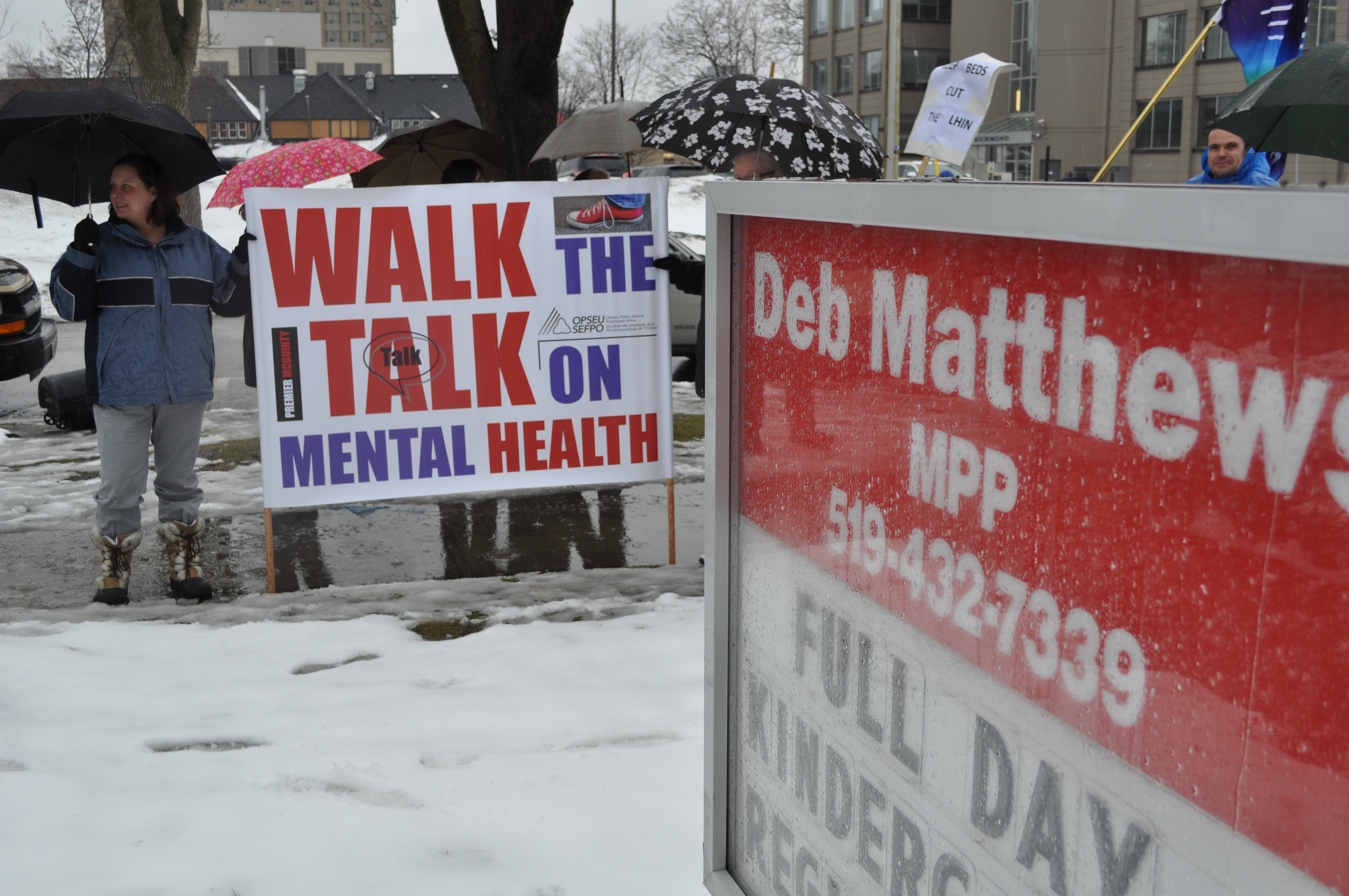
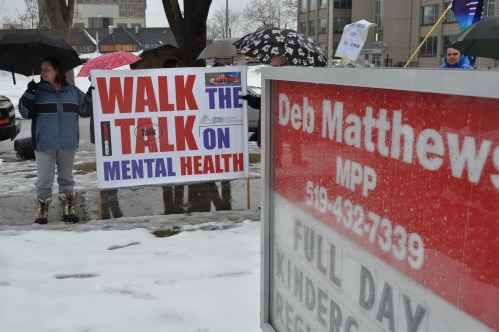
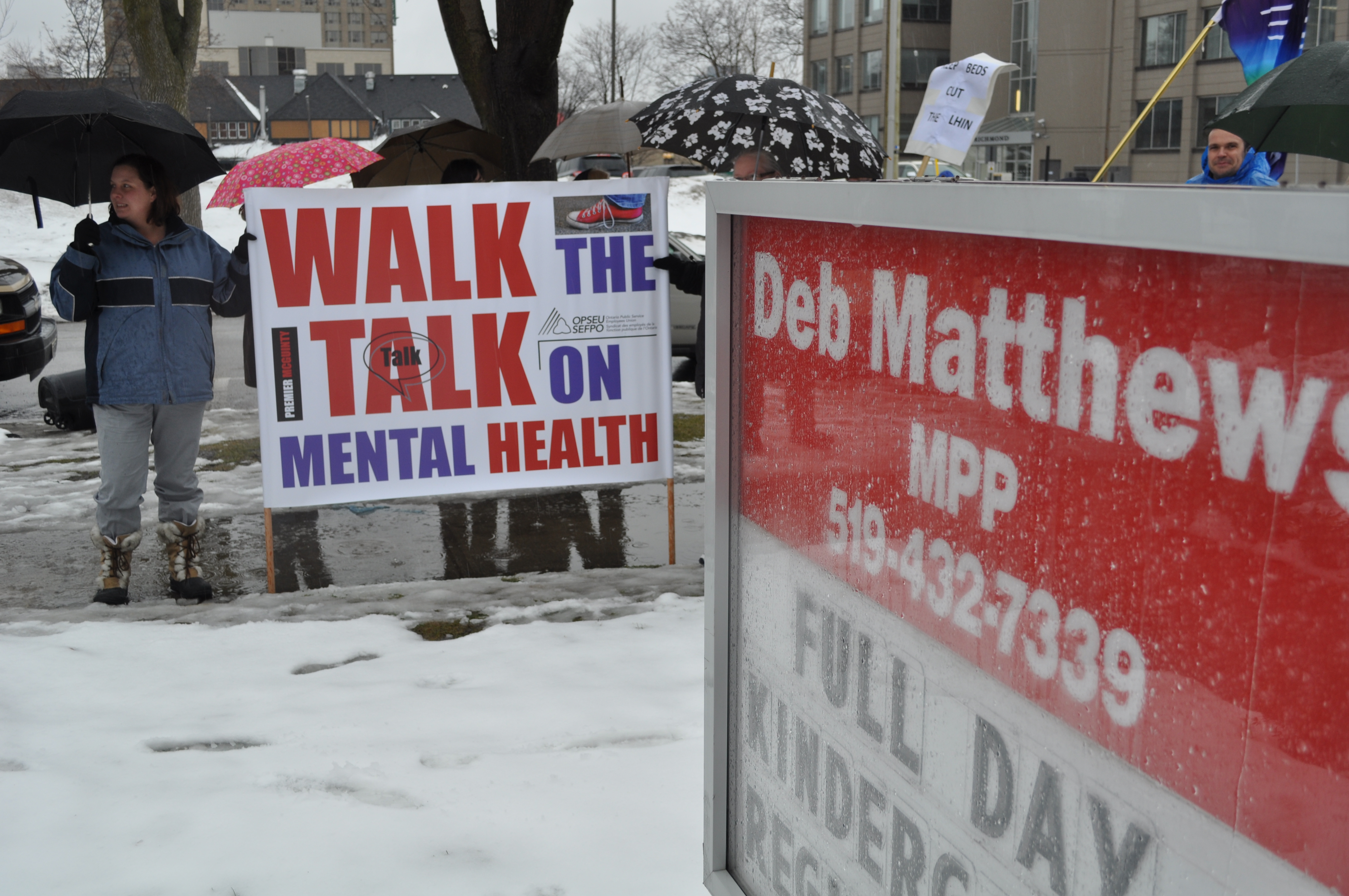
Protesters outside of Health Minister Deb Matthews constituency office in London.

LONDON – Standing in the freezing rain March 9, about 25 OPSEU activists in downtown London, Ontario called upon the McGuinty government to “walk the talk” on mental health March 9th

Organized by OPSEU Local 152, the mobile protest gathered in front of the South West LHIN and eventually marched a few blocks to Health Minister Deb Matthews’ constituency office.

Fifty-nine beds from the London and St. Thomas Regional Mental Health Centre are to be transferred to Windsor later this year, but OPSEU expects that at least another 21 beds will simply disappear.

“We don’t want that to happen. It will affect our clients who need mental health services in London and area,” Elizabeth Craik, vice-president of OPSEU Local 152 told the London Free Press.

When the Regional Health Centre eventually moves into new quarters in three years, there will be at least 70 fewer beds that presently exist in the region.

In addition, the hospital has been cutting staff to deal with underfunding from the province. This year 20 jobs were eliminated, including skills instructors and the only hairdresser serving the two facilities.

Local 152 VP Elizabeth Craik is interviewed by the media outside the SW LHIN offices in downtown London.

OPSEU Regional Vice-President Gino Franche told the gathering that patients will be transferred with the beds to Windsor, “whether they want to go or not.”

Franche said the government failed to follow the plan of the Health Restructuring Commission, which insisted, on cutting no beds until services were replaced in the community.

“Our community-based mental health agencies would need to receive a 50 per cent increase in funding to match the targets set by that Commission,” he said.

OPSEU Region 2 board member Eduardo Almeida said that when the system failed the mentally ill, they would end up in his workplace – corrections.

“Are there no jails, are there no workhouses?” Almeida said, comparing the plight of Ontario’s mentally ill to the poor in Charles Dickens “A Christimas Carol.”

“Criminals belong in jail,” he said, “not people with mental illness.”

When the group arrived at the Health Minister’s Constituency office, a prepared letter from the MPP was distributed to the group.

Matthews said the South West LHIN was working on a community capacity implementation plan for mental health. The plan is expected this summer.

She said that fundamentally moving people out of institutional care is the “absolutely right approach.” She says they are bringing them into the community where a range of supports will be organized around them.

Unfortunately the beds are being cut, and nobody knows where these supports will be.
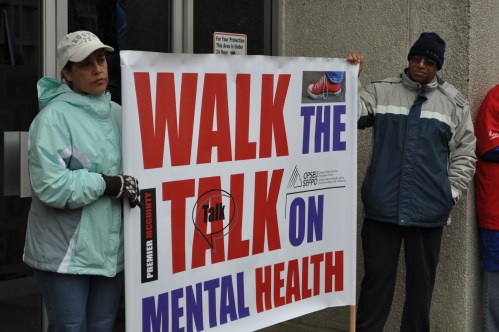
Local 152 members with a banner asking Dalton McGuinty to "walk the talk on mental health."



McGuinty receives postcards on the floor of the legislature

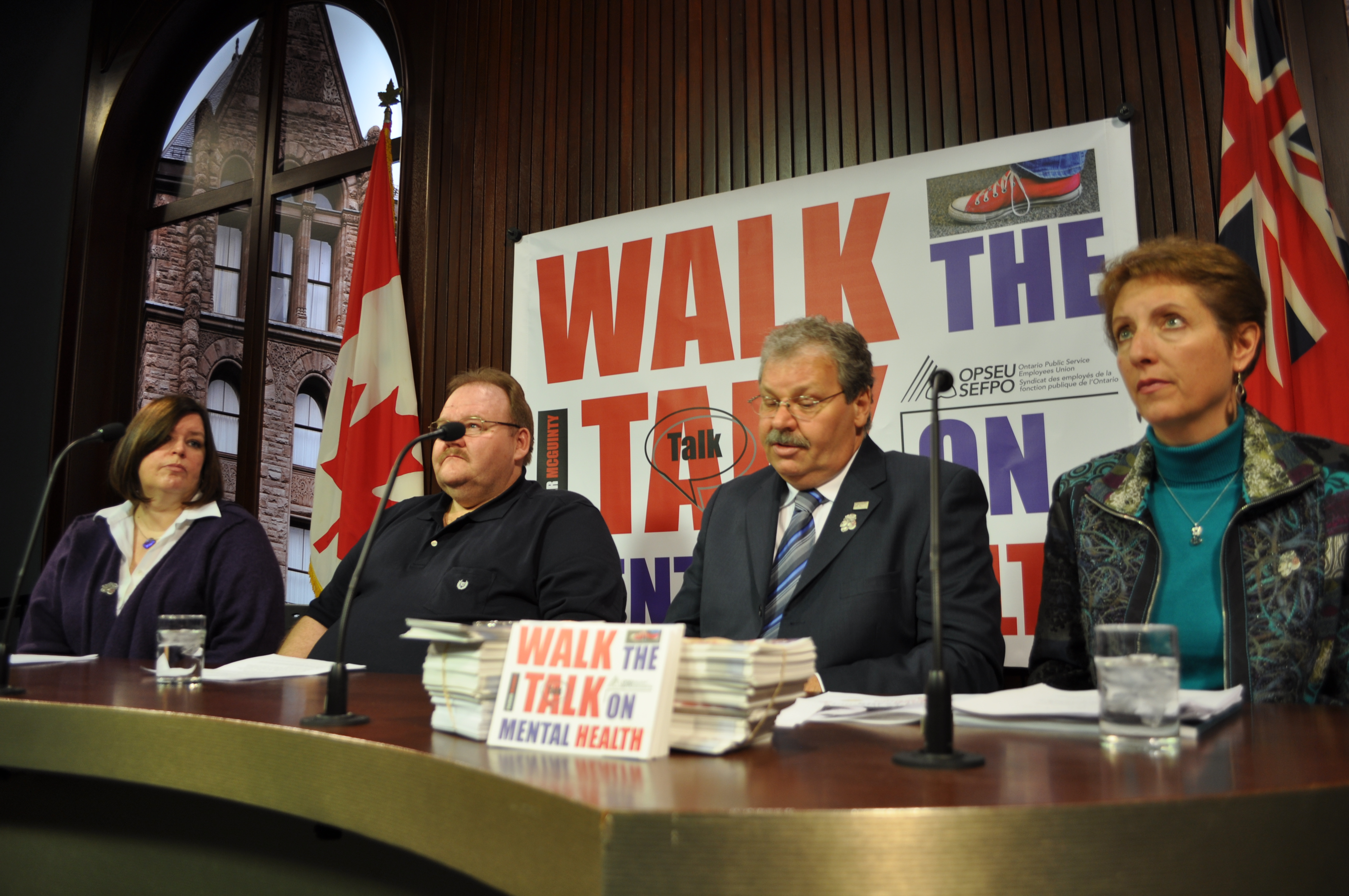
At Queen's Park March 8 -- L to R: OPSEU's Deborah Gordon, Al Donaldson, and Warren (Smokey) Thomas with NDP Health Critic France Gelinas.

Dalton McGuinty personally received more than 600 postcards in the legislature Tuesday signed by OPSEU members asking him to “walk the talk on mental health.” The stack of cards was walked across the legislature floor from the desk of NDP Leader Andrea Horwath.

OPSEU had been at the legislature that day to bring the message that two and a half years of talk about improving mental health had coincided with two and a half years of actual cuts to mental health.

In a press conference earlier that morning, OPSEU President Warren (Smokey) Thomas gave recent examples of a mental health system in decline.

They include:

  • Layoff of 28 child and youth workers at Ontario Shores Centre for Mental Health Sciences, jeopardizing an adolescent residential rehab program that served young adults from across the province;
  • Twenty jobs were recently cut at the Regional Mental Health Centre in London and St. Thomas, and more are expected later this year.
  • Children’s Mental Health Ontario expects they will lose capacity to serve 2,000 children across the province. They have only received two funding increases since 1992.

NDP Health Critic France Gelinas expressed her disappointment in the government’s lack of response to the recommendations of the all-party select committee on mental health. Gelinas had been a part of the committee, which issued its report last August.

“It sounds good to say every door is the right door,” said Al Donaldson, Chair of OPSEU’s Mental Health Division. “In the past decade that door has increasingly been our justice and corrections system. It has also been homeless shelters and the street.”

Deborah Gordon, Chair of OPSEU’s Child Treatment Centre, told the media conference “we now have a generation of children and youth who have not had timely access to treatment – in other words four out of 10 doors have been close for them.”

Gordon said a 14-bed residential home for girls is closing in Sarnia is closing at the end of the month, and other residential facilities are just hanging on.

OPSEU is asking that the government place a moratorium on any further cuts to mental health and restore funding to the Child Treatment Sector.

Health Minister Deb Matthews has promised a 10-year plan for mental health will be introduced later this spring.

OPSEU has received more than 1,000 “walk the talk” postcards from members this week and will continue forwarding them on to the Premier’s office.

Tom Juravich Re-Releases Song in Support of U.S. Public Sector Workers

Ottawa-based singer-songwriter Tom Juravich is re-releasing his song “When Did I Become the Problem” in support of workers and unions fighting back against the attacks on public sector workers across the U. S. It is available as a download.

Juravich is one half of Healy & Juravich, who recently produced a music video with OPSEU for “What Will You Do When I’m Gone?” The song chronicles the struggle of home care nurses to maintain their jobs amid the insecurity of forced competitive bidding. (See http://www.opseu.org/bps/health/community/whatwillyoudo/index.htm )

“I have been shocked by the blatant attacks on public sector workers and their unions in Wisconsin, Indiana, Ohio and so many others states across the country,” says Juravich. “Without a doubt states are facing some difficult financial times, but our kids’ teachers, the people who pick up trash in our towns and the folks working at the social security office that take care of our parents didn’t cause this problem, and slashing their wages, cutting their benefits and destroying their unions isn’t the solution.”

In his song Juravich writes about a teacher, a state mental health worker and a national park ranger who all find themselves blamed for everything that is going wrong. They lament:

When did I become the problem?
How did the fault become all mine?
They all say they’re tightening their belt
But the only one they’re tightening is mine.

“The Problem” first appeared on Juravich’s CD Altar of the Bottom Line released by Finnegan Music in 2009. Juravich is joined by drummer Dave Mattacks (Fairport Convention, Paul McCartney, and Rosanne Cash), electric guitarist Duke Levine (Mary Chapin Carpeneter) and Richard Gates on bass (Paula Cole, Suzanne Vega, and Patty Larkin).

Pete Seeger says, “I was impressed by Tom’s wide variety of material and frankly jealous of his wonderful voice,’” Dirty Linen writes that “Tom Juravich is foremost a storyteller. He has been traveling the country, hearing and retelling his stories of American sweat and struggle for a long time.”

Give the song a listen at When Did I Become The Problem

The song is also available on iTunes.

Walk The Talk on Mental Health – London Rally March 9

LONDON – Words are not enough. OPSEU members in London and St. Thomas are calling upon the community to help “walk the talk on mental health” in front of Local Health Integration Network (LHIN) offices on Wednesday, March 9 beginning at 1 pm.

The demonstration follows more cuts this winter at Regional Mental Health – London and St. Thomas (RMHC) as well as in other communities across Ontario.

“For the past two and a half years the government has been working on a 10-year strategy for mental health,” says Kim McDowell, President of OPSEU Local 152 (RMHC). “While they have been talking about improving the system, the reality on the ground has been one of program closures and layoffs.”

The union is concerned that residents needing mental health care will have no place to go after the regional center divests beds to other communities and downsizes in 2014.

Protesters are asked to gather in front of the Local Health Integration Network offices at 201 Queens Ave in London. After a brief rally there, the protest will march to Health Minister Deb Matthews’ constituency office at 242 Picadilly St.

Want to help? Contact Kim McDowell at 519-765-8660.

Walk the Talk on Mental Health – Postcard Campaign

Fill out your postcard and return it to your nearest OPSEU regional office by March 3.

This week postcards are being distributed to OPSEU’s regional offices. The postcards ask Dalton McGuinty to “walk the talk” on mental health.

The Ontario government has spent the last two-and-a-half years developing their 10-year strategy for improving mental health. This has been against a backdrop of fiscal restraint that has resulted in cuts to front line jobs caring for Ontarians with mental illness.

Instead of making every door the right door, front line workers are telling us that the doors are simply closing. Their ability to provide real care, comfort and assistance to adults, youth and children with mental illness has been seriously jeopardized.

The postcard contrasts the $2.4 billion the government is spending on corporate tax cuts with the shortages faced by Ontarians with mental illness. It asks the premier to “walk your talk and keep your promise to Ontarians with mental illness.”

OPSEU Locals are being asked to pick up the cards they need from their regional office and return them to these offices by March 3rd. The postcards will then be sent to Toronto for a press conference and presentation on March 8th.

Ontario spends far less on mental health than most comparable international jurisdictions.

Recently layoffs have taken place at Toronto’s Centre for Addictions and Mental Health (CAMH), Ontario Shores Centre for Mental Health Sciences, and Regional Mental Health Centre – London and St. Thomas. Services have also been transferred out of North Bay and Brockville. The Salvation Army recently announced it was closing down its transition program in the west end of Toronto, although the decision has been placed on hold until the SA can appear before the Local Health Integration Network.

A recent Toronto Star story highlighted how CAMH’s schizophrenic unit was transferring to a building with a long history of criminal activity. One CAMH client described the building as infested with bed bugs.

Health Minister Deb Matthews has committed to releasing the final 10-year plan for mental health this spring.

Right night, wrong time – Ontario Shores struggles with the idea of being public

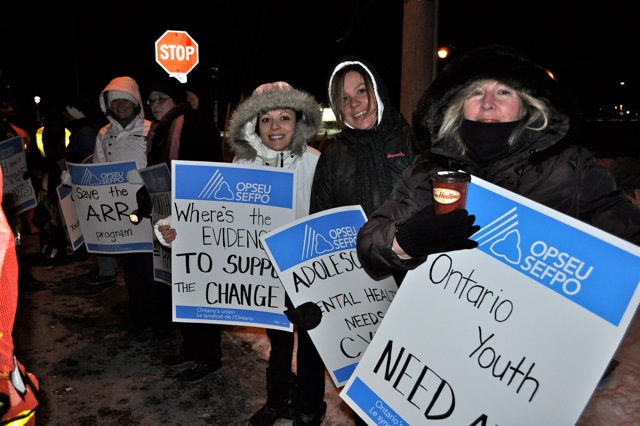
Workers brave the freezing cold to greet arriving board members at Ontario Shores. Most board members ducked the demo by arriving early.

Wednesday night OPSEU Local 331 set up a welcoming party outside of the Ontario Shores Centre for Mental Health Sciences. Standing in the freezing cold, the members hoped to give a package about cuts to the adolescent unit to board members arriving for their February meeting.

Problem was, the hospital told the union the board meeting was half an hour later starting than it really was. Only a handful of late arriving board members encountered the union picket line.

Ontario Shores has had issues with being a public hospital.

While the Ontario Hospital Association has called for greater transparency and has long established guidelines around open board meetings, Ontario Shores has been reluctant to sign on.

When we inquired about the board meeting, we were told that attendance was by invitation only. While they did extend an invitation to the union, we were given the wrong time despite the fact that the only in camera session on the agenda didn’t occur until the end of the meeting.

The hospital claims it wasn’t an error. The first item on the agenda, they say, was educational, and that the real meeting didn’t formally start until the agenda was adopted. Which raises the question, if the first item on the printed agenda was educational, how did they proceed with that item without first approving the agenda?

Arriving while the meeting was in progress, having to leave due to the in camera session, there was no actual time to informally speak to board members.

Ironically, the first item we missed on the agenda was a briefing about the hospital’s obligations under Freedom of Information legislation. Bill 122 will require hospitals to open up their files to Freedom of Information requests beginning January 2012.

Meanwhile, our Freedom of Information Request to the Central East LHIN still awaits an answer regarding any documentation to show some due diligence on their part as Ontario Shores radically changes the parameters of an important adolescent mental health program that serves youth from across Ontario.

To date the LHIN has maintained that the changes are within the hospital’s decision-making scope.

Ontario Shores maintains that the decision to change the delivery model for the Adolescent Residential Rehab program is based on best practices and evidence. However, we have been asking for documentation to support their claims since December.

Recently a meeting was offered to go over the evidence that they have so far denied us.

For more on this story, go to:
No Evidence, But Plenty of Runaround

NDP Leader Critical of Ontario Shores Decision

Last day for a haircut in London-St. Thomas

 Tomorrow will be the last day to get a hair cut for patients at the Regional Mental Health Centre in London and St. Thomas.

The hairdresser employed by the centre was among 20 workers let go last month due to fiscal restraint. Now staff are being asked to “assist patients by providing guidance to access hair salon services in the community.”

The Centre says “alternate arrangements are being finalized to address the need for patients who are not able to attend the community for this service.” Of course, they couldn’t say what those arrangements are.

For those who need assistance in getting their haircut, it will now require two staff to take them into the community, instead of one performing the service on site.

 The e-mail to staff at the Centre prompted a flurry of replies, most questioning the wisdom of this decision.

Writes one doctor: “She offered direct patient care to those who have been unable to gain access to community services due to mental illness, physical illness or poverty. Getting one’s hair done by Brenda had greatly helped the self esteem and sense of self worth of many of my patients as well as others. Just because Brenda is not able to prescribe prozac or olanzapine does not make her contribution to clinical care any less significant.”

Another doctor stated on the e-mail chain: “Our patients are already “marginalized” and stigmatized by the society at large. By taking away what little they do have we are also promoting, aiding and abetting this STIGMA ourselves. How can we then tell our peers in the non-mental health settings and the society at large to dispel this stigma?”

Mental health crisis deepens as agency shuts down 29 more beds for individuals with mental illness

TORONTO – On Friday January 21, employees at Liberty Housing Support Services (LHSS) were notified that the agency was shutting its doors on March 31.

Eleven supportive housing workers providing rehabilitation services and transitional housing to people struggling with mental illness were told that the agency was closing due to financial constraints. Staff reacted in disbelief. The occupancy average was almost always at capacity and the need for service high. 

The permanent loss of 29 beds comes at a time when provincial mental health recommendations call for more supportive housing for people with mental illness. LHSS has a contract partnership with the Centre for Addiction and Mental Health (CAMH) to provide five beds for clients upon discharge.

“At some point someone has to have the courage to stop the hypocrisy” said Warren (Smokey) Thomas, president of OPSEU. “We have government officials and mental health professional lining up to denounce the reality that people with mental illness end up in our shelters and in our jails and yet, the government stands by as mental health programs are being eliminated across this province.” 

The closure follows on the heels of recent layoffs at the Regional Mental Health Centre in London and St. Thomas as well as job cuts at Whitby’s Ontario Shores Centre for Mental Health Sciences.

Last year the Select Committee on Mental Health and Addictions produced its final report for the provincial government. One of its recommendations stated that additional supportive housing be created to support long-term and transitional needs for people with mental illness and addictions.