Category Archives: Uncategorized

Video: Health Minister Deb Matthews visits OPSEU Brampton picket

September 1: Health Minister Deb Matthews visits the OPSEU information picket outside Brampton’s Lionhead Golf and Country Club September 1st. OPSEU members picketed the early morning Liberal fundraiser, contrasting wage restraint with generous tax cuts given to corporations.

Thanks to Michael Healy for contributing much of the video.

Founding Chair of Canadian Health Coalition passes away

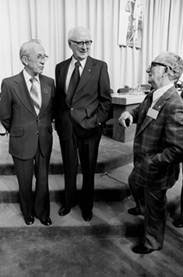
Jim MacDonald, the founding chairperson of the Canadian Health Coalition passed away July 5 at age 91. MacDonald organized the first S.O.S. Medicare Conference in 1979 which led to the formation of the Canadian Health Coalition. “We fondly remember Jim’s Cape Breton wit and his visits in his retirement years to the CHC office,” the CHC said in a communiqué today. MacDonald has also served for many years as coordinator of Social and Community Programs for the Canadian Labour Congress. In 2007 he was given the “Spirit of Tommy Douglas Award” from the Douglas family during S.O.S. Medicare II in Regina.

Jim MacDonald (far right) with Tommy Douglas and Justice Emmet Hall in 1979.

Event: Rally to save services at Peterborough Regional Health Centre

Peterborough Regional Health Centre is proposing a plan to eliminate 171 full-time equivalent jobs, cut 20 beds, and consolidate services at the new hospital site.

Rally to protect hospital services:
Thursday, June 17 / 5 pm
Millenium Park, Peterborough

Freedom of Information, the LHINs and the Ministry of Health

OPSEU recently submitted a number of freedom of information (FOI) requests to the Ministry of Health, one of which is still making its way through the system.

The early responses we have would suggest that “officially” little information is finding its way from the Local Health Integration Networks to the Ministry of Health. The Ministry of Health’s access and privacy office has  told us that the only way to gather this information is to apply separately to all 14 provincial LHINs. It would be up to us to collate this information to get a provincial snapshot of what’s going on.

One has to wonder how the Ministry is making policy decisions if it doesn’t really collect such information from the LHINs?

The information the Ministry claims not to have includes detailed budgets for each of the 14 LHINs. It is true that you can find, with considerable effort in some cases, a very basic level budget on their web sites. However, we were told we would have to ask the LHINs directly for a more comprehensive view. The Ministry claims it does not possess this level of budget information, yet it was concerned enough a few months ago to insist the LHINs tighten up their spending procedures.

After hearing a discussion of staff-management ratios as part of their scorecard system, we asked to see this information from the Central East LHIN. We were told we couldn’t have it because this information belonged to the hospitals, not to the LHIN. Ontario is the only province in Canada not to subject its hospitals to FOI legislation, although the Minister of Health has been promising to change this since last fall. Once the LHIN collects it, one would normally believe it to belong to the LHIN. When we requested this same information from the Ministry, they claimed they do not receive these detailed scorecards from the LHINs. They claim to have no idea how many managers occupy positions in Ontario hospitals relative to front-line staff.

When we initially submitted a form to the Ministry asking for information about what the Central East LHIN was describing as $55 million in hospital “efficiencies,” we were sent a letter with our original request form telling us to resubmit it to the LHIN directly. The Ministry does not, apparently, provide direct access to LHIN information. Nor do they forward these requests on.

When we asked about the use of private consultants by the Ministry, they said we could have the information post 2004-05, but it would have to exclude e-Health and the LHINs, for which we would have to make separate applications.

When we asked for any review or evaluation of the pilot projects that utilized retirement homes for hospital “alternate level of care” (ALC) patients, we were shocked to receive a letter from the access and privacy office that said no such evaluation existed. Yet the Ministry has established new rules and is pushing hospitals to proceed in finding more retirement homes to house their ALC patients. How did they decide this without ever evaluating the pilots?

Similarly, when we asked for any correspondence between the LHIN, the Ministry and the Northumberland Hills Hospital around the closure of that hospital’s diabetes clinic, we were told none existed. Yet the LHIN claims the clinic was directly funded by the Ministry. Nobody formally expressed any concerns around the fact that 2,300 patients would be orphaned by the closure, or where alternate services might be provided? It’s absolutely breathtaking.

While there has been much discussion of problems with the LHINs, nobody yet has pointed out that finding province-wide information has become 14 times more difficult as a result of their creation in 2006.

The Minister and the OHA speak frequently about openness and transparency, but the reality on the ground is somewhat different.

Where is the information?

Despite high P3 costs, Birmingham Labour seat holds

Recently UK’s The Independent reported a new P3 (PFI) hospital in Birmingham had the potential to affect the outcome of the national election in that city. Gisele Stuart, the sitting Labour MP, was considered to be at risk given the Queen Elizabeth Hospital was to cost taxpayers almost three times its building cost in interest and service costs. As an update, Ms. Stuart was able to hang on to her seat, although several nearby Midlands constituencies did fall to the Conservatives. Interesting enough, we did have a message sent to us from a ‘Gisela’ in the UK who denied that constituents had even heard of this issue despite the article in The Independent. Could this have been the same Gisela Stuart?

New Act vague on executive compensation

Health Minister Deb Matthews has introduced a new bill on health quality that ties executive salaries to performance, establishes provider quality committees, and amends the province-wide Ontario Health Quality Council. The question is, will it make any difference?

Bill 46 – better known by its cheerful moniker, the “Excellent Care for All Act” was read into the legislature May 3rd.

While intended to show government resolve to curb excessive executive salaries within the health system, the legislation provides little detail that would lead anyone to believe that it will be anything but business as usual.

What the bill doesn’t do is prescribe how executive compensation will take place beyond requiring hospitals to base bonuses on targets set by yet-to-be-defined provider quality committees. If there is an executive presently not on a bonus system, a portion of their salary will now be deemed bonus.

The targets will be reviewed by the Local Health Integration Networks. However, the LHINs have no authority under the Act to alter these targets.

Given there is no detail in the Act on what these targets should be, it is not clear how they will differ from targets already set under the LHIN Accountability Agreements.

The Act also calls on health providers to put in place a patient relations process, reflective of its patient declaration of values. It also calls for patient surveys – a process that it already in place and is reflected on present hospital scorecards.

The Act also brings the Ontario Quality Health Council out of the Commitment to the Future of Medicare Act (2004) and makes some changes mostly to scope of the Council, including a new duty to monitor and report on health human resources as well as access to publicly-funded health services.

Bill 46 allows for considerable alteration by regulation, including expanding the reach of the Act to other public health providers.

Ontario begins to phase out global funding for hospitals — moving to US system?

Concurrent to its Act to tie health care executive salaries to performance, the province also quietly announced it was beginning the process of replacing global budgets with a patient-based payment scheme.

While few details are available, the communiqué suggests the new system will be built upon the wait times strategy funding, which will allocate procedures based on a number of factors, including the ability to perform the service under a cost threshold.

The Ministry says it will first move larger hospitals to the new funding model beginning April 1st of next year.  

However, details have yet to be worked out. The Ministry promises to consult with hospitals, LHINs and other “relevant partners” in the detailed design of the payment system. Among issues the Minsitry says need to be resolved: how to recognize hospitals with unique roles, such as academic health sciences centres as well as those serving small and rural communities.

The Minister’s office had told OPSEU weeks ago that rural hospitals would be exempt from the competition model, although the new communiqué is more ambiguous, suggesting the model may be instead adjusted to take into account their specific needs.

It is not clear how the move to more patient-based funding will be balanced by the government’s other promise – to bring in a funding formula that would address inequities in the current system. With the move to more patient-based funding, it would appear that funding formula may have already been abandoned.

With more hospital funding being directed from Queen’s Park, it raises questions around the autonomy of hospital boards and LHINs to determine local service.

It also means hospitals may be more subject to fluctuations in their funding base, raising difficulties in long term planning. This could impact on the recruitment and retention of health care staff.

The statement suggests Canada would be joining countries like the United States, England and Western Europe by moving to such a system, claiming, among other things, that it will improve access and cost efficiency. Wait a minute, the United States?

May 6 public forum: Your grandchildren’s future

Our todays … their tomorrow’s… The Older Canadians Network with the Alliance of Seniors is hosting a free public forum to consider our future alternatives. All are welcome!

 Panelists include:

Elizabeth May – Leader of the Green Party of Canada
“Ensuring Our Grandchildren Have a Future”

Natalie Mehra – Director, Ontario Health Coalition
“The Uncertain Future of Health Care in Canada”

David Miller — Mayor, City of Toronto
“Choosing the Kind of City Torontonians Want”

Host Moderator: Actor Eric Peterson (Corner Gas, Street Legal)

When: Thursday, May 6 / 1-3 pm
Where: Toronto City Hall, Council Chamber

For more information, call 416-260-3429 or e-mail OlderCanadiansNetwork@bellnet.ca

Cobourg calls upon local MPP to stand up for hospital

COBOURG – OPSEU members joined several hundred community members at an April 10 rally to call upon their local MPP to seek funding to retain health services at the Northumberland Hills Hospital.

The hospital is closing beds, a diabetes clinic and all outpatient rehab services in an attempt to balance its budget.

Officials at the Local Health Integration Network have already described NHH as among Ontario’s most efficient hospitals for its size.

The community is asking MPP Lou Rinaldi to go back to Queen’s Park and get $2 million in funding to save these services.

To see video of the rally, go to:

Video of rally at St. Thomas Elgin General Hospital

A short video of Monday’s rally at St. Thomas Elgin General Hospital. The Hospital is spending $550,000 on a new biometric monitoring system to track employees while cutting front line health services.