Home care increases slip downward in 2014-15 budget

Ontario Health Minister Deb Matthews has had a fairly consistent narrative of late – health services should be delivered closer to home, or more specifically, in the home.

It’s been the justification for a lengthy freeze on hospital base budgets – now predictably frozen for the third year. The answer to every hospital cut is ‘don’t worry, it will be delivered in the community.”

If there is one interesting aspect of the 2014 provincial budget it’s this: the amount of money the Wynne government has allocated for home care is beginning to slip.

Last year’s budget promised a six per cent increase for home care. This year it is pegged at five per cent, or $270 million. The three year total for home care is forecast to be $750 million, which suggests a further slide in investment next year and the year after.
Continue reading

PSW minimum wage hike not the end of the story

Deb Matthews promised and delivered – sort of.

The Ontario Health Minister had committed earlier this year to revisit compensation for personal support workers. Minimum wage for PSWs had not changed since 2006.

This she has done – announcing yesterday that the minimum wage for PSWs would escalate in three steps to $16.50 per hour by April 1, 2016.

The first step is retroactive – PSWs earning the previous minimum wage of $12.50 per hour will see their pay rise to $14 an hour as of April 1 of this year. Next April 1st it will rise to $15.50 for 2014-15.

It’s a good start but not the end of the story.

Continue reading

CAMH asks staff to mail patients’ cigarettes back home

Ah, Rosie.

Toronto Star columnist Rosie DiManno recently used her shotgun style prose to take the Centre for Addiction and Mental Health (CAMH) to school.

While addiction is part of CAMH’s mandate, not everyone who seeks help there has arrived to engage in a smoking cessation program.

True, smoking tobacco is addictive. Its negative health consequences are well documented.

CAMH has been escalating its war on tobacco for some time, starting with the elimination of smoking rooms back in 2003. Since then they have prohibited patients from smoking anywhere on the property – both inside and out. Now the patients are told they cannot even store their ciggys in lockers on site, even if they have to run out into the streets to actually smoke them.

April 18 DiManno called CAMH’s war on tobacco a “pathology,” noting derisively that they (CAMH) “can act as coercively as they please against some of the most vulnerable people among us and call it a matter of health.”

Continue reading

2014 budget: If your hospital is not already on the rebuild list, it won’t be

When Charles Sousa unwraps his Ontario budget on Thursday there likely won’t be any new money for expanding hospital infrastructure.

Coming out of the Harris era, the McGuinty/Wynne government faced a considerable backlog of infrastructure needs, including updates to many Ontario hospitals.

To date there have been more than 100 major hospital infrastructure projects – or a project for two out of every three hospital corporations in the province. About a third of these projects have been costly long-term public-private partnerships where the private sector is responsible for the design, construction, financing and maintenance.

Paul Rosebush, CEO of the South Bruce Grey Health Centre told Bayshore Broadcasting that the economic forecast has raised some red flags that essentially mean that if you are not on the existing list for a rebuild, you won’t be.

Continue reading

Why the CN tower will be yellow tonight

Each year more Ontarians lose their lives through their job than by criminal homicide.

It’s a sobering thought.

In 2012 the WSIB reported 254 workplace-related fatalities and more than 140,000 injuries in Ontario. Of those 254 deaths, 64 were traumatic fatalities. By contrast, in Ontario there were 161 deaths by homicide in 2011.

Today is the National Day of Mourning for Workers Killed and Injured on the job.

Healthcare is responsible for the second highest percentage (16.9%) of allowed lost time claims among 16 sectors classified by the WSIB. Manufacturing, which has twice as many people covered under WSIB, has a lower rate of lost time claims. Much of these health care injuries are strains and sprains from what are defined as “assisting occupations.” The typical injury within health care is from overexertion experienced by a woman between the ages of 50-54.

While our sector is not known for occupation-related deaths, in 2013 four members of an Ornge air ambulance crew were tragically killed when their Sikorsky helicopter crashed in Northern Ontario. The WSIB notes that transportation-related events are the leading cause of traumatic fatalities.

Continue reading

Big-pharma backed patient groups attack bill banning paid blood and plasma collection

The current debate over paid plasma donation has brought out a number of patient groups – including those funded by big-pharma – that are suggesting Canada has no choice but to pay for plasma donation owing to a world-wide shortage.

Given Canadian Blood Services has been emphatic about sufficient supply on the world market, this is a rather curious claim.

If you go to the home page of Alpha 1 Canada (which is funded by Kamada, Grifols, and GlaxoSmithKline, among others) there is no mention of their members having difficulty obtaining existing plasma–based products.

So what changed, other than lobbying by Canadian Plasma Resources?

In fact one of Alpha 1 Canada’s sponsors, Grifols, just opened a new fractionation plant in Spain that will double capacity in that country and assist in increasing their world-wide output from 9.6 million litres to 12 million litres of fractionated plasma by 2016. Grifols accounts for 20 per cent of the world market for plasma-based pharmaceuticals.

Continue reading

Will Act banning paid blood and plasma collection die in committee?

All the election talk raises the question of whether the opposition parties will pull the plug on the present minority government before passage of a bill that will ban paid plasma collection in the province.

The Voluntary Blood Donations Act 2014 was referred to the legislature’s Standing Committee on Social Policy after it passed second reading April 14.

The question is, will the parties drag the Act out in committee to an inevitable death, or will they push it back quickly to the legislature for third reading? The former, rather than the latter seem more likely at this point. Readers concerned about this issue may want to contact their MPP’s soon to encourage passage.

The private for-profit Canadian Plasma Resources has already opened its doors in Toronto without licensing from either the Federal or Provincial governments.

Yesterday Dr. Ryan Meili (EvidenceNetwork.ca) and Dr. Monica Dutt (Chair, Canadian Doctors for Medicare) published an op/ed in the Globe and Mail arguing paid plasma donation “poses significant ethical, safety and public health concerns.”

They made particular note of the World Health Organization’s caution that where paid blood donations are permitted, the number of voluntary donors decrease. This point should be underlined given the blood shortages Canada faced towards the end of last summer.

Continue reading

Ontario slow to address meager recommendations in healthy kids strategy

Last March the Healthy Kids Panel made a series of recommendations around tackling child obesity including investing $80 million per year in new funding.

That’s only $5.87 per person to tackle a problem that is said to cost Ontarians $4.5 billion in downstream health care costs. We’ll see if it shows up in the spring budget.

There hardly seems to be fire lit underneath the Ministry of Health to implement what was essentially a very modest set of initiatives. Some might say too modest.

The report by the Healthy Kids Panel has few tangible recommendations around active living, for example, nor does it make any recommendations around regulation of processed food despite well-documented links to diabetes and heart disease.

The panel does recommend banning marketing of high-calorie, low nutrient foods to children. While that would be a no-cost item to government, more than a year after the report was issued Ontario has not yet acted.

There have been a few smaller initiatives started – the government maintains that it is working on breastfeeding supports, a student nutrition program, and an expansion of the Northern Fruit and Vegetable program which provides healthy snacks to 18,000 students. Up to 30 Ontario communities will get training and funding to run local initiatives under a program called the Healthy Kids Community Challenge.

Continue reading

Enough already – Stop public funding to Mike Harris’ pet institute

Kathleen Wynne should say enough is enough.

Why is the Harris-era Institute for Competitiveness and Prosperity still receiving nearly $1 million a year in public funding to manipulate the public towards some of the most ludicrous right wing ideas?

Earlier today Roger Martin, former Dean of the Rotman School of Management, delivered an eight-point “working paper” that is the most regressive health care advocacy document we have ever seen in this province.

The paper essentially advocates for the end of Medicare as we know it.

Instead of addressing inefficiencies – and there are many in our present public/private system – it goes after working people and the poor to pay for more of their own health care. That’s hardly our idea of reform.

In one scenario, while it advocates a co-pay amounting to up to three per cent of your annual income to access public health care, it caps families with an income of more than $100,000 per annum to $987. Only those under $10,000 per year would be exempt, leaving many under the poverty line to still pay more.

Is Roger Martin really that big of an idiot, or is the point of the Institute to shout out the most extreme ideas imaginable in the hopes that watered down elements will be found acceptable by comparison?

Continue reading

Tommy Douglas never said health care would be free — advisor to Premier

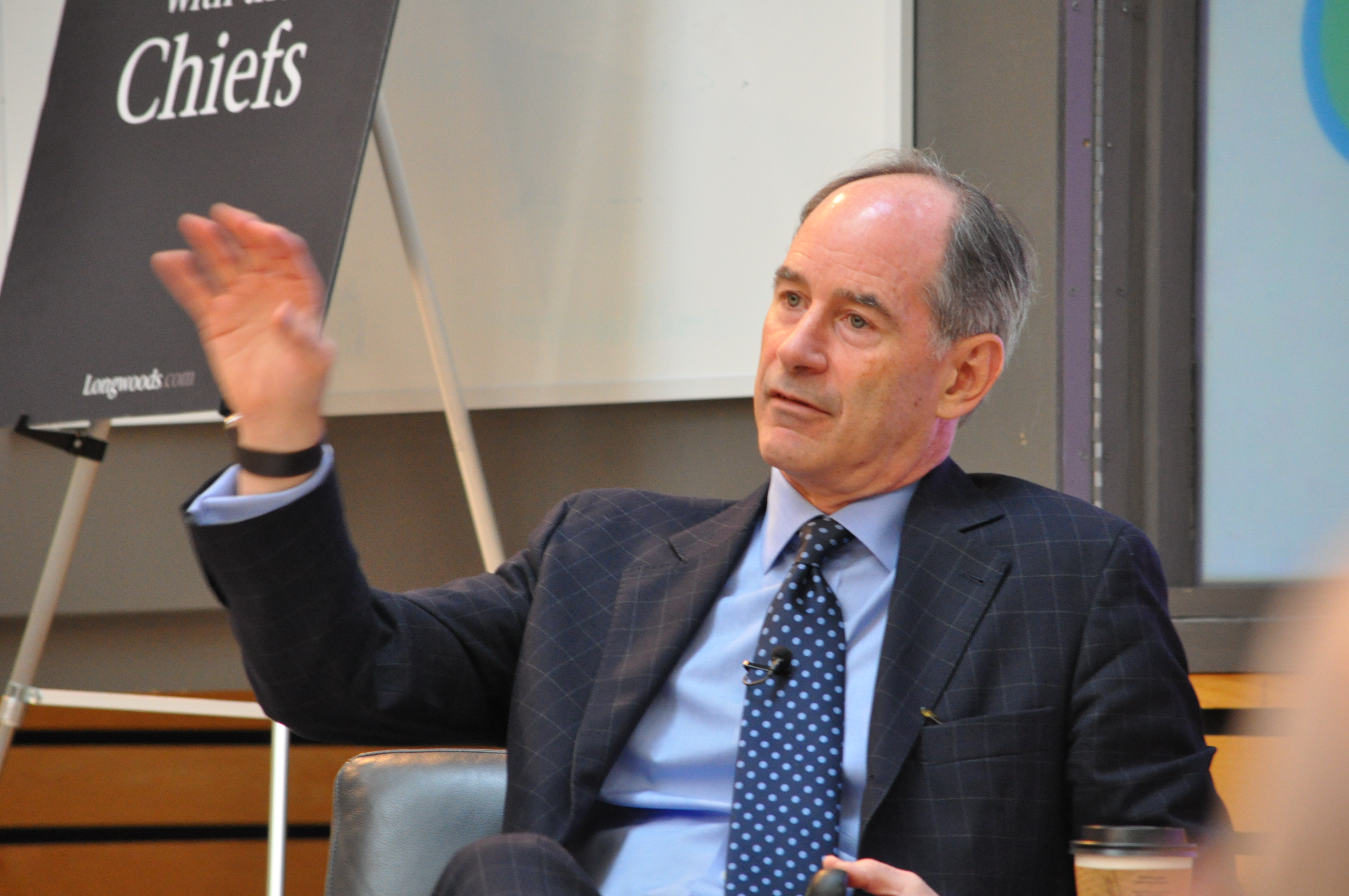
Roger Martin at Breakfast With The Chiefs

Roger Martin advocates government treat worker health plans as a taxable benefit.

Is Roger Martin having us on?

This morning the publicly funded Institute for Competitiveness & Prosperity released a working paper on policy opportunities for Ontario’s health care system during Longwood’s Breakfast With The Chiefs speaker series.

Roger Martin, the former Dean of the University of Toronto’s Rotman School of Management, was breezy in his presentation of the paper’s eight big ideas.

Some of it is the predictable low-hanging fruit, such as the need to get on with electronic medical records, reforming primary care delivery and focusing on end-of-life care (which accounts for one-third to one-half of a person’s lifetime health expenditures).

More alarming, three of the recommendations are essentially a manifesto for shifting the cost of health care away from the collective to the individual, and especially to low-income Ontarians.

In the brief question period after Martin’s presentation, his argument for co-payment on health care costs failed to get much attention despite being the most radical. Perhaps the audience felt it so far-fetched it was unlikely to get any traction from government despite coming from an advisor to the Premier.

Continue reading