Poirier should hold Gallinger to account for treatment of VON PSWs

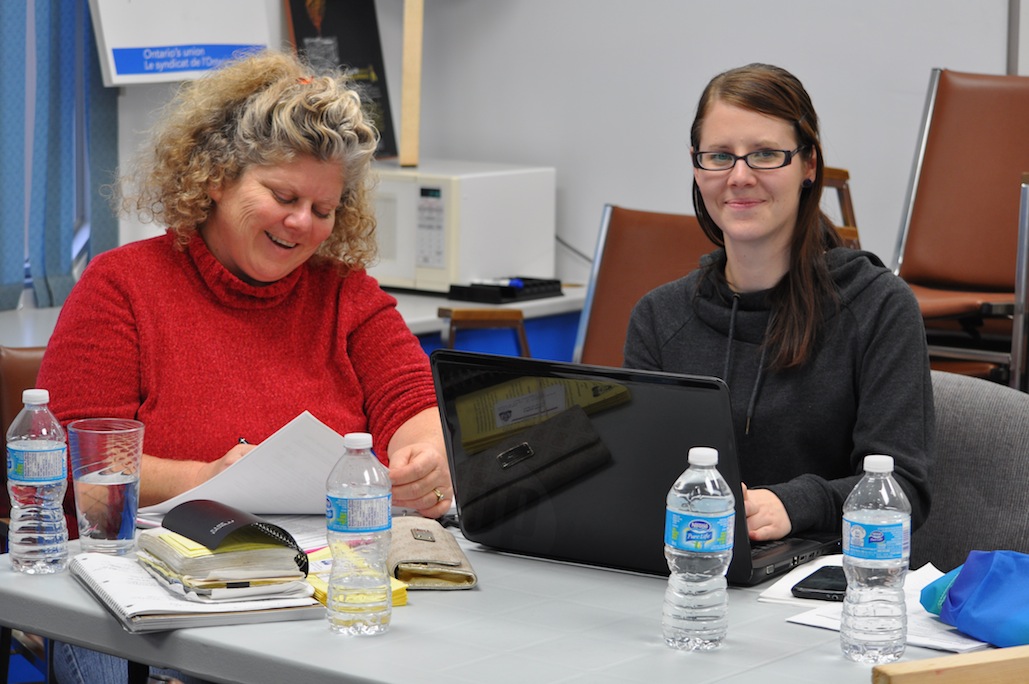
Today we’re in Owen Sound to talk to the media about the VON’s treatment of 35 Personal Support Workers.

In the scheme of things, 35 part-time PSWs represent a small portion of the tens of thousands of workers that make the health system run.

These are 35 women who work part-time for wages mostly below $14 an hour – an amount so low that it requires the community to actually care for the caregivers through the United Way and other charities.

This year their employer sent a negotiator to the bargaining table who not only appears to have contempt for these workers, but also seems intent on damaging the long relationship between our union and VON Canada. We have to wonder; given the damage he is creating, is it really worth it from VON’s perspective?

The bargaining team is still reeling from the negotiator’s assertion that a wage increase for these poverty-level workers would only be used for cigarettes and booze.

Later he denied saying “booze.”

If VON Canada had any sense, they would have pulled the negotiator immediately and apologized to these workers.

We have had a long partnership with the VON.
Continue reading

VON Grey Bruce — Nobody respects a cheapskate

Sometimes the government and its contract health providers just don’t know where to draw the line between fiscal responsibility and simply being cheap.

Nobody respects a cheapskate except for other cheapskates.

Already saving a bundle by whisking patients out of hospital as soon as possible, the province had to rush immediately to “cheap” when it came to paying the thousands of personal support workers (PSW) whose job it is to care for these patients.

When something is cheap, we usually don’t put a lot of value in it. Yet PSWs are incredibly valuable to the Ontario’s government’s overall health strategy. They are also critical to home care recipients and long-term care residents who rely upon them. So why is the government still treating PSWs as if they were of only minimal value when it comes to pay?

Recently Wal-Mart endured considerable wrath from the public when a store in Canton, Ohio actually asked for food donations to support their underpaid employees. Everybody was reminded of the Walton family’s $150 billion personal fortune made from the toil of these workers. And of course, if the donors bought that food from Wal-Mart…

Closer to home the VON pays so little to its part-time PSWs in Grey Bruce Counties that some have also become reliant on charities and food banks to make ends meet for their families.

Continue reading

Mental Health: Strike looming over province’s failed promise

Lori White and Dawn Godfrey of OPSEU Local 489 prepare for a potential strike tomorrow in Kingston.

Lori White and Dawn Godfrey of OPSEU Local 489 prepare for a potential strike tomorrow in Kingston.

Update: Monday night a tentative agreement was reached between OPSEU and Frontenac Community Mental Health and Addictions Services. A ratification vote will be taking place next week. 

————

Hopefully Kingston Mayor Mark Gerretsen made some phone calls yesterday.

Having met with unionized staff members from Frontenac Community Mental Health and Addictions Services, he expressed concern about a potential strike tomorrow (Wednesday) that will impact directly upon the municipality and its residents.

The 130 staff of the mental health and addictions agency provide a wide range of services in the Kingston community, including residential and crisis support. At midnight tonight they will be on a legal strike unless a last-minute deal is reached with the assistance of a mediator.

In the absence of the workers it will likely be up to the city’s police and emergency services to do what they can. It’ll cost much more this way, especially for those who wind up at the hospital emergency room.

Each day we are told the crisis line that Frontenac workers operate receive as many as 40 calls a day. This is on top of the 1200 clients that Frontenac routinely serves in the community.

The professional and support staff at the agency have been without a contract since the beginning of April. That’s too long.

With significant cuts happening at the former Kingston psychiatric hospital, the expectation was that Frontenac would be given new resources to deal with the pressures of downloading.

Earlier this year Providence Care said it was eliminating 60 full-time equivalent mental health positions – that translates to somewhere between 80-90 real jobs.

When the news broke, we got the same old line from government politicians about how services were not really being cut, but shifted to the community as part of health care transformation.

So how did that downloading from the hospital convert to front line jobs at Frontenac?

The answer is: it didn’t.

Continue reading

Today’s austerity will be tomorrow’s professional shortage

During the November meeting of the Canadian Health Professional Secretariat, our colleagues in British Columbia let us know that they are seeing increasing numbers of health professionals migrate there from Ontario.

It’s not surprising given austerity appears to be biting very hard here – and its not just in the hospital sector.

We’ve noticed that despite incredible organizing success, our overall health care membership has not grown within the last six months. This confirms the view from BC that our health care professionals and skilled support are departing to where the jobs are.

There have been numerous high profile cases where hospitals have unloaded significant numbers of staff – we reported earlier this year that about 290 full-time equivalent jobs were leaving The Ottawa Hospital. Similarly, The Scarborough Hospital has been in the spotlight for shedding jobs and services. Even smaller centers, such as the Perth and Smiths Falls District Hospital has lost significant employment for health professionals and support staff.

Continue reading

Outbreak equals opportunity

It’s the things that go wrong in the health system that often preoccupy us.

While we frequently look for big answers, it is often in the everyday efforts that real change is taking place.

In the past we have seen some hospitals react to funding restraint by simply hacking off clinics or beds, as if they were sawing off a piece of sausage.

Many more have been undergoing process changes that appear to be paying off in both savings and quality of care. This story is just one of many.

Recently Lakeridge Health won an international award for its efforts to reduce incidents of hospital acquired C-Difficile.

Rather than cutting off another piece of the sausage, Lakeridge actually added a second pharmacist to its now three-member anti-microbial stewardship team. That investment is paying off.

Continue reading

Harris had to stop hospital cuts after two years – what about Wynne?

When Health Minister Deb Matthews spoke at the closing of this year’s Ontario Hospital Association (OHA) HealthAchieve, the hall was two-thirds empty. Only two days before there was standing room only for Canadian astronaut Chris Hatfield.

Attendance at the final morning of the OHA’s annual get-together is usually smaller than the preceding two days, but we’ve never seen it this sparse.

Former Health Minister George Smitherman could usually command a decent audience on the final day. For Deb Matthews, the reception might be connected to how hospital executives are feeling about the restraint they are under.

Two years ago the OHA reminded the province that the Harris Tories had planned three years of cost cutting at Ontario hospitals but had to abandon the effort after year two.

Not only did the Tories halt the last $507 million in cuts in 1998, but had to substantially increase their restructuring budget.

The OHA maintains those were days when hospitals could better afford the haircut.
Continue reading

Funding “reform” has CEOs chasing hospital mergers

In a perfect world hospitals would be publicly funded to meet the health needs of their communities. That would be it.

When the government started talking about funding reform, the thinking was that at last we would be moving closer to a rational system of allocation.

What we got instead was a hybrid of global funding, competition, and a funding formula that was supposed to take into consideration both existing usage and local demographics. Layered on top is a base funding freeze to at least 2018. Money has always been a driver in the health system, but suddenly it appears to be driving everything.

The evidence suggests that the complex and confusing system of funding allocation is creating new inequities that may be even worse than the ad hoc system of the past.

The South Bruce Grey Health Centre, for example, has argued to the South West LHIN that they are being penalized for efficiently combining the resources of four small rural hospitals. The Scarborough Hospital and the Rouge Valley Health System have made it clear that the complex demographic needs of their two communities are not being recognized in their base funding allocation.

What the new funding system appears to be doing is driving a new wave of costly and disruptive hospital mergers. You can’t blame the hospitals for seeking such mergers because they are simply acknowledging the new rules of the game set by the province. In this new world bigger gets more clout gets more funding.

Continue reading

Toilets without seats — warnings from England

Too big to fail.

For most that expression applies to big banks, but what about our health care?

As Ontario prepares the way for further transfer (read: privatization) of hospital services to mostly for-profit independent health facilities, it’s a good question to ask.

When the government recently decided earlier this year to end its relationship with 90 private OHIP designated physiotherapy clinics , it was revealed that these clinics were almost all owned by just four companies.

The same narrowing of interests also occurred in Ontario’s home care, where the former competitive bidding system ushered out many of the smaller players.

That’s far from healthy.

We’ve previously said that if you want to see the future of Ontario’s health care system, look to England.

Continue reading

The Lang-Jimbo Reality Show? CBC may be missing its moment

Economist "Jimbo" Stanford speaking Sunday morning at the Ontario Health Coalition conference.

Economist “Jimbo” Stanford speaking Sunday morning at the Ontario Health Coalition conference.

Somebody suggested that the CBC would be a far more interesting place if the Lang-O’Leary Exchange morphed into the Lang-Jimbo Reality Show.

Now that’s a CBC we might be inclined to fight a little harder to protect.

There are not many economists who would take on the moniker of “Jimbo,” but Jim Stanford doesn’t shy away from it. Speaking at the Ontario Health Coalition weekend conference at the Toronto Sheraton Centre, the Unifor economist and founder of the Progressive Economics Forum was in high spirits.

“An economist is someone who is good with numbers but hasn’t the personality to be an accountant,” he told the crowd with a big wide grin. Don’t be fooled, “Jimbo” has personality to spare.

With a Master’s degree from Cambridge and a Phd from New York’s New School for Social Research, Stanford doesn’t come across as pedantic. Early Sunday morning he finds ways to convey complex economic principles clearly to a mixed community audience of under-caffeinated seniors, labour and young people interested in health care advocacy.

Stanford has been doing this for much of his career, including writing Economics for Everyone: A short guide to the economics of capitalism. That textbook has become a staple for those who wish to know more about how economics work in order to take on the issues of the day.

“Health care (costs) are going up because we are aging and we are willing to pay more,” he said this weekend. Stanford explained that it’s rational that Canadians would want to take advantage of new technologies that would extend their lives or improve the quality of life.

Continue reading

Thinking upstream — new institute invites us to think differently about health and politics

Dr. Ryan Meili has received considerable attention for his short 2012 book A Healthy Society: How a Focus on Health can Revive Canadian Democracy. Little did we know that the book would become a manifesto for a new institute dedicated to change how we think about politics.

The central theme of the book is based around a parable. In it a bystander leaps into a river when he or she sees a young child struggling in the current. After bringing the child safely to the shore, another child appears in the river. The bystander leaps in again to repeat the rescue. And then another child, and another. As a crowd develops to witness this spectacle, a wise person suggests that maybe they should look upstream to see who is chucking children into the river.

The parable is of course about our health system. Increasingly we are struggling to meet demand that results from changes in our society, including the widening gap between rich and poor. But are we really addressing the root causes of that spike in demand?

In his book Meili suggests that poverty alone is costing Canadians $7.6 billion in health care costs, $13 billion in lost income taxes and more than $35 billion in decreased productivity.

Continue reading