Ontario Shores manager shows DeNiro-Stiller movie clip to intimidate staff

WHITBY – Dietary staff failed to get the joke when their Ontario Shores manager showed them a clip from the 2000 film “Meet The Parents” during a staff meeting earlier this year.

In the YouTube clip, Robert DeNiro corners his future son-in-law in a tuxedo rental dressing room after finding drug paraphernalia among the bridal party. DeNiro reminds Stiller of his “circle of trust.”

“If I can’t trust you, Greg, I have no choice but to put you outside the circle. Once you’re out, you’re out. There’s no coming back.”

“I will be watching you, studying your every move,” DeNiro warns. “I will bring you down, baby. I will bring you down to Chinatown.”

“Veiled threats of this nature are not acceptable in the modern workplace,” says Warren (Smokey) Thomas, president of the 130,000-member Ontario Public Service Employees Union which represents the workers at the Whitby mental health hospital. “Is this the message management truly wants to send to staff about their working relationship?”

OPSEU Local 331 has complained about the incident and has yet to receive either explanation or apology for the inappropriate video.

The video comes amid deteriorating labour relations at the Whitby hospital.

Draw your own conclusions: This YouTube clip is from movieclips.com:
 

New Tory health plan is simple – too simple

The new Ontario Tory plan for health care is simple – eliminate the Local Health Integration Networks and the Community Care Access Centres and let between 30-40 “hub” hospitals run the health care system – or at least the bits not run by the municipalities or the doctors.

The new PC Caucus white paper, Paths To Prosperity: Patient-centered Health Care, is thin on specifics and long on rhetoric – much of it borrowed surprisingly from the McGuinty government. Aside from attacks on the LHINs and the CCACs, the broader strokes are not that different from the government’s own plan, including the Triple Aim we continually hear so much about. The “Triple Aim” sets goals to enhance patient quality and satisfaction, improve population health and reduce costs. Who could be against that?

While dumping the LHINs and the CCACs, the Tories would create physician-led “Primary Care Committees” which would link to the hospital hubs. The role of these committees is not clear beyond giving physicians more of a say in how the health system runs and somehow charging them with scrutinizing their own performance. How nice.

While this plan appears to centralize decision-making functions to the hospitals, the Tories counter that this represents a “decentralized and delayered” system. At the same time they sing from the George-Smitherman-Career-Memorial integration songbook. Decentralize and integrate? Confused? We all should be.

Continue reading

Deane Report: Which came first, the underfunding or the internal conflict?

How much of a factor is underfunding to the working relationships within a public hospital? What is the impact of resulting cuts on the public’s perception and trust?

In July Ken Deane’s final report was submitted to Health Minister Deb Matthews. Deane was appointed supervisor for the Windsor Hotel-Dieu Grace Hospital after a series of public incidents that shook the community’s confidence. His report was made public a month later.

Deane sums up the so-called “difficult” period the hospital went through. Those issues include “a tragic murder/suicide; medical errors, and pathology mistakes that resulted in an investigation into surgery and pathology; an external review of cardiology; fraud in the finance department; termination of a vice-president and a related $6.3 million lawsuit against the hospital and specific staff; ministry announcement that it will appoint a provincial Supervisor; removal of the Board Chair by the sponsoring organization; and a subsequent resignation of a Board member.”

While Deane casts the usual blame on the dysfunctional relationships between the leadership of the hospital and the constant conflict within the organization, he does highlight financial stresses that may not rest entirely with the hospital.

Deane makes a particular plea to the Erie St. Clair LHIN noting the hospital provides substantial specialized regional services without accompanying compensation. Deane notes that the hospital has the highest “acute specialization index” (ASI) among Ontario community hospitals and 11th highest overall in the province. The ASI measures the per cent of hospital inpatient activity that is identified for specialized services or programs. Deane also identifies HDGH as having the highest resource intensity weight (RIW) of any community hospital in the province. The RIW measures the relative expected cost to care for a patient, suggesting a very high intensity level. While the new provincial funding formula does take these measures into consideration, Deane notes these issues have been identified to both the LHIN and the Ministry of Health for redress.

Continue reading

How we die in Canada

Statistics Canada maintains a snapshot of how Canadians die. The chart not only gives an indication of how nearly a quarter million of us cast off this mortal coil each year, but suggests where we are making progress and where the numbers are climbing dramatically.

You may have noticed that the Heart and Stroke Foundation no longer suggests cardiovascular disease is Canada’s number one killer. Canadians who die of major cardiovascular disease has dropped from 71,338 in 2005 to 68,342 in 2009, the most recent year for which Statscan has complete data. That would put it slightly behind those who die of “malignant neoplasms,” better known as cancer.

In 2009 71,125 deaths were recorded from cancer, a rise of nearly 4,000 since 2005. To put that in perspective, nearly one in three deaths in Canada are cancer-related. That does not necessarily mean we are doing that bad – Canada is just slightly better than the OECD average (age standardized) for all cancers at 205 per 100,000 population (OECD is 208). What is the leading country for fewest cancer deaths? Mexico, at 101 per 100,000, followed by Israel (162), Sweden (165) and Finland (165). Our nearest neighbour, the United States, has 185.

Continue reading

Looking upstream: Law Commission report a step in the right direction

If Ontario really wants to look at upstream investments to improve population health, it may want to pay attention to an unlikely source – the Law Commission of Ontario.

In August the LCO issued an interim report on vulnerable workers and precarious work.  In it they note that the rise in precarious work “leads to a greater risk of injury and illness, stress and lack of access to medical care.”

The 166-page LCO report states that such work not only leads families to experience “the intergenerational costs of poverty,” but also impacts society at large.

Unlike PC leader Tim Hudak’s drive to take labour rights in this province back to the stone age – or at the very least to Wisconsin – the LCO makes many constructive recommendations to really improve the lives of Ontario workers. Implementing many of these recommendations could have the two-fold effect of also addressing the social determinants of health. That should be a wake-up call to Health Minister Deb Matthews.

Given the McGuinty government is now in its third term, it has few excuses not to finally address the mess made by the Harris government and bring about change to improve labour conditions in the province. The LCO report appears as a breath of fresh air amid all the gloom about beating back already stagnant workers’ wages to match those of the Chinese.

The report includes recommendations to update, review and streamline exemptions to the Employment Standards Act (ESA). Such a review would develop and use principles that aim to promote a “broadly available minimum floor of basic workers’ rights, including that justifications for exemptions be balanced against the need to reduce precarious work and provide basic minimum standards to a broader sector of the working population.”

Continue reading

What does Dalton McGuinty have against physiotherapists?

In 2005 the Ontario government partially delisted physiotherapy, limiting public coverage to Ontarians who are age 19 and younger or 65 and older, to those receiving Ontario Disability Support or Family works, or to anyone who has spent at least a night in a hospital for a condition that will require physiotherapy.

Preservation of even this limited public coverage followed an outcry from the community over a proposal to completely delist these services.

Even if you do qualify, finding publicly funded physiotherapy is likely to mean a lengthy wait and often travel. The number of independent physiotherapy clinics licensed to conduct OHIP work has been frozen since 1964 – that’s almost 50 years. According to the Ontario Physiotherapy Association, there are 91 authorized licenses to bill OHIP for both clinic based and home based services for the entire province. With no new licenses in nearly half a century, geographic distribution has become unbalanced. The city of Mississauga, for example, has a population of more than 713,000 people but has no independent OHIP licensed physiotherapy clinic.

Having lost the battle to totally delist physiotherapy, the McGuinty government’s new strategy appears to be about labelling it a “fringe” service and to shut down access to publicly funded care wherever they can.

Continue reading

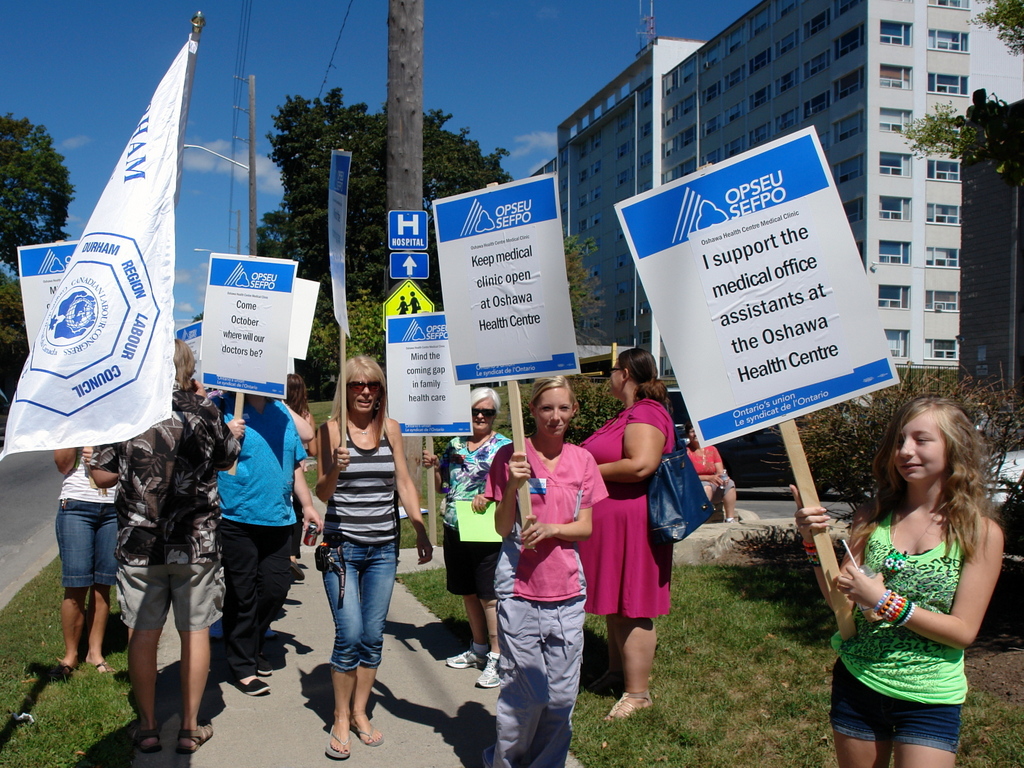
Picket outside Oshawa Health Centre clinic brings partial answers

Medical office assistants and their supporters picket outside the Oshawa Health Centre August 29. The workers were told they were losing their jobs at the medical clinic upon the retirement of chiropractor Dr. Adrian Pettyan.

Picketing OPSEU members got a partial result for their efforts outside the Oshawa Health Centre on August 27.

Medical office assistants at the Oshawa Health Centre were calling for the medical clinic’s owner to reveal his plans for the future of services offered at the clinic after it formally closes at the end of September.

Dr. Adrian Pettyan, who says he owns the clinic, had been adamant patients were not being “abandoned,” but could not say earlier in the week where the clinic’s health practitioners would move their practices.

Pettyan told the news media yesterday that he expects most of the doctors will make lease arrangements to continue working out of the facility at the corner of Adelaide and Simcoe Streets.

Continue reading

Thousands of patients affected by closure of Oshawa medical clinic

Dr. Adrian Pettyan is retiring, but staff at his medical clinic may be excused for not taking up a collection to buy him a gift.

Pettyan is closing the busy Oshawa medical clinic, disrupting access to primary care for thousands of patients in the community and costing the jobs of at least 15 recently unionized certified medical office assistants who were given notice of termination late last week. The medical clinic maintains about 27,000 medical health records.

Seven family doctors work out of the clinic. Two have already announced they are relocating to the Glazier Medical Centre. Pettyan’s medical health care clinic also offers a walk-in clinic, massage therapy, psychotherapy and has hosted Dr. Pettyan’s chiropractic practice, which he has been preparing to hand over to another doctor.

“Most people try to leave a positive legacy when they retire,” says Warren (Smokey) Thomas, president of the 130,000 member Ontario Public Service Employees Union which represents the office assistants. “Dr. Pettyan appears to have left a significant gap in the city’s primary care services and has shown indifference to the workers he is abandoning.”

Continue reading

Summit organized for Kitchener-Waterloo by-election

A coalition of community and labour organizations is hosting a local summit in Kitchener-Waterloo in time for the September 6 by-election.

The by-election will determine whether or not the McGuinty government can pick up the seat vacated by former MPP Elizabeth Witmer and regain a majority government in Ontario.

Many community groups are fearful that a majority government will take off the brakes from the McGuinty government’s austerity plan and bring greater hardship to Ontarians who can least afford the cuts.

Ontario already has the fastest growing gap in income inequality in Canada, much of it fueled by the current austerity plan. The coalition argues we need a clear economic plan to restore jobs and build our community in a way that benefits the people of Ontario.

Concerned citizens are asked to come to the Royal Canadian Legion Polish Branch, 601 Wellington St. N., Kitchener at 5:30 pm on Wednesday, August 29. A light supper will be provided courtesy of the coalition.

This event is being sponsored by the Ontario & Waterloo Region Health Coalitions, the Waterloo Regional Labour Council and the Ontario Federation of Labour.

PSW Registry – Many issues unresolved despite impending deadline

As the deadline approaches for home care personal support workers to register with the government’s new PSW Registry, key issues remain up in the air and are unlikely to be resolved soon. PSWs may very well ask what they are registering for?

Home care employers like the VON are telling their PSWs that they must be registered by the end of the month, but the government anticipates that only 70 per cent of the estimated 26,000 publicly funded home care PSWs will meet that deadline.

What happens to the 8,000 unregistered PSWs is anybody’s guess. The PSW Registry Steering Committee does acknowledge it hasn’t worked through the implications of mandatory registration or how it will be enforced. No kidding.

CUPE announced last week that they are departing from the steering committee, calling the Registry “a dollar-store form of regulation, which benefits the province at the expense of the rights and dignity of personal support workers.”

Continue reading