“Staff satisfaction in our sector is bad” – Devitt

“Generally speaking, staff satisfaction in our sector is bad,” says Rob Devitt, CEO of the Toronto East General Hospital. Speaking at a Longwood’s Breakfast with the Chiefs forum November 23rd, Devitt and Dr. Josh Tepper, Assistant Deputy Minister (HealthForce Ontario) were invited to address the issue of healthy work environments, from policy to practice.

While winning a Great Places To Work Award, Devitt said when comparing against bad it’s easy to look good. He said that when his hospital looked at leading private sector employers who had taken the award, they were shocked at how poorly they stacked up.

 Devitt said while there isn’t always agreement, “organized labour has a lot of good ideas.”

The CEO highlighted the turnaround at his own hospital, including quarterly staff satisfaction surveys, conducting threat assessments, establishing an on-site gym and wellness center for staff, and developing a mental health wellness strategy.

Devitt says he is resisting every temptation to cut these programs in difficult economic times given the results, which include measured increases in productivity and reduced sickness and lost time.

“There’s such an important and wonderful focus on patient safety and quality of care,” Tepper told the forum. “I would argue the healthy work environment  — the well-being of our front line care providers is the flip side of the same coin. You cannot truly have a quality agenda for patient-centered care without have a healthy work environment strategy.”

 This forum is available on video at http://www.longwoods.com/audio-video

Another blow for children’s mental health – 28 specialized workers given layoff notice at Whitby’s Ontario Shores

WHITBY – Twenty-eight full and part-time child and youth workers are facing layoff at Ontario Shores (formerly Whitby Mental Health Centre) despite four decades of success with some of the province’s most difficult to place youth.

The Ontario Shores Adolescent Residential Rehab program has turned around the lives of youth who had previously found the province’s mental health system a revolving door. The program provides therapy to youth for periods of up to six months in a residential setting. Most of the youth in the program have had three to seven prior hospitalizations. Last year there was an average wait of 44 days to get into the program.

While the hospital has told patient family members that the program is merging with the shorter stay transition program, the large layoff suggests the staff mix is being altered away from highly trained child and youth workers to more general health care nursing staff.

“These workers graduate from a three year accredited program that looks at everything from child-protection legislation and children’s rights to therapeutic recreational programming and advanced therapeutic interventions,” says Warren (Smokey) Thomas, President of the 130,000-member Ontario Public Service Employees Union. “They will be soon replaced by general nursing staff who have been given very little of this specific training. How does that improve quality?”

The union is also concerned that fewer long term beds will be available for youth in need.

Two-thirds of youth in the program come from outside the boundaries of the Local Health Integration Network, suggesting how unique it is within the province’s mental health continuum.

The union is concerned that lives are being endangered by a short-sighted move that will likely not save money.

“For these youth, this program ended the revolving door,” says Thomas. “Instead any minimal savings from this action will likely be multiplied many times over as costs to elsewhere in the system.”

OPSEU has written to the Minister of Health and Long Term Care asking that the program be left intact and expanded to meet need. It has also asked the Minister to assure families that quality of care will not be jeopardized by replacing these skilled workers with staff who do not possess similar skill sets.

Coverage from CHEX-TV:

Health care workers face many obstacles going into new round of bargaining

As the 2009-2011 round of bargaining comes to a close and the last of the arbitration awards covering this period are released, health care workers across the province are preparing for a new round of bargaining with their employers. Already, workers face an uncommon barrage of nasty attacks on many fronts from government, Hospital CEOs and the Ontario Hospital Association. To fend off these attacks, workers will need to campaign together to educate the public and stand up for the future of healthcare.

The government’s present wage restraint legislation exempts unionized workers, but Finance Minister Dwight Duncan said public sector employers would not receive additional funding to pay for wage increases. For health care employers, this does not necessarily mean a freeze in what they receive in public funding. This year all health care sectors received a total of $2.6 billion more in funding. Next year the rate of increase will be slowed to $1.9 billion, and $1.5 billion in the following year.

The Ontario Hospital Association has been openly advocating for changes to HLDAA, including placing limits on arbitration awards. Windsor Regional Hospital CEO David Musyj has been vocal in the media, claiming he can’t afford the recent two and 2.5 per cent OPSEU arbitration award. This is despite the fact the province gave his hospital an increase of more than 4.5 per cent last year. It is clear hospital CEOs like Musyj are advocating for a legislated outcome.

While public sector workers are fighting off the government’s attempt to diminish their standard of living through wage freezes, the same cannot be said for those at the top, who continue to rake in excessive bonuses.

In the financial sector bonuses are definitely back – this despite the role that sector played in triggering the latest recession. In the U.S. the average Wall Street bonus increased by 25 per cent in 2009. Experts say the real value is more like 30 per cent when the non-cash portion of the bonus is considered. On this side of the border, Canadian bankers paid themselves $8.3 billion in bonuses for 2009 — just a year after the Harper government helped the banks weather the recession with $75 billion in public money.

Bonuses will likely increase again in 2010 for executives at Ontario’s largest companies. Ontario continues to roll back corporate taxes, placing greater profits in the hands of investors and top executives. When the corporate tax cuts are fully phased in, Ontario will hand corporations a gift amounting to $2.4 billion per year. Ontario corporations already pay among the lowest rates of taxation in the industrialized world.

For families of public sector workers, costs are going up and wages are remaining relatively stagnant. The McGuinty government has warned that electricity rates alone will go up 42 per cent by 2015. The HST is also increasing costs on many items by 8 per cent – including energy bills.

Donating the equivalent of $500 per household to Canada’s largest and most successful corporations while attempting to freeze the wages of more than one in three Ontario workers is a bad idea and will only further polarize the growing gap between the wealthy and the rest of us. The Canadian Centre for Policy Alternative recently reported the top one per cent of Canadians pocketed 32 per cent of all income growth from 1997 to 2007. This is the highest level of wealth concentration in Canadian history.

The good news is there are several things you can do.

If you belong to OPSEU’s Hospital Professionals Division (HPD), the executive is running a “Tax cuts or health care?” campaign to highlight the choices that are being made at Queen’s Park. They are speaking to locals and handing out bumper magnets and buttons to get the conversation started. HPD Locals are being asked to visit their MPPs in the new year. You can see a video about the campaign at:

OPSEU is also running a central campaign that is demanding a stop to the $2.4 billion corporate giveaway. You can see for yourself how much money you would be losing in the event of a wage freeze by going to

http://www.opseu.org/campaign/stopthewagefreeze/calculator.htm

After you calculate your loss, you can send an e-mail to your MPP at:

http://www.opseu.org/campaign/stopthewagefreeze/december-3-2010.htm

There is also a video about this campaign —

Ontario eliminated enough beds last year to fill a regional hospital

Some interesting notes from this week’s auditor’s report:

Ontario eliminated the equivalent of a regional hospital in beds cut last year.

According to information provided by the Ministry of Health and Long-Term Care, 400 fewer beds existed in the province’s hospitals from 2008/09 to 2009/10 (from 18,800 beds to 18,400 beds). Despite all the new construction, our bed capacity is the same as it was five years ago.

The province may be both increasing and aging, but the number of hospital discharges has also remained relatively static. In 2005/06 there were 1,095,000 discharges. In 2009/10 there were 1,092,000. The average length of stay has remained the same – six days.

While other countries are looking at managing their occupancy rates to build surge capacity, some Ontario hospitals are trying to build capacity by discharging patients earlier in the day to make more beds available during peak emergency room times. The Auditor General of Ontario commends this activity, but it is indicative of the level of micromanaging necessary to accommodate patient demand in these overloaded facilities.

About one in five patients discharged will need to be sent to another health care setting. That could be home with visiting care (10%), a long term care home (4%), a complex continuing care facility (2%), or palliative and other care settings (4%). Given these settings are also stretched to capacity, something has to give.

While home care has been the focus of the auditor’s comments, there are also long waits to access other forms of care. In theory, if patients cannot access this care, they remain in hospital longer. This issue has been the focus for government in recent years. The question is, if “alternate level of care” (ALC) patients are taking up more beds in the hospital, why has the average length of stay not increased over the last five years?

In Brief – “A concerted corporate attack on independent groups” – BC pharmaceudical researcher

BC is ending its contract with Therapeutics Initiative — an independent drug watchdog organization and is instead substituting a Drug Review Council which allows individuals with drug company ties to participate in the review process. Based at the University of British Columbia, Therapeutics Initiative had enjoyed an excellent international reputation and is widely credited with saving more than 500 lives in the province after it warned about the dangers of rofecoxib (better know under its trade name Vioxx) and rosiglitazone. This was long before reports linked the drugs to an increased risk of heart attacks. James Wright, managing director of the Therapeutics Initiative, told the British Medical Journal “our job was to assess the evidence and provide unbiased information to the government so they could make a funding decisioin. You need an independent group that provides you with the information, and that’s what they have abolished.” Alan Cassels, a pharmaceudical policy researcher at the University of Victoria, told the BMJ “I see this as a global problem, a concerted corporate attack on independent groups.”

Addressing poverty would pay off in reducing health care costs – Stanford

CAW economist Jim Stanford writes in Wednesday’s Globe and Mail that Canada could cut diabetes costs in half by improving the living conditions of our poorest citizens. “There is now hard medical evidence that a person’s economic status and social participation directly affects their physical health,” he writes. “And that, in turn, affects the cost of health care. This is not vague, bleeding-heart sentimentalism; it is hard scientific proof.” Stanford says countries with very low poverty rates experience less than half the rate of diabetes as Canada. Matching their performance would save Canada $7 billion in health costs annually. He says the same math could apply to other socially determined diseases, such as hypertension, digestive maladies and mental health.

American unions also fighting back against attacks on public sector

Canadian unions are not the only ones to be addressing the scapegoating of public sector employees. The American Federation of Federal, State, County and Municipal Employees has launched its own campaign “Stop the Lies.” Check out their video below:

Auditor’s report gives opening to finally leave Mike Harris’ failed home care system behind

Earlier this spring the Health Minister extended the moratorium on competitive bidding for service contracts in home care. She did promise that the controversial system would eventually return.

Reading this week’s report by the office of the Auditor General of Ontario, one has to question why she is not looking at alternatives.

While there have been some providers itching to see a return to the bidding system, the Community Care Access Centres have cautioned that the return to competition for home care services will not necessarily save money nor narrow the gap between the costs of agencies providing identical services. The auditor notes that in some cases the rates paid for shift nursing services by one CCAC could be twice as high as those paid by another CCAC.

While proponents of the bidding system – including former Minister Elinor Caplan – have argued the competitions enhance quality, the auditor says we just don’t have the present oversight to even know if patients are receiving the care the province is paying for – let alone measure quality.

According to the Auditor, three-quarters of the service providers had limited ability to assess whether their staff had delivered the required services in the client’s home in a timely manner. Further, 60 per cent of service providers had inaccurate or unclear definitions of what constituted a missed visit.

More disturbing is the inconsistent data that was made available. At one CCAC a service provider reported that it had rejected about seven per cent of requests for service in that quarter – the auditor’s review of the CCAC data showed that the provider had in fact rejected 39 per cent of requests for its services.

The auditor noted that the number of service complaints was relatively small compared to the number of clients the agencies see. However, his office fails to acknowledge that many care recipients are reluctant to complain about their service less they be taken off care. The auditor notes the CCACs told his staff that some issues brought to case managers by clients or family members were not classified as formal complaints, while others were dealt with as “events.” It’s hard to boast about how few complaints there are when the system doesn’t even have a standardized description of what a complaint is.

The auditor writes that the service discrepancies may be based partially on historic funding patterns. While the auditor likes the idea of a funding formula that reflects real need, it may be difficult to implement when one agency can be charging double that of another agency to provide the same service.

The auditor also notes that lengthy waits for service are also due to a lack of both human and financial resources. With the return of competitive bidding it will only accelerate this problem as professional workers will continue to leave in the face of continued job insecurity.

There is enough in the auditor’s report to warrant a deeper look at the present home care system. Ontario is the only province to rely almost exclusively on contracted service providers.

Its time for the McGuinty government to finally deal with Mike Harris’ failed home care system – a system they too opposed while in opposition.

US spends more on public health care than Canada — CIHI

The Canadian Institute for Health Information has recently updated its National Health Expenditure Trends (1975-2010).

It’s the first time we are able to look at actual numbers for 2008.

Here’s some highlights that may surprise you:

The United States actually spends more than Canada on public health care as a percentage of the size of the economy. Canada spent 7.3 per cent of GDP on public health care, the U.S. 7.4 per cent. In other words, if the US adopted Canada’s model of health care, it is currently spending enough to cover all of its citizens. Canada is 10th out of 26 select countries in public health care spending. When private spending is included, Canada is ranked 6th out of 26.

Our current annual growth rate likely reflects the need to catch-up from the period of 1991 to 1996, when government restraint reduced the average annual growth rate to less than one percent. From 1996 to 2008 reinvestment in the health system took the annual growth rate to 3.6 per cent per year. From 1975 to 1991 annual growth was 2.6 per cent. All measurements are in constant 1997 dollars.

Is health care spending out of control? According to CIHI, the real rates of increase after adjusting for inflation are expected to be 1.6 per cent in 2009 and 1.4 per cent in 2010. In 2008 real growth was 3.3 per cent.

Ontario spends more on private health care than any other province. 32.6 cents of every health dollar is spent privately, compared to 22.1 cent in Newfoundland or 22.7 cents in Saskatchewan.

Hospitals continue to decline as a share of health expenditures. In the mid-1970s hospitals represented about 45 per cent of total health expenditure and 56 per cent of provincial expenditure. In 2008 Canadians spent 28.7% of total health expenditures on hospitals. It is expected to dip slightly to 28.6 per cent in 2009 and come back up to 28.9 per cent in 2010.

Total per capita health expenditures – public and private – in Canada was $5,154 in 2008. It is forecast to grow to $5,397 in 2009 and $5,614 in 2010.

More to come!

Rachlis says Canadians can fix Medicare by completing it

Dr. Michael Rachlis has got a great story to illustrate the folly of the current hysteria around health care spending. He talks about a family where one of two sons has died. The remaining son is told the family can no longer afford to feed him because he now takes up 33 per cent of the family’s food, compared to 25 per cent of the food when his brother was alive.

Rachlis told an Ottawa meeting of NUPGE’s Canadian Health Professional Secretariat November 25th that public health care spending is only slightly higher than its previous peak in 1992. When the economy shrinks in a recession, health care appears to consume much more as a percentage of that economy. Like the surviving son, it has little to do with increased costs and much to do with the economy it exists within.

As Canada recovers from the recession, already health care spending is decreasing as a share of the economy.

However, there is more to the story than the ups and downs of the Canadian economy.

Since 2000, taxes have been cut by 5.3 per cent of the size of the Canadian economy. That means there is $85 billion less available each year for all public services, including health care. “What if you only cut taxes by half that amount?” he asks. “Imagine what we could with $40 billion more each year?”

Rachlis has heard the stories of how health care is taking money away from poverty reduction, housing and other important social objectives. While health care is continually accused of “eating everybody else’s lunch,” he says, the actual facts tell a different story. Health care spending has slightly increased its share of provincial program spending since the late 1990s. This is mainly due to cuts in other areas rather than increases in health care spending. In the past eight years health care has remained relatively static as a percentage of provincial program spending across Canada. This is contrary to government-led hysteria that suggests 70-80 cents of every health care dollar will soon be consumed by health care spending.

While the United States continues to stand out for its high health care costs, Canada’s spending is comparable to other wealthy nations. Spending in France, Switzerland, Germany and Austria is slightly more than Canada’s. Belgium, Portugal, Netherlands, New Zealand, Denmark and Sweden are slightly less.

Rachlis says we should be proud of Medicare and its principles – but the job is yet complete. Tommy Douglas warned that the second phase would be much more difficult to implement.

“We should acknowledge that there are problems with Medicare,” Rachlis says, “but these problems are because it has never been fully implemented.”

Few Canadians know that the original vision of Medicare went well beyond public payment for the old system. The original vision of Medicare included new ways of delivering care.

Models based on group practice and integration of public health care have been shown also to be cost-effective.

Rachlis says Canadians still believe strongly in Medicare. “We believe strongly all Canadians share access to health care.”

He says immigrants tell him that they chose to come to Canada because of Medicare.

This graph shows public spending has gone from 6% of GDP to just over 8% in 30 years. The last upturn reflects the shrinking of the economy in the latest recession, not a large increase in spending. The dotted line shows where spending would trend had the growth in the economy remained stable -- below 8%. This is hardly the image of health care spending out of control. The level of growth has been particularly flat during the last decade.


Canadian provincial program spending as a percentage of GDP. Public spending on health care has been relatively flat for 30 years. Declines in non-health care expenditures owe more to the impact of tax cuts that increases in health care spending.


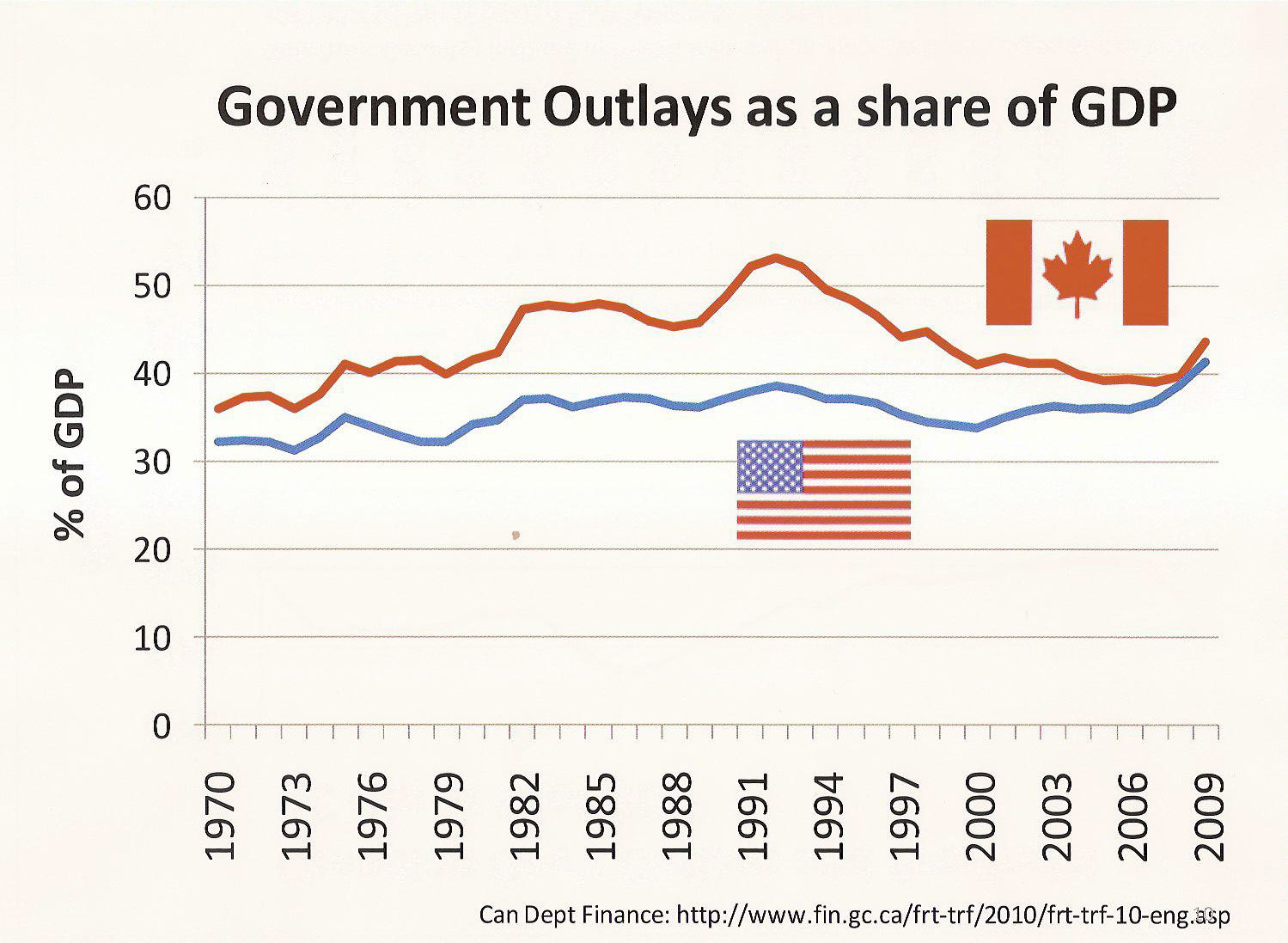
Long thought to have more generous social programs, Canadians have historically spent more of their economy on public services than Americans. In 2009 Canadians and Americans spent about the same percentage of their economy on government services.

Province adds $4.5 million to Muskoka Algonquin’s base funding

Unwilling to choose between its two remaining hospitals, the Muskoka Algonquin Healthcare board held firm in refusing to make cuts recently. Last week they were rewarded for standing by their community.

The province announced November 23 it was adding $4.5 million to MAHC’s bottom line this fiscal year, bringing the hospital to within $1.5 million of balancing their budget.

It is expected an additional $1.5 million will be included in the 2011-12 budget year.

Facing a $6 million shortfall, the Muskoka Region was fearful that one of the two hospitals – Bracebridge or Huntsville – would have to be downgraded to balance the budget.

OPSEU Local 380 President Barb Barry has played a key role in raising awareness about hospital cuts in the communities of Bracebridge, Huntsville and Burk’s Falls. Campaigning hard for the past three years, Barry has rallied the community to demand more funding rather than witness further devastating health care cuts.

South Bruce hospital board won’t eat the food either: OPSEU

CHESLEY, ON – The Board of Directors of the South Bruce Grey Health Centre met Nov. 24 in Chesley and, for the first time, ordered catered food from outside the facility. Staff members previously served home cooked meals from the hospital cafeteria at board meetings.

The union representing the food service workers says this demonstrates what its members have been saying about re-thermed food.

“No wonder the hospital CEO would not accept our challenge; the people who made this decision have no intention of eating the food themselves,” said Warren (Smokey) Thomas, president of the Ontario Public Service Employees Union.

Last month Thomas challenged hospital CEO Paul Davies to eat the food for a week. Although Davies declined the challenge, he did admit he would lose weight eating the food. In conjunction, OPSEU made a donation of $1,000 to the four hospital foundations.

Yesterday the hospital announced that they will no longer be microwaving the food, which they say was often overcooked or undercooked. The hospital says it will be moving to a convection-style oven system for Chesley and Durham which have converted to the re-thermed food structure.

“This is yet another setback for a system that was badly flawed from the start,” said Thomas. “The members have been doing their best in trying circumstances, but they just couldn’t make this work.”

OPSEU says the hospital should scrap its plan completely and make use of Ministry of Agriculture grants to bring in fresh locally-grown food instead.

The union has not been officially informed of the change.