Category Archives: Health System

Canadian Medical Association seeks your input on health care transformation

The Canadian Medical Association (CMA) has launched a new website and is hosting town hall meetings to get input on the future of our health care system.

Representing 74,000 doctors across Canada, the CMA is trying to start a national dialogue prior to the 2014 expiry of the federal-provincial health transfer agreement.

Dr. Jeff Turnbull, CMA President, says they are asking three questions:

1. Should the Canada Health Act be expanded to include pharmacare and long term care?

2. What do citizens consider to be good value in their health care system?

3. What role should patients and their families play now and in the future?

The CMA’s web site is www.healthcaretransformation.ca

Dr. Turnbull’s video is below:

“Staff satisfaction in our sector is bad” – Devitt

“Generally speaking, staff satisfaction in our sector is bad,” says Rob Devitt, CEO of the Toronto East General Hospital. Speaking at a Longwood’s Breakfast with the Chiefs forum November 23rd, Devitt and Dr. Josh Tepper, Assistant Deputy Minister (HealthForce Ontario) were invited to address the issue of healthy work environments, from policy to practice.

While winning a Great Places To Work Award, Devitt said when comparing against bad it’s easy to look good. He said that when his hospital looked at leading private sector employers who had taken the award, they were shocked at how poorly they stacked up.

 Devitt said while there isn’t always agreement, “organized labour has a lot of good ideas.”

The CEO highlighted the turnaround at his own hospital, including quarterly staff satisfaction surveys, conducting threat assessments, establishing an on-site gym and wellness center for staff, and developing a mental health wellness strategy.

Devitt says he is resisting every temptation to cut these programs in difficult economic times given the results, which include measured increases in productivity and reduced sickness and lost time.

“There’s such an important and wonderful focus on patient safety and quality of care,” Tepper told the forum. “I would argue the healthy work environment  — the well-being of our front line care providers is the flip side of the same coin. You cannot truly have a quality agenda for patient-centered care without have a healthy work environment strategy.”

 This forum is available on video at http://www.longwoods.com/audio-video

Health care workers face many obstacles going into new round of bargaining

As the 2009-2011 round of bargaining comes to a close and the last of the arbitration awards covering this period are released, health care workers across the province are preparing for a new round of bargaining with their employers. Already, workers face an uncommon barrage of nasty attacks on many fronts from government, Hospital CEOs and the Ontario Hospital Association. To fend off these attacks, workers will need to campaign together to educate the public and stand up for the future of healthcare.

The government’s present wage restraint legislation exempts unionized workers, but Finance Minister Dwight Duncan said public sector employers would not receive additional funding to pay for wage increases. For health care employers, this does not necessarily mean a freeze in what they receive in public funding. This year all health care sectors received a total of $2.6 billion more in funding. Next year the rate of increase will be slowed to $1.9 billion, and $1.5 billion in the following year.

The Ontario Hospital Association has been openly advocating for changes to HLDAA, including placing limits on arbitration awards. Windsor Regional Hospital CEO David Musyj has been vocal in the media, claiming he can’t afford the recent two and 2.5 per cent OPSEU arbitration award. This is despite the fact the province gave his hospital an increase of more than 4.5 per cent last year. It is clear hospital CEOs like Musyj are advocating for a legislated outcome.

While public sector workers are fighting off the government’s attempt to diminish their standard of living through wage freezes, the same cannot be said for those at the top, who continue to rake in excessive bonuses.

In the financial sector bonuses are definitely back – this despite the role that sector played in triggering the latest recession. In the U.S. the average Wall Street bonus increased by 25 per cent in 2009. Experts say the real value is more like 30 per cent when the non-cash portion of the bonus is considered. On this side of the border, Canadian bankers paid themselves $8.3 billion in bonuses for 2009 — just a year after the Harper government helped the banks weather the recession with $75 billion in public money.

Bonuses will likely increase again in 2010 for executives at Ontario’s largest companies. Ontario continues to roll back corporate taxes, placing greater profits in the hands of investors and top executives. When the corporate tax cuts are fully phased in, Ontario will hand corporations a gift amounting to $2.4 billion per year. Ontario corporations already pay among the lowest rates of taxation in the industrialized world.

For families of public sector workers, costs are going up and wages are remaining relatively stagnant. The McGuinty government has warned that electricity rates alone will go up 42 per cent by 2015. The HST is also increasing costs on many items by 8 per cent – including energy bills.

Donating the equivalent of $500 per household to Canada’s largest and most successful corporations while attempting to freeze the wages of more than one in three Ontario workers is a bad idea and will only further polarize the growing gap between the wealthy and the rest of us. The Canadian Centre for Policy Alternative recently reported the top one per cent of Canadians pocketed 32 per cent of all income growth from 1997 to 2007. This is the highest level of wealth concentration in Canadian history.

The good news is there are several things you can do.

If you belong to OPSEU’s Hospital Professionals Division (HPD), the executive is running a “Tax cuts or health care?” campaign to highlight the choices that are being made at Queen’s Park. They are speaking to locals and handing out bumper magnets and buttons to get the conversation started. HPD Locals are being asked to visit their MPPs in the new year. You can see a video about the campaign at:

OPSEU is also running a central campaign that is demanding a stop to the $2.4 billion corporate giveaway. You can see for yourself how much money you would be losing in the event of a wage freeze by going to

http://www.opseu.org/campaign/stopthewagefreeze/calculator.htm

After you calculate your loss, you can send an e-mail to your MPP at:

http://www.opseu.org/campaign/stopthewagefreeze/december-3-2010.htm

There is also a video about this campaign —

US spends more on public health care than Canada — CIHI

The Canadian Institute for Health Information has recently updated its National Health Expenditure Trends (1975-2010).

It’s the first time we are able to look at actual numbers for 2008.

Here’s some highlights that may surprise you:

The United States actually spends more than Canada on public health care as a percentage of the size of the economy. Canada spent 7.3 per cent of GDP on public health care, the U.S. 7.4 per cent. In other words, if the US adopted Canada’s model of health care, it is currently spending enough to cover all of its citizens. Canada is 10th out of 26 select countries in public health care spending. When private spending is included, Canada is ranked 6th out of 26.

Our current annual growth rate likely reflects the need to catch-up from the period of 1991 to 1996, when government restraint reduced the average annual growth rate to less than one percent. From 1996 to 2008 reinvestment in the health system took the annual growth rate to 3.6 per cent per year. From 1975 to 1991 annual growth was 2.6 per cent. All measurements are in constant 1997 dollars.

Is health care spending out of control? According to CIHI, the real rates of increase after adjusting for inflation are expected to be 1.6 per cent in 2009 and 1.4 per cent in 2010. In 2008 real growth was 3.3 per cent.

Ontario spends more on private health care than any other province. 32.6 cents of every health dollar is spent privately, compared to 22.1 cent in Newfoundland or 22.7 cents in Saskatchewan.

Hospitals continue to decline as a share of health expenditures. In the mid-1970s hospitals represented about 45 per cent of total health expenditure and 56 per cent of provincial expenditure. In 2008 Canadians spent 28.7% of total health expenditures on hospitals. It is expected to dip slightly to 28.6 per cent in 2009 and come back up to 28.9 per cent in 2010.

Total per capita health expenditures – public and private – in Canada was $5,154 in 2008. It is forecast to grow to $5,397 in 2009 and $5,614 in 2010.

More to come!

Rachlis says Canadians can fix Medicare by completing it

Dr. Michael Rachlis has got a great story to illustrate the folly of the current hysteria around health care spending. He talks about a family where one of two sons has died. The remaining son is told the family can no longer afford to feed him because he now takes up 33 per cent of the family’s food, compared to 25 per cent of the food when his brother was alive.

Rachlis told an Ottawa meeting of NUPGE’s Canadian Health Professional Secretariat November 25th that public health care spending is only slightly higher than its previous peak in 1992. When the economy shrinks in a recession, health care appears to consume much more as a percentage of that economy. Like the surviving son, it has little to do with increased costs and much to do with the economy it exists within.

As Canada recovers from the recession, already health care spending is decreasing as a share of the economy.

However, there is more to the story than the ups and downs of the Canadian economy.

Since 2000, taxes have been cut by 5.3 per cent of the size of the Canadian economy. That means there is $85 billion less available each year for all public services, including health care. “What if you only cut taxes by half that amount?” he asks. “Imagine what we could with $40 billion more each year?”

Rachlis has heard the stories of how health care is taking money away from poverty reduction, housing and other important social objectives. While health care is continually accused of “eating everybody else’s lunch,” he says, the actual facts tell a different story. Health care spending has slightly increased its share of provincial program spending since the late 1990s. This is mainly due to cuts in other areas rather than increases in health care spending. In the past eight years health care has remained relatively static as a percentage of provincial program spending across Canada. This is contrary to government-led hysteria that suggests 70-80 cents of every health care dollar will soon be consumed by health care spending.

While the United States continues to stand out for its high health care costs, Canada’s spending is comparable to other wealthy nations. Spending in France, Switzerland, Germany and Austria is slightly more than Canada’s. Belgium, Portugal, Netherlands, New Zealand, Denmark and Sweden are slightly less.

Rachlis says we should be proud of Medicare and its principles – but the job is yet complete. Tommy Douglas warned that the second phase would be much more difficult to implement.

“We should acknowledge that there are problems with Medicare,” Rachlis says, “but these problems are because it has never been fully implemented.”

Few Canadians know that the original vision of Medicare went well beyond public payment for the old system. The original vision of Medicare included new ways of delivering care.

Models based on group practice and integration of public health care have been shown also to be cost-effective.

Rachlis says Canadians still believe strongly in Medicare. “We believe strongly all Canadians share access to health care.”

He says immigrants tell him that they chose to come to Canada because of Medicare.

This graph shows public spending has gone from 6% of GDP to just over 8% in 30 years. The last upturn reflects the shrinking of the economy in the latest recession, not a large increase in spending. The dotted line shows where spending would trend had the growth in the economy remained stable -- below 8%. This is hardly the image of health care spending out of control. The level of growth has been particularly flat during the last decade.


Canadian provincial program spending as a percentage of GDP. Public spending on health care has been relatively flat for 30 years. Declines in non-health care expenditures owe more to the impact of tax cuts that increases in health care spending.


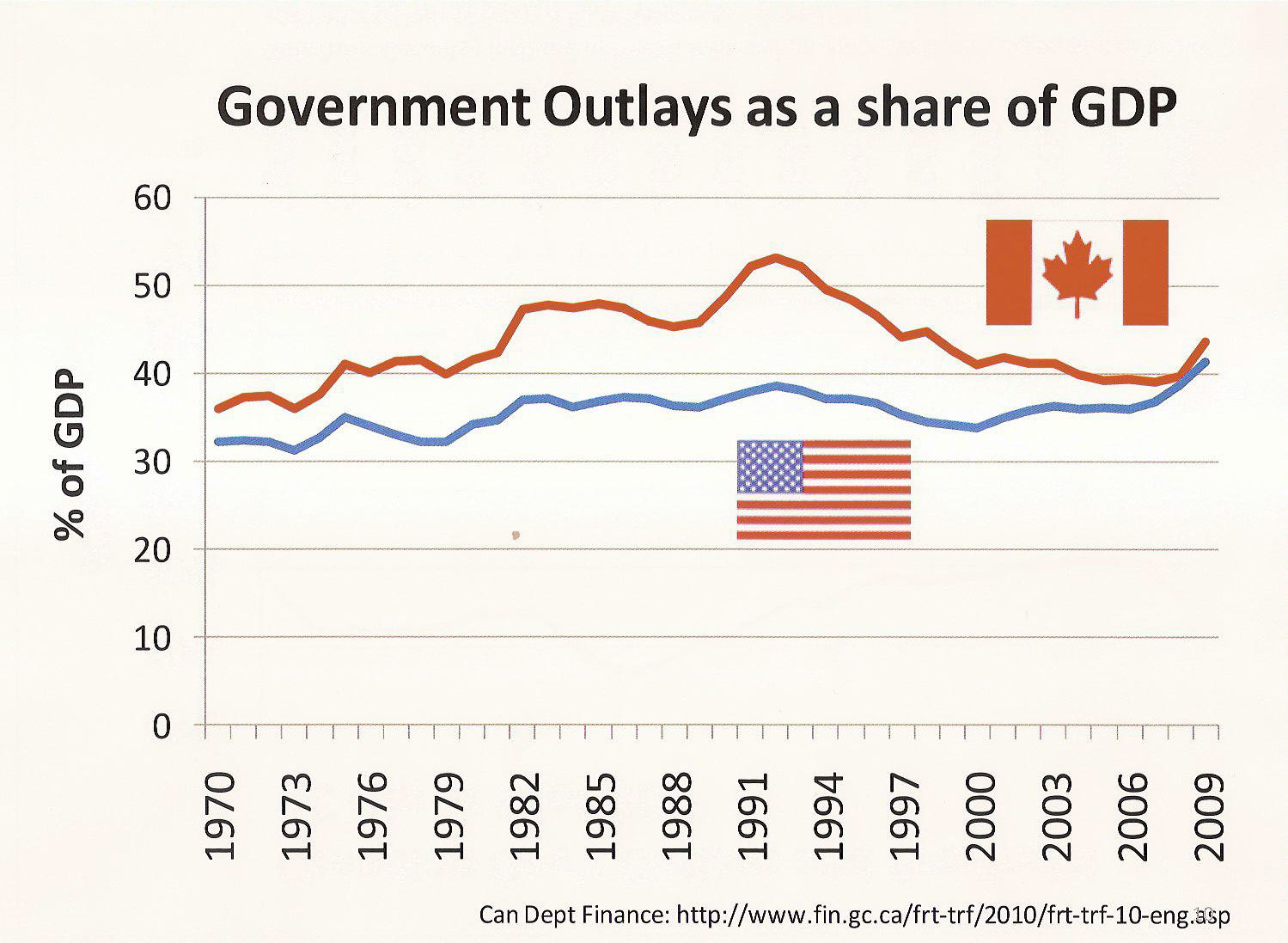
Long thought to have more generous social programs, Canadians have historically spent more of their economy on public services than Americans. In 2009 Canadians and Americans spent about the same percentage of their economy on government services.

Video: Saskatchewan draws attention to health professionals

The NUPGE affiliated Health Sciences Association of Saskatchewan has launched a television campaign highlighting the role of health professionals.  The theme is “hidden heroes” :


National Medicare Week — Letters to the PM

It’s National Medicare Week this week. The Canadian Health Coalition is using social media to encourage supporters to write to Prime Minister Harper to urge the federal government to enforce the Canada Health Act. So far the campaign has generated thousands of letters.

The letter reads:

This week is National Medicare Week and I urge you to use the occasion to show federal leadership on health care.

There are serious problems that need to be urgently addressed, including lack of access to timely care, home and continuing care, and affordable prescription drugs.

Further, you have stood idly by as provinces de-listed services, allow extra-billing by physicians, and permit the selling of medically-necessary diagnostic services and queue-jumping. I expect your government to uphold its legal duty and enforce the Canada Health Act in these well documented violations.

I call upon you to celebrate National Medicare Week by enforcing the Canada Health Act. I also call on you to secure Medicare for future generations by committing to adequate federal funding, and initiating a national public drug plan (Pharmacare) that will save billions while providing Canadians with better access to prescription drugs.

Mr. Prime Minister, defend our health care system. Stand up for Medicare.

To send your letter, go to:

 http://medicare.ca/defend-health-care-letter/langswitch_lang/en

Flaherty non-committal to future CHT increases

Federal Finance Minister Jim Flaherty gave an economic update recently that hinted towards adjusting the Canada Health Transfer after 2014.  

With the CHT renewal up in 2014, Jim Flaherty has hinted the formula may be changed to match inflation combined with economic growth. Over a projected three year period this could mean as much as $5 billion less transferred to the provinces.

Under the 10-year Federal-Provincial agreement, Canada’s Health Transfer to provinces increases by 6 per cent per year.  Paul Martin’s government signed  the federal-provincial-territorial Health Accord with the intention to “heal health care for a generation”.

Any changes that would reduce federal contributions would contradict the Harper government’s pledge in the 2010 budget to maintain equalization payments to have-not provinces and not to cut health care or social services.

Conservative Quebec MP Maxime Bernier has broken ranks suggesting the CHT agreement should be scrapped and replaced with the equivalent tax cut to each province.

Bernier told the Globe and Mail that instead of sending money to the provinces, Ottawa would cut its taxes and then the provinces would use the vacated fiscal room. “Such a transfer of tax points to the provinces would allow them to fully assume their responsibilities without federal control,” he said.

Critics say basing health care funding on fiscal capacity would be a regressive move that would leave provinces and territory health care funding based solely on their ability to generate income. 

The creation of transfer payments was intended to eliminate the disparity between have and have-not provinces and territories. Delivery of health and social services would solely rely on the provinces or territories income ability.

If Bernier’s idea gains traction it would end the principal of fiscal equity between provinces and territories in Canada.

Ontario deflects auditor’s criticism on use of consultants with new Act

The Ontario government unveiled the Broader Public Sector Accountability Act on the same day the Ontario auditor released his report into the use of consultants by Ontario’s Ministry of Health, the Local Health Integration Networks (LHINs) and Ontario’s public hospitals.

The Act addresses many of the criticisms leveled by the auditor in his October 20th report and once again promises to bring hospitals under Freedom of Information legislation.

Ontario auditor Jim McCarter said his office found too many examples where consultants were engaged on a sole-source basis, where significant increases in the initial fee estimate and follow-up work were repeatedly awarded, and where there was inadequate oversight to ensure consultants delivered on time and on budget.

One of the auditor’s recommendations is that the Ministry actually follow existing procurement requirements.

McCarter also said that billings for fees and expenses were not properly monitored and supported, giving the example of one hospital which paid a lobbyist $170,000 in expenses between 2007 and 2009. When the hospital asked for receipts to support the expenses, they were told that supplying the receipts would entail a $3,000 service charge.

Of 16 hospitals looked at by the auditor, half of them had paid consultants to lobby for more funding, a practice the auditor called a “questionable use of funds provided to hospitals for clinical and administrative activities.”

The new act would bring in new standards for hospitals, Community Care Access Centres and LHINs – in fact any broader public sector organization that receives more than $10 million in government funding would be included. The new rules will apply to school boards, colleges, universities, hydro entities, Children’s Aid Societies and more.

Other requirements under the Act include

  • A requirement for hospitals and LHINs to post expenses of senior executives on-line
  • Require hospitals and LHINs to report annually on their use of consultants
  • Ban the use of public funds to hire external lobbyists (own-source funding for lobbying is still permitted)

Video: OPSEU Street Theatre at Ontario Liberal AGM

Video of last Friday’s OPSEU Street Theatre outside the Ontario Liberal AGM in Toronto.  When fully implemented, the annual cost of corporate tax cuts will be greater than all new funding to health service providers this year.