Category Archives: Uncategorized

Home care – it’s critical we get it right this time

Ontario’s Community Care Access Centres could have been very different had events unfolded differently in the early 1990s.

At the beginning of that decade home care was considered to have more of a leg in social services than health care.

The Rae government, like those that followed, were attempting to transition services from hospital to community and realized the potential of home care to look after patients discharged early from hospital.

The NDP were also sensitive to complaints that health care policies were being decided by the provider community, not by the users of the system. To that end, they not only encouraged widespread consultation, but even funded groups – particularly those representing seniors and the disabled – to speak to their communities and report back on what they heard.

That process was massive, involving more than 75,000 people, 110 provincial associations, 1,800 submissions and nearly 3,000 public meetings – all taking place within a five month window.

While the previous Peterson government had preferred more of a brokerage model – similar to today’s CCAC model which contracts to for-profit and not-for-profit agencies – the consultation process demonstrated that there was little appetite for a system most believed to be bureaucratic and fragmented.

Continue reading

Matthews seeks to enhance nursing home inspections – how about enough inspectors to get the job done?

For more than 30 minutes a resident of The Wexford went on a rampage, roaming the halls of the Scarborough long-term care facility, battering one woman before leaving his own floor and heading upstairs to kill another.

It wasn’t the first time that this resident had been involved in a violent assault at the home. A psychiatrist had assessed the resident as a chronic risk to others and recommended he be placed in a psychiatric group home better suited to manage his behaviour.

Despite a scathing Ministry report on the incident, the last time The Wexford had undergone a detailed inspection by the Ministry of Health was 2009.

Last year Health Minister Deb Matthews had said homes that generated few complaints or critical incidents would not likely undergo such an inspection, since the new resident quality inspection (RQI) regime would only apply to those homes that raised the most red flags.

Continue reading

Aborted Sudbury plan expected ALC patients to pick up tab for convalescent care

The Ontario government has always maintained that getting alternative level of care patients out of hospital is so much more cost-effective than having costly beds tied up with patients who have essentially finished their acute care treatment but are otherwise unable to go home.

The question is, cost-effective for whom?

This week a proposal to set up a 25-bed convalescent unit at a Sudbury retirement home fell through when Health Sciences North (formerly the Sudbury Hospital) learned that standards around convalescent care would actually apply to a convalescent unit. Imagine that?

By applying those standards, the convalescent unit would actually cost $1.4 million – money the hospital says it doesn’t have.

Northern Life says Dave McNeil, Health Sciences North’s vice-president of clinical services, told the newspaper that it was hoped the unit would cost between $300,000 and $800,000 a year to run, depending on the patient’s ability to contribute financially to their care.

In short, they were contemplating patients picking up as much as $500,000 of that tab for what would clearly be substandard care. Assuming the 25 beds were full 365 days a year, that would amount to a levy of about $55 a day. A two week stay would therefore cost about $770 without any extras.

On the other hand, if the patient were medically unable to be discharged from hospital, their care would be ordinarily covered under our Medicare system and guaranteed under the Canada Health Act.

Continue reading

Diluted chemo drug scandal — why was this ever contracted out?

It looked for a while that Marchese Hospital Solutions’ explanation for the diluted chemotherapy drug bags may have had legs, suggesting there was miscommunication between hospital purchasing agent Medbuy and Marchese over the use of the product.

Marchese claimed it was their understanding that the bags of chemotherapy drugs they were preparing were to be administered as a single dose entirely to one patient, when in fact the contents of the bags were being used for multiple doses.

Appearing before a Ontario legislature committee probing how 1200 cancer patients received diluted doses of chemotherapy, Anne Miao, director of pharmacy for rival corporation Baxter, told the committee that Marchese’s explanation was far-fetched.

According to today’s Toronto Star, Miao told the committee that dosage is based on the patient’s surface area, and “a four gram dose to be used as a single-patient dose, using a standard five foot 10 inch tall patient, you’re looking at a patient of over 900 pounds.”

Continue reading

Health care sustainability: evidence shows this debate should have been long over

Over the weekend CPAC was playing excerpts from two conferences – one on drug coverage the other on health care sustainability.

The first, Rethinking Drug Coverage, was held in Ottawa May 24-25 and was co-hosted by the Canadian Health Coalition and Carleton University. Most of the sponsors were public sector unions.

The second, the Western Summit on Sustainable Health Care, was hosted May 23 by the Conference Board of Canada in Edmonton. The Conference Board  claims to be “objective and non-partisan” but mostly reflects the interests of Canada’s business class. Most of their conference sponsors were corporations.

Despite the recent decline of health care as a percentage of both the size of the economy and provincial spending, the Conference Board took to the podium with the same “sky is falling” rhetoric we’ve heard for the past five years on sustainability.

Do these people really have no shame?

Last October the Canadian Institute for Health Information noted: “For the third straight year, growth in health care spending will be less than that in the overall economy. The proportion of Canada’s gross domestic product (GDP) spent on health care will reach 11.6% this year—down from 11.7% in 2011 and the all-time high of 11.9% in 2010.”

While former TD economist Don Drummond and others were projecting health care to eat up most of the provincial budget, Ontario is spending 41.8 cent of every program dollar on health care this year, down from 43 cents in 2009-10.

Now that the data doesn’t really support the notion that health care is going to rise to be 70-80 per cent of provincial budgets and crowd out education and social programs, the Conference Board is getting far more creative in how it bends the truth to scare us into accepting their ideas about reform.

Continue reading

Obesity rates rise – will Ontario implement the recommendations of its own panel?

Obsesity is on the rise in Canada. From the Health Council of Canada Progress Report 2013.

Obsesity is on the rise in Canada. From the Health Council of Canada Progress Report 2013.

Health prevention is one of those hands down winners. You ask people about health care reform, and almost everyone believes that moving health issues upstream has the potential to reduce costs for the health system.

In the Health Council of Canada’s progress report for 2013, they note that when it comes to public health, we have too few objectives and measures to evaluate our successes or failures. No kidding.

Health promotion was supposed to be a key narrative in the health accord signed between the provinces and federal government in 2004. That accord is about to expire in October of next year.

One measure they do have is the prevalence of obesity.

Clearly obesity is a major factor for public health, yet the results between 2003 and 2011 are disastrous. Almost every province and territory has seen a rise in obesity. Only the Yukon saw a decline.

Continue reading

More “transformation” — 53 jobs cut at Peterborough Regional

Peterborough’s regional hospital  is losing more staff positions.

The good news is the hospital administration isn’t at least pretending these new cuts are about “transformation” of the health system as the Health Minister and Premier have repeatedly claimed elsewhere.

The government’s ongoing funding freeze to base hospital budgets means 53 more positions are being eliminated in Peterborough, many of these already vacant positions. In 2010 Peterborough eliminated close to 300 full-time equivalent positions to deal with a mounting deficit and meet its accountability obligations to the Local Health Integration Network.

The Peterborough Regional Health Centre’s board chair told the Peterborough Examiner “when you are getting 0% increases and you have to absorb inflation and other cost increases plus pay off our debt, it’s getting tougher every year.”

In his pre-election report in 2011, the Auditor General of Ontario described the government’s decision to limit health care funding increases to 3.6 per cent as “aggressive,” suggesting it would lead to a choice between hospital deficits and cuts to services. A 3.6 per cent increase now seems like the Halcyon days in this province, overall health care budget increases now limited to 2 per cent. None of that 2 per cent is applied to hospital base budgets, the government instead maintaining the fiction that it is being instead reallocated in the community as part of that “transformation.”

Continue reading

Losing four psychiatrists at Grand River may very well be carelessness

Oscar Wilde’s character Lady Bracknell says in The Importance of Being Earnest: “to lose one parent may be regarded as a misfortune … to lose both seems like carelessness.” Does the same apply to psychiatrists?

Kitchener-area residents in need of outpatient psychiatric support for their children may very well be quoting Wilde these days.

The Grand River Hospital has lost not one, not two, but four psychiatrists recently, requiring the hospital to restrict outpatient psychiatric care for children and adolescents to the most acute cases. It has also lost two clinical managers according to an on-line source in the community.

Usually when an exodus like this takes place, you need not look much further than management of the facility for the reasons why, but Grand River claims the docs are leaving for personal reasons.

A spokesperson for the hospital said one is leaving to be closer to family, another for professional opportunities, and a third is expanding a community practice. In all, Grand River has 16 psychiatrists on staff (not all full-time), some of which are being required to “switch over” to the children’s unit.

Continue reading

Linda McQuaig for Mayor?

Linda McQuaig speaking at the Older Canadians Network forum Wednesday at Toronto City Hall.

Linda McQuaig speaking at the Older Canadians Network forum Wednesday at Toronto City Hall.

Linda McQuaig couldn’t resist. Standing at the Mayor’s podium at the Toronto City Hall council chambers, she told the Older Canadians Network: “I have never smoked crack cocaine.”

Linda McQuaig for Mayor?

The author (The Trouble with Billionaires w/Neil Brooks) and journalist compared the recent Senate scandal to the U.S. Watergate scandal that led to the impeachment of President Nixon. While in Canada we may not have had a burglary, we did have the involvement of the highest office in the land in “an attempt to stop an investigation that was an embarrassment to government,” she said.

On hand for the presentation of the Alexander Gorlick Humanitarian Award to former Parliamentary Watchdog Kevin Page, McQuaig criticized the Harper government for shuffling off the Senate scandal investigation to ethics commissioner Mary Dawson, who is now going to conduct her investigation in secret.

McQuaig said she particularly liked Page because he publicly raised questions of accountability around austerity programs, which had an enormous impact on Canadians.

“He exemplifies the best of the public service and the best of Canadians,” she said of the now unemployed budget officer.

McQuaig says the best way to understand that a better more equitable society is possible is by simply looking to the past.

She asked who in the room had been borne since 1980?

Continue reading

“My office will start to unravel” – former federal budget watchdog Kevin Page

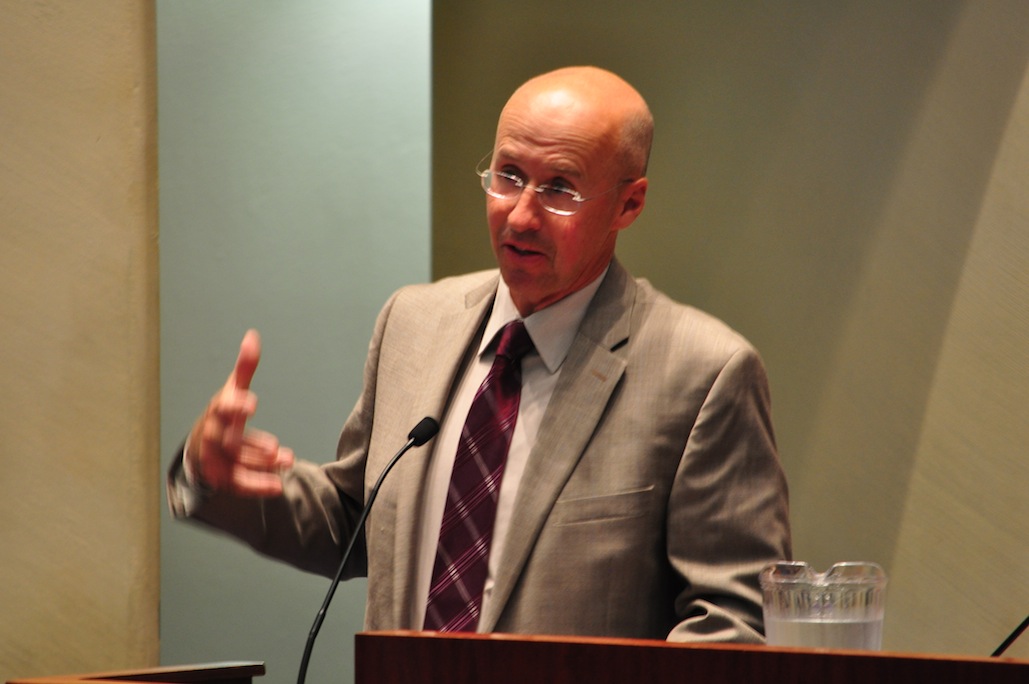
Former budgetary watchdog Kevin Page speaks about the bumpy ride he had during an open forum hosted by the Older Canadians Network.

During an open forum hosted by the Older Canadians Network, former federal budgetary watchdog Kevin Page speaks about the bumpy ride he had in office.

Federal Conservatives sure liked to talk about accountability while in opposition. In power? Not so much.

Kevin Page, Canada’s first parliamentary budget officer, said no governments want more accountability. It’s not even a partisan issue.

That puts a budget watchdog in a very difficult situation.

While appointing Page to the job to fulfill his own election promise, Stephen Harper made the appointment at the “pleasure” of the Prime Minister’s office, not that of Parliament.

Appearing in Toronto Wednesday to accept a humanitarian award from the Older Canadians Network, Page said the appointment by the PM’s office meant he could be removed from office at any time by the Prime Minister’s office – a major flaw in the design.

The legislation creating the parliamentary budget watchdog never protected for what Page calls “analytical dissonance.”

When he was first appointed five years ago, opposition members on committees just assumed he was the “PM’s guy.”

Continue reading