Category Archives: Uncategorized

Guidelines for media reporting of suicide need reconsideration – Picard, Goldbloom

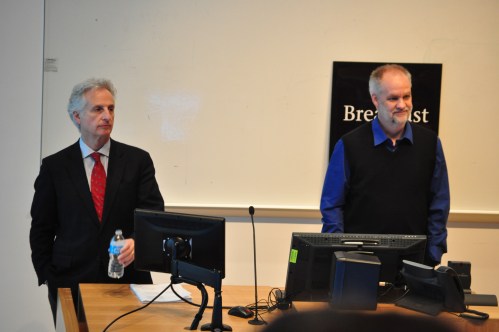
David Goldbloom and Andre Picard speak about media guidelines for suicide coverage.

Dr. David Goldbloom and Andre Picard speak about media guidelines for suicide coverage as part of a December 12th Longwood’s Forum.

If the audience was expecting a debate, they may have left disappointed.

Globe and Mail reporter Andre Picard and Dr. David Goldbloom, Chair of the Mental Health Commission of Canada, spoke about the media’s portrayal of mental health during a Longwood’s Breakfast with the Chiefs forum December 12.

While billed as being about mental health, much of the discussion centered around whether media reporting of suicide prompts copycat actions.

The issue is particularly timely given the Vancouver School Board has challenged the media in its reporting on the death of Amanda Todd, the teen who took her life after experiencing on-line bullying. The Board has suggested the media follow guidelines established by the Canadian Psychiatric Association for reporting on suicide.

Picard challenged the science used by the CPA to establish the guidelines and suggested that the “hush hush” attitude towards suicide actually created more stigma.


Continue reading

If public sector workers have it so good, how come private sector firms dominate best employer lists?

The Canadian political elite really needs to be much more consistent in their propaganda. They like to whip up antipathy towards public sector workers suggesting they are overpaid and pampered, but they may have overlooked that strategy recently in the rush to give themselves a pat on the back.

Ontario PC leader Tim Hudak uses such sentiment to advocate for public sector wage freezes and more recently has set his sights on attacking modest public sector pension plans.

Hudak is banking on a policy of reducing the modest pension incomes of seniors as a vote getter. Good luck with that, Tim.

But if things were indeed so cushy for public sector employees, you’d think public sector employers would absolutely dominate year-end best employer lists, especially given these lists are made up by the same media conglomerates that peddle this anti-public sector message.

On Monday the Globe and Mail published its top 20 list of Canada’s top family friendly firms for 2013.

Continue reading

Who should you trust? Former PC advisor shills in the Star for private health care

Francesca Grosso says she is an established expert in health care policy. A former PC health care policy director, her day job these days is a principal at Grosso McCarthy, a public affairs company for hire.

So when she writes in the opinion pages of the Toronto Star, as she did on Sunday (What’s Behind The Attack On Clinics?), who is she really shilling for? Who paid for this?

The piece itself is full of misinformation about private delivery of health care, a situation that might be embarrassing to her professionally given her claims to expertise.

She argues that private clinics are getting a bad rap as a result of a Toronto Star series that reveals nine private clinics failed a quality inspection by the College of Physicians and Surgeons.

Continue reading

Tory MPP Hillier supports cuts to hospital in his own constituency

Tory MPP Randy Hillier is the Rob Ford of rural Ontario. He often makes headlines for all the wrong reasons.

His hatred of unions seems to be trumping common sense these days. Hillier recently wrote an editorial in the local media aligning his views with those of Health Minister Deb Matthews. Whereas most MPPs would stand up for their local hospital, Hillier is supporting deep cuts to the Perth and Smiths Falls District Hospital most likely because it is the local unions that are raising the alarm. It will be interesting to see how this plays out with an election likely on the horizon for 2013.

Hillier has bought Matthew’s inaccurate assertion that hospital cuts simply represent a transfer of services to community-based providers. We see Matthews’ interest is saving her own skin amid the obvious effects of austerity on Ontario’s health care system, but what’s in it for Hillier?

Perhaps Hillier should have a conversation with his own caucus members. Last year fellow Tory MPP John O’Toole characterized the government’s “Home First” initiative as the “Home Alone” initiative during a visit by the Ontario Health Coalition. Have they had a last-minute conversion to the Liberal cause?

Continue reading

Half of Ontario hospitals admit to recent outpatient physiotherapy cuts

The last time the government granted a license to operate a OHIP designated physiotherapy clinic was 1964. This is the alternative government now wants patients to turn to after hospital-based outpatient physiotherapy is eliminated – an almost forgotten system leftover from 50 years ago.

The Designated Physiotherapy Clinics Association (DPCA) gives us a glimpse into the significant number of Ontario hospitals that are reducing access to outpatient physiotherapy services. The DPCA received back 120 surveys of Ontario hospitals in October 2011 and found 50 per cent had reduced outpatient physiotherapy services within the last two years. Further, another 16 per cent indicated that they had planned to do so before the end of that year. This is a significant policy shift with little to no public discussion.

The survey information was part of a DPCA press release this week. Faced with significant cuts to hospital physiotherapy, the DPCA proposes to pick up some of the slack, offering to soldier on at $12.20 per visit for another two years and even help out the CCACs with home care at $60 per visit – half of what they say the present costs are by contract home care agencies.

There are 94 of these designated OHIP clinics in Ontario and distribution reflects the population as it existed in 1964, not 2012. The City of Mississauga, for example, had a population of 156,070 in 1971 (it didn’t become incorporated until 1968). It has no OHIP designated physiotherapy clinics today despite a 2011 census population of more than 700,000 residents. On the other side of Toronto, Oshawa has three such clinics with a population of about 150,000.

Continue reading

The Lean Debate – A “Wicked Disease”

John Seddon, a British occupational psychologist, has been a lightning rod for Lean promoters (which he refers to as “tool-heads) over his criticism of Lean.

Seddon bases his own work on Taiichi Ohno, the father of the Toyota Production System that Lean is also based on.

Seddon argues that industrial processes don’t adapt well to the service sector, where standardization often gets in the way of meeting the need for a variety of approaches, calling Lean a “wicked disease.”

“Lean as ‘tools and projects’ appeals to managers,” writes Seddon in one of his newsletters. ”Managers think they know what their problems are and they think tools training and projects will be useful. Managers like the idea (promoted by the lean tool-heads) that services should be standardized (big mistake). If they do get improvement it is marginal, often they end up worse but they don’t know because they are still measuring the wrong things (lean tool-heads don’t question targets or activity measures for example, indeed they don’t question management philosophy).”

Continue reading

Family Council Network Four launches long term care letter/petition campaign

Tired of broken promises on long-term care?

The Family Council Four Network – the largest of Family Council Networks in Ontario – is organizing a letter writing/petition campaign to improve long-term care.

The Council is asking that Ontario:

  • Immediately increase the number of paid hours of nursing and personal care per resident per day to 4.0 hours – as was promised in 2008;
  • Develop a plan to phase-in future increases to 5.0 hours by January 2015;
  • Establish a licensing body, such as a college, that will develop a process of registration, accreditation and certification for all Personal Support Workers (PSWs).

The Council argues that present PSW training is inconsistent and insufficient to deal with higher physical, psychological and emotional needs of residents.

If you support these goals, you can download a draft letter and petition at:

http://www.familycouncilmembers.net/wordpress/?p=1303

SBGHC: Small, rural, and looking to find $622,000

When the province introduced its new hospital funding formula, it specifically highlighted its intention not to subject small rural hospitals to it.

Evidently when the Minister meant small, she meant very small.

South Bruce Grey Health Centre is reporting that the new hospital funding formula means they will be facing a $622,000 shortfall next year.

SBGHC is made up of four very small hospital sites in Walkerton, Durham, Kincardine and Chesley. With four hospitals, it’s total budget is about $41.7 million, of which $29.5 million comes directly from the Ministry of Health (another $6.3 million comes in MOH physician funding).

The community makes the argument that had these four hospitals not been amalgamated, they would not be subject to this punitive funding formula.

Continue reading

“The practice of tyrants?”

Earlier this week we noted that evidence supporting the efficacy of flu shots specifically for health care workers has been weak.

Much of the anti-flu shot sentiment is based on a number of reviews by the Cochrane Collaboration (CC). The CC is a respected non-profit network of 28,000 people over 100 countries that produce reviews to help decision-makers make evidence-based decisions on health care.

The CC has turned out a number of papers on the efficacy of flu shots as a preventative measure in health care settings.

What the reviews most commonly state is that there is little research free of bias (that is, not sponsored by vaccine companies who have an interest in the outcome) to come to any evidence-based conclusion. Cochrane notes the specific need for high-quality randomized trials.

Continue reading

NUPGE Video: Canada has become a radically unequal country

Our colleagues at NUPGE have put together this excellent video on income inequality as part of their All Together Now campaign. In just six minutes the video provides an analysis on why divisions in Canada are deepening and why trust is disappearing. Please share with others!