Diluted chemo drug scandal — why was this ever contracted out?

It looked for a while that Marchese Hospital Solutions’ explanation for the diluted chemotherapy drug bags may have had legs, suggesting there was miscommunication between hospital purchasing agent Medbuy and Marchese over the use of the product.

Marchese claimed it was their understanding that the bags of chemotherapy drugs they were preparing were to be administered as a single dose entirely to one patient, when in fact the contents of the bags were being used for multiple doses.

Appearing before a Ontario legislature committee probing how 1200 cancer patients received diluted doses of chemotherapy, Anne Miao, director of pharmacy for rival corporation Baxter, told the committee that Marchese’s explanation was far-fetched.

According to today’s Toronto Star, Miao told the committee that dosage is based on the patient’s surface area, and “a four gram dose to be used as a single-patient dose, using a standard five foot 10 inch tall patient, you’re looking at a patient of over 900 pounds.”

Continue reading

Health care sustainability: evidence shows this debate should have been long over

Over the weekend CPAC was playing excerpts from two conferences – one on drug coverage the other on health care sustainability.

The first, Rethinking Drug Coverage, was held in Ottawa May 24-25 and was co-hosted by the Canadian Health Coalition and Carleton University. Most of the sponsors were public sector unions.

The second, the Western Summit on Sustainable Health Care, was hosted May 23 by the Conference Board of Canada in Edmonton. The Conference Board  claims to be “objective and non-partisan” but mostly reflects the interests of Canada’s business class. Most of their conference sponsors were corporations.

Despite the recent decline of health care as a percentage of both the size of the economy and provincial spending, the Conference Board took to the podium with the same “sky is falling” rhetoric we’ve heard for the past five years on sustainability.

Do these people really have no shame?

Last October the Canadian Institute for Health Information noted: “For the third straight year, growth in health care spending will be less than that in the overall economy. The proportion of Canada’s gross domestic product (GDP) spent on health care will reach 11.6% this year—down from 11.7% in 2011 and the all-time high of 11.9% in 2010.”

While former TD economist Don Drummond and others were projecting health care to eat up most of the provincial budget, Ontario is spending 41.8 cent of every program dollar on health care this year, down from 43 cents in 2009-10.

Now that the data doesn’t really support the notion that health care is going to rise to be 70-80 per cent of provincial budgets and crowd out education and social programs, the Conference Board is getting far more creative in how it bends the truth to scare us into accepting their ideas about reform.

Continue reading

Obesity rates rise – will Ontario implement the recommendations of its own panel?

Obsesity is on the rise in Canada. From the Health Council of Canada Progress Report 2013.

Obsesity is on the rise in Canada. From the Health Council of Canada Progress Report 2013.

Health prevention is one of those hands down winners. You ask people about health care reform, and almost everyone believes that moving health issues upstream has the potential to reduce costs for the health system.

In the Health Council of Canada’s progress report for 2013, they note that when it comes to public health, we have too few objectives and measures to evaluate our successes or failures. No kidding.

Health promotion was supposed to be a key narrative in the health accord signed between the provinces and federal government in 2004. That accord is about to expire in October of next year.

One measure they do have is the prevalence of obesity.

Clearly obesity is a major factor for public health, yet the results between 2003 and 2011 are disastrous. Almost every province and territory has seen a rise in obesity. Only the Yukon saw a decline.

Continue reading

More “transformation” — 53 jobs cut at Peterborough Regional

Peterborough’s regional hospital  is losing more staff positions.

The good news is the hospital administration isn’t at least pretending these new cuts are about “transformation” of the health system as the Health Minister and Premier have repeatedly claimed elsewhere.

The government’s ongoing funding freeze to base hospital budgets means 53 more positions are being eliminated in Peterborough, many of these already vacant positions. In 2010 Peterborough eliminated close to 300 full-time equivalent positions to deal with a mounting deficit and meet its accountability obligations to the Local Health Integration Network.

The Peterborough Regional Health Centre’s board chair told the Peterborough Examiner “when you are getting 0% increases and you have to absorb inflation and other cost increases plus pay off our debt, it’s getting tougher every year.”

In his pre-election report in 2011, the Auditor General of Ontario described the government’s decision to limit health care funding increases to 3.6 per cent as “aggressive,” suggesting it would lead to a choice between hospital deficits and cuts to services. A 3.6 per cent increase now seems like the Halcyon days in this province, overall health care budget increases now limited to 2 per cent. None of that 2 per cent is applied to hospital base budgets, the government instead maintaining the fiction that it is being instead reallocated in the community as part of that “transformation.”

Continue reading

Losing four psychiatrists at Grand River may very well be carelessness

Oscar Wilde’s character Lady Bracknell says in The Importance of Being Earnest: “to lose one parent may be regarded as a misfortune … to lose both seems like carelessness.” Does the same apply to psychiatrists?

Kitchener-area residents in need of outpatient psychiatric support for their children may very well be quoting Wilde these days.

The Grand River Hospital has lost not one, not two, but four psychiatrists recently, requiring the hospital to restrict outpatient psychiatric care for children and adolescents to the most acute cases. It has also lost two clinical managers according to an on-line source in the community.

Usually when an exodus like this takes place, you need not look much further than management of the facility for the reasons why, but Grand River claims the docs are leaving for personal reasons.

A spokesperson for the hospital said one is leaving to be closer to family, another for professional opportunities, and a third is expanding a community practice. In all, Grand River has 16 psychiatrists on staff (not all full-time), some of which are being required to “switch over” to the children’s unit.

Continue reading

Linda McQuaig for Mayor?

Linda McQuaig speaking at the Older Canadians Network forum Wednesday at Toronto City Hall.

Linda McQuaig speaking at the Older Canadians Network forum Wednesday at Toronto City Hall.

Linda McQuaig couldn’t resist. Standing at the Mayor’s podium at the Toronto City Hall council chambers, she told the Older Canadians Network: “I have never smoked crack cocaine.”

Linda McQuaig for Mayor?

The author (The Trouble with Billionaires w/Neil Brooks) and journalist compared the recent Senate scandal to the U.S. Watergate scandal that led to the impeachment of President Nixon. While in Canada we may not have had a burglary, we did have the involvement of the highest office in the land in “an attempt to stop an investigation that was an embarrassment to government,” she said.

On hand for the presentation of the Alexander Gorlick Humanitarian Award to former Parliamentary Watchdog Kevin Page, McQuaig criticized the Harper government for shuffling off the Senate scandal investigation to ethics commissioner Mary Dawson, who is now going to conduct her investigation in secret.

McQuaig said she particularly liked Page because he publicly raised questions of accountability around austerity programs, which had an enormous impact on Canadians.

“He exemplifies the best of the public service and the best of Canadians,” she said of the now unemployed budget officer.

McQuaig says the best way to understand that a better more equitable society is possible is by simply looking to the past.

She asked who in the room had been borne since 1980?

Continue reading

“My office will start to unravel” – former federal budget watchdog Kevin Page

Former budgetary watchdog Kevin Page speaks about the bumpy ride he had during an open forum hosted by the Older Canadians Network.

During an open forum hosted by the Older Canadians Network, former federal budgetary watchdog Kevin Page speaks about the bumpy ride he had in office.

Federal Conservatives sure liked to talk about accountability while in opposition. In power? Not so much.

Kevin Page, Canada’s first parliamentary budget officer, said no governments want more accountability. It’s not even a partisan issue.

That puts a budget watchdog in a very difficult situation.

While appointing Page to the job to fulfill his own election promise, Stephen Harper made the appointment at the “pleasure” of the Prime Minister’s office, not that of Parliament.

Appearing in Toronto Wednesday to accept a humanitarian award from the Older Canadians Network, Page said the appointment by the PM’s office meant he could be removed from office at any time by the Prime Minister’s office – a major flaw in the design.

The legislation creating the parliamentary budget watchdog never protected for what Page calls “analytical dissonance.”

When he was first appointed five years ago, opposition members on committees just assumed he was the “PM’s guy.”

Continue reading

Ombudsman would be ideal party to resolve London’s toilet cleaning claims

Oh come on now. Attending question period at Queen’s Park can be an exercise in frustration as the opposition’s questions and the government’s answers seldom align.

You can ask anything you want, but it doesn’t necessarily mean the government will provide you with an answer that remotely addresses it.

Yesterday NDP Leader Andrea Horwath asked the Premier about an 80-year old patient at the London Health Sciences Centre who says he was told to clean his toilet.

Joseph Cummins was not just any patient – he is a retired professor of genetics at Western University and knows about hospital-acquired infections.

According to today’s Toronto Star, Cummins wandered out into the ward looking for someone to clean the bathroom he shares, at first finding no professional staff on the ward. Cummins admits to having had a mishap after being given a strong laxative and wanted to ensure it was cleaned up.

Continue reading

Even the wealthy can be impacted by the negative health effects of austerity

At first it was a mystery. How was it that during an excessively dry and hot 2007 summer that cases of West Nile disease had jumped in Bakersfield California by 276 per cent?

Dry weather is not normally associated with an abundance of mosquitos, which are transmitters of the disease from birds to humans.

Laboratories confirmed 140 cases in Bakersfield, a city of more than 800,000 in Southern California.

According to researchers at the University of California, aerial photography of the city showed something unusual – a high number of algae blooms in private swimming pools, hot tubs and ornamental ponds. One photograph showed 17 per cent of visible pools and hot tubs appearing green and likely producing mosquitos.

It turns out that Bakersfield was also at the epicenter of mortgage foreclosures, the downturn in the housing market leading to a 300 per cent rise in mortgage delinquencies.

Dr. William K. Reisen, a research entomologist with the Center for Vectorborne Diseases, had his team knock on the doors of these homes and found no one living there. The pools, hot tubs and water features were essentially abandoned and had become breeding grounds for the mosquitos.

The story, featured in a new book, The Body Economic: Why Austerity Kills by David Stuckler and Sanjay Basu, reminds us that we are ultimately all in this together.

Continue reading

Canada could have universal drug coverage without raising taxes – Morgan

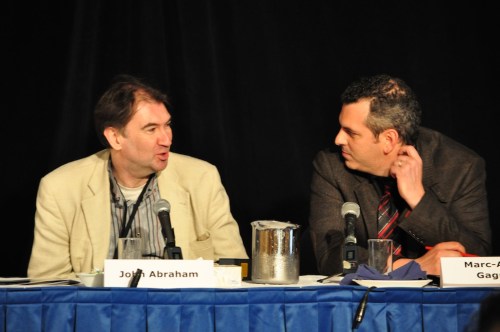
The UK's John Abraham on a panel with Carelton University's Marc Andre Gagnon.

The UK’s John Abraham on a panel with Carleton University’s Marc Andre Gagnon.

10 things we learned from last week’s Ottawa conference on drug coverage hosted by the Canadian Health Coalition and Carleton University:

1. The University of British Columbia’s Steven Morgan noted that if Canada were to adopt the UK’s public drug plan without any changes, it would “be enough to pay for universal Pharmacare in Canada at current rates. We would not have to increase taxes.” Carleton University’s Marc Andre Gagnon says Canada could save $10.7 billion on pharmaceutical costs with a universal drug plan. The question is not can we afford universal drug coverage, but can we afford not to?

2. We’ve reported in several posts on how Canada and the U.S. are outliers when it comes to a universal drug plan for our citizens. This has been the case for a very long time. The international panel noted many countries adopted universal access to prescriptions shortly after World War II. France adopted its social insurance system in 1945 while Britain was a few years behind in starting the National Health System in 1948, quickly adding prescriptions to it in 1952. More recent Scotland, Wales and Northern Ireland abolished all prescription charges, whereas England charges about 5 per cent co-pay on the cost of drugs in its Pharmacare program.

3. New Zealand has among the lowest drug costs in the world. They do this by placing a cap on total drug spending and making pharmaceutical companies bid on a share of that pie. The drawback is it does tend to slow the speed in which expensive new drugs become available, but does succeed in providing universal access to needed medications. There is a small co-pay of about $5 per prescription. There is no co-pay after 20 prescriptions are filled annually. There is practically no private coverage for pharmaceuticals in New Zealand. According to Matthew Brougham, former CEO of PHARMAC, New Zealand has been able to limit the increase in drug pricing over the last decade to 3 per cent per year compared to 9-10 per cent increases worldwide. While Canadian politicians claim they cannot afford to introduce Pharmacare, New Zealand adopted such a system precisely because the country was in dire economic circumstances.

4. The lack of universal drug coverage in Canada has not been for want of evidence or trying. Dr. Joel Lexchin of York University noted in his opening remarks that the Hall Commission recommended it in 1964, the National Health Forum did so in 1997, and it is now policy for both the federal Liberals and NDP. Lexchin says Canada’s Pharmaceutical policy resembles the U.S. health care system – some private coverage, some public, and a lot of people who have nothing. “This is not a pie in the sky scheme,” he said, noting Saskatchewan formerly had universal drug coverage.

Continue reading