Retraction

On April 8 and 9, 2013, the Ontario Public Service Employees Union (“OPSEU”) published statements on news wire websites, OPSEU’s website, and certain blog websites, regarding Procom Consultants Group Ltd. (“Procom”).  The statements accused Procom of impropriety with respect to purported bargaining with OPSEU.  OPSEU confirms and accepts that the contents of the statements were untrue of Procom. 
 
OPSEU regrets any damage or harm that may have been caused to the reputation and integrity of Procom and hereby unequivocally and unreservedly retracts all the allegations in the aforesaid statements about Procom and apologizes to Procom.
The Federal Health Minister is not Steve Outhouse

Where is Leona Aglukkaq? Do you know who Leona Aglukkaq is? Perhaps you are more familiar with Steve Outhouse?

He’s the spokesperson every time the Federal government is called upon to respond to a rather embarrassing issue related to Canada’s health care. In fact, he is Leona Aglukkaq’s Director of Communications. Aglukkaq is technically Canada’s Minister of Health. At least that’s who Prime Minister Stephen Harper appointed to the role.

It’s almost like the Harper government is afraid to let the real health minister out in public.

The non-elected Outhouse was the face of the Federal government when Swiss pharmaceutical manufacturer Sandoz abruptly reduced production in Boucherville Quebec and left Canadian hospitals scrambling for intravenous drugs.

Outhouse was again the spokesperson when Sandoz had to recall 57,000 vials of injectable morphine after a heart drug was found to have been mistakenly packaged with the painkiller. That mistake was found by a hospital, not Health Canada. Whoops.

When Dr. Yoni Freedhoff complained publicly about her invisibility in the role, calling her one of Canada’s worst health ministers, the National Post reported “through her staff, Ms Aglukkaq calls the allegation of invisibility unfounded.” Did the reporter really type that with a straight face?

Continue reading

A tangible response to physiotherapy cuts – the province finally adds community capacity

After significantly cutting outpatient physiotherapy at hospitals across Ontario, the government is finally putting something back.

The Ministry of Health says it is making a major investment in community-based physiotherapy, exercise classes and falls prevention services that will benefit up to 218,000 more Ontarians.

The Local Health Integration Networks (LHINs) will receive $10 million more for falls prevention and exercise classes – giving them an ability to serve 68,000 more seniors. This is in addition to $44.5 million to provide physiotherapy in community-based settings that will increase capacity to 90,000 more seniors and “eligible patients.”

These community-based settings could include Family Health Teams, Nurse-Practitioner led clinics and Community Health Centres.

Long term care homes will get the biggest share — $68.5 million for one-on-one physiotherapy with seniors in their care.

Community Care Access Centres are also to receive $33 million to reduce the wait list for in-home physiotherapy, giving them the capacity to add up to 60,000 clients.

Oddly the Ministry’s release suggests that “until now, a small number of for-profit companies have had almost exclusive control over the delivery of publicly-funded physiotherapy.”

Huh?

Did they forget about the 50 per cent of hospitals that recently cut outpatient physiotherapy services?

Continue reading

Harper cuts funding to Health Council of Canada – will the provinces step in?

The Health Council of Canada’s days may be numbered. A creation of the 2003 10-year health accord between the provinces and the federal government, the Harper government has indicated that the Council will go the way of the Accord itself – into history – unless someone else decides to fund it.

The question is: will the provinces see value in maintaining the Council after the Accord is complete?

If you are expecting to see your taxes cut or the federal deficit to be reduced by shuttering the Council’s offices, don’t hold your breath. The most recent Annual Report from the Council indicates expenditures of about $5.7 million. This is  relatively small change given Canada spends more than $200 billion on both public and private health care. Having an actual roadmap is not an entirely bad plan.

The Council is very much the creature of its participants – each provincial and territorial government appointing their own representative. The Ottawa Hospital CEO Jack Kitts is Ontario’s appointee and serves as the Council’s chair.

The Council therefore tilts towards what the provinces want it to tilt towards. In recent years it’s been all about “health care renewal.”

Continue reading

Kingston votes 96 per cent against hospital privatization

Kingston City Council's Jim Neill urges residents to vote on Princess Street.

Kingston City Council’s Jim Neill urges residents to vote on Princess Street.

It had all the trappings of an election. There were lawn signs, TV commercials, and door-to-door campaigners. The local media solicited the views of both politicians and citizens as everyone scrambled to become informed before the vote.

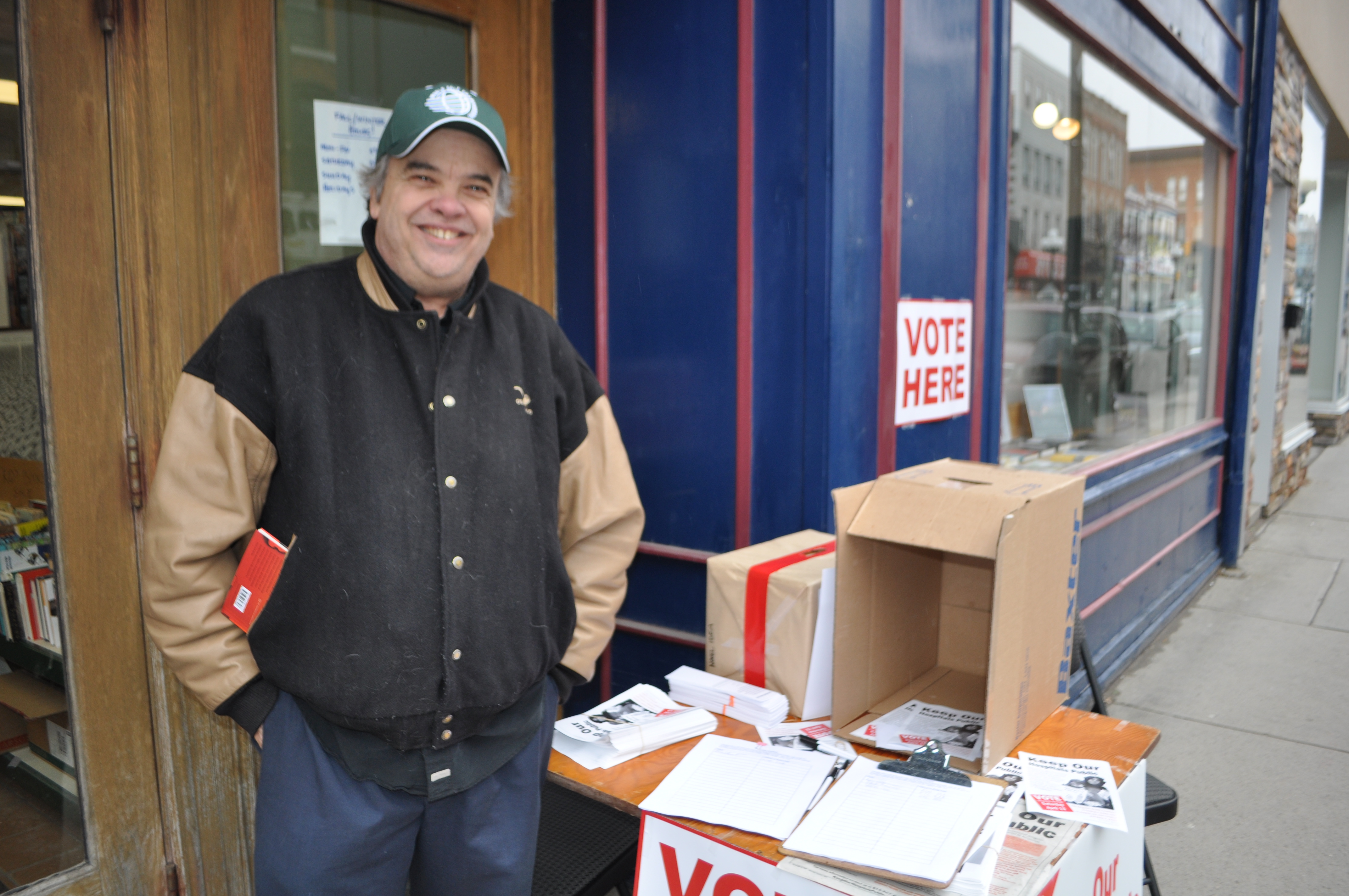
Saturday Kingston residents got the opportunity to express their preference on whether a proposed new hospital facility in their community was going to be entirely public or be under a 30-year finance and maintenance contract with a private for-profit consortium.

While this election wasn’t conducted by Elections Ontario or Elections Canada, it had the feeling of being the real deal. Citizens were given the opportunity by the Ontario Health Coalition to consider a private or public option even if the result will be non-binding.

After five weeks of public debate, the answer was clear. 96% of the 9,885 votes cast at more than 50 polling stations said yes to keep the new hospital entirely public.

We have had one “official” election on this issue before. In the 2003 provincial election Dalton McGuinty opposed privatizing public infrastructure, campaigning against two “public-private partnership” (P3) hospital deals set up by then Premier Ernie Eves.

Like the results in Kingston, in 2003 the public instinctively bridled against the idea of privatizing key elements of Ontario’s public infrastructure. It helped give McGuinty the first of his two back-to-back majorities. Ontarians were already aware of what a bad deal the province got from privatizing Highway 407. They were worried about the impact of deregulation and privatization of electric power, particularly after a devastating outage in August of that year that took out much of the continental northeast.

Continue reading

Canadians to get an opportunity to express views on paid plasma donations

Health Canada is going to give Canadians the opportunity to express their views on paid plasma donations soon.

April 10 stakeholders selected by Health Canada took part in a round table discussion over the issue of increasing paid donation in Canada.

Health Canada is waiting for a report of that meeting before opening their website to feedback on this issue.

At present almost all blood donations in Canada are voluntary. However, the issue has generated headlines recently over a proposal by a private for-profit company to operate paid donation centers in both Toronto and Hamilton.

Canadian Blood Services (CBS) does admit that while all its collections are voluntary, it does also source plasma from the United States where the donations are both paid and unpaid.

In the 1980s Canada was importing blood products generated from paid donation at an Arkansas prison. While the US FDA banned use of prison blood in the United States, it had no problem approving it for export to other countries. Canada’s tainted blood scandal had its roots in those paid blood donations when it was found the Arkansas prison blood was infected with both HIV and Hepatitis C.

Continue reading

Kingston to cast vote on public hospital Saturday

This Saturday residents in the Kingston area will get a chance to have their say on whether the planned new psychiatric/rehab hospital will be entirely public.

While the vote is non-binding, a large turnout by those wishing to keep their hospital public will send a clear message to Queen’s Park.

The Ontario government is planning to replace St. Mary’s Of The Lake and Providence Care (formerly the Kingston Psychiatric Hospital) with a new public-private partnership hospital (P3). The proposal is for a 30-year contact with a private for-profit consortium that will include the design, build, financing and maintenance of the hospital.

It is the last two – 30-year financing and maintenance – that are the problem.

Corporations pay a much higher interest to borrow money, substantially raising the public cost of the hospital. Thirty-year maintenance gives the hospital less flexibility during tight economic times. That means the hospital is not in a position, for example, to put off new carpets for a year in order to keep a clinic open. Instead the clinic closes, and new carpets arrive.

A 30-year P3 contract also makes it far more difficult to adapt the building to emerging new technologies and transaction costs around the deal are enormous.

It is important that Kingston and area residents get out and vote. A limited number of advance polls are open tomorrow. 53 polling stations will be set up on Saturday, most in Kingston. However, there will be polls in the surrounding area, including Sharbot Lake, Ganonoque, Harrowsmith, Sydenham, and Amherstview.

If you would like to volunteer to assist with polls or to help get citizens to the polls, please contact the campaign office by clicking here.

Canadian children pay the price of austerity — report

Who pays for government austerity? A new report by UNICEF would suggest it is Canadian children.

Relative to other nations, Canada is stuck in the middle of 29 wealthy nations when it comes to the well-being of our children, and indicators particularly around health care and poverty are disturbing.

According to UNICEF’s most recent report card, Canada is 21st out of 29 for relative child poverty, 22nd for infant mortality, and 27th for the percentage who are overweight.

While the report suggests that at 17th Canadian children overall are doing relatively well, “we have too many children who are left out of public health efforts and who are not benefitting from their years of compulsory education by going on to further education.”

While children in poverty are most likely to be left out, the report notes that there are conditions affecting childhood in Canada that cut across all socioeconomic levels, stating we are raising children “in families squeezed for time as well as income.”

Children’s own impression of their well-being is startling – for that we rank in the bottom third at 24th. Only Eastern European nations fare worse. While children’s self-impression usually falls in line with the other indicators on the survey, that is not the case for Canada.

Continue reading

Perram House: Why health professionals increasingly don’t want to work in community agencies

The closure of eight downtown Toronto hospice beds is hardly creating buzz in the health care community. But it should.

Perram House hospice is not big enough to warrant major headlines, but it is symbolic of why the government’s policies around service transfers to community-based providers are so flawed.

Perram House gave its workers two days’ notice that the hospice will close on Wednesday. Up until this point, there was no indication that the operators were even considering closure. If you visit the Perram House website, as of this afternoon it still is promoting its services. There’s still a button to become a “friend” of Perram House. There’s still an endorsement from actor Eugene Levy, even if the internet link to the video doesn’t work anymore.

We don’t know when the Toronto Central LHIN found out about it, but they reported to us that three of the patients have been transferred to the Grace Hospital and two more are now at home in the hands of the Community Care Access Centre. They figure their job is done.

Eight hospice beds are now gone from the mix. This is not how health system planning is supposed to take place. There was no public consultation. There is no assessment of need. It is closing because the Perram House board has decided to do so.

Perram House’s board has offered no explanation for the sudden closure.

Continue reading

Given tax breaks, Royal Bank betrays public trust by replacing staff with foreign workers

If the McGuinty government is to be remembered for one thing, it’s the parade of bankers giving their advice on how to run government – including our public health care.

Former TD economist Don Drummond even did two assignments, first giving advice on health care “sustainability” and then given the larger assignment of providing a blueprint for the government to get out of its financial difficulties.

Given the financial services industry’s role in bringing down the world economy, it’s a little like inviting the arsonist to come back to discuss how to repair your torched house.

The parade extended beyond Drummond.

CIBC and Goldman Sachs were hired by the McGuinty government to give advice on selling off crown assets. The CEO of BMO Financial was asked to vette changes to social assistance. A top executive from Scotiabank was picked to run Infrastructure Ontario.

The banks were also the beneficiary of the blank cheque the government gave corporations in the form of across-the-board tax cuts. The phased in $2.5 billion in tax cuts were supposed to be about generating jobs in this province – that was the excuse — but there was no actual requirement to do so to benefit from this largesse. Instead, as we found out this weekend, the Royal Bank – the largest financial institution in Canada – was doing the opposite.

The very profitable Royal Bank was caught this weekend running a “pilot” project where it was bringing in – via a third-party – temporary foreign IT workers to be trained to take the jobs of 45 IT staff at RBC Investor Services. Incredibly, the training was to be provided by the Canadian workers the contract foreigners were to replace.

One of the non-union IT staff spoke to the CBC and in the process placed himself at enormous personal risk. A whistleblower at 60 years of age, his prospects for finding another job may be grim – especially in the financial services industry, and he may be also putting his severance at risk. We all owe him a debt of gratitude for exposing what many of us already suspected to be true – that corporate outsourcing was now creeping into the middle class and destroying even more jobs here in Canada.

It is no surprise that this is taking place in IT. With remote technology also becoming an increasingly part of the health care industry, there is every incentive for a growing for-profit list of Canadian health care providers to do the same. Their primary duty is not to care, but provide a return to shareholders.

Ironically while Canada is very particular about credentialing foreign doctors, Ontario has no problem with funding citizens to travel abroad to receive surgeries in places like India as part of a growing medical tourism industry. If health care workers think they are safe from similar outsourcing, they should think again.

The Royal’s excuse is rather lame. They claim that abiding by the rules around temporary foreign workers is the responsibility of their outsourcing contractor – iGate – not the bank. Yet clearly Royal knew that it was training these workers in their own Toronto offices with their own Toronto staff to clearly take the jobs of these staff members overseas. The temporary foreign worker program is supposed to fill gaps in the labour market, not displace workers presently in these jobs. iGate and Royal can hardly claim that these foreign workers have skills the Canadians do not possess when it is asking the displaced staff to train them.

Continue reading