Nicaragua Day 6: The Mayor cuts class to greet us

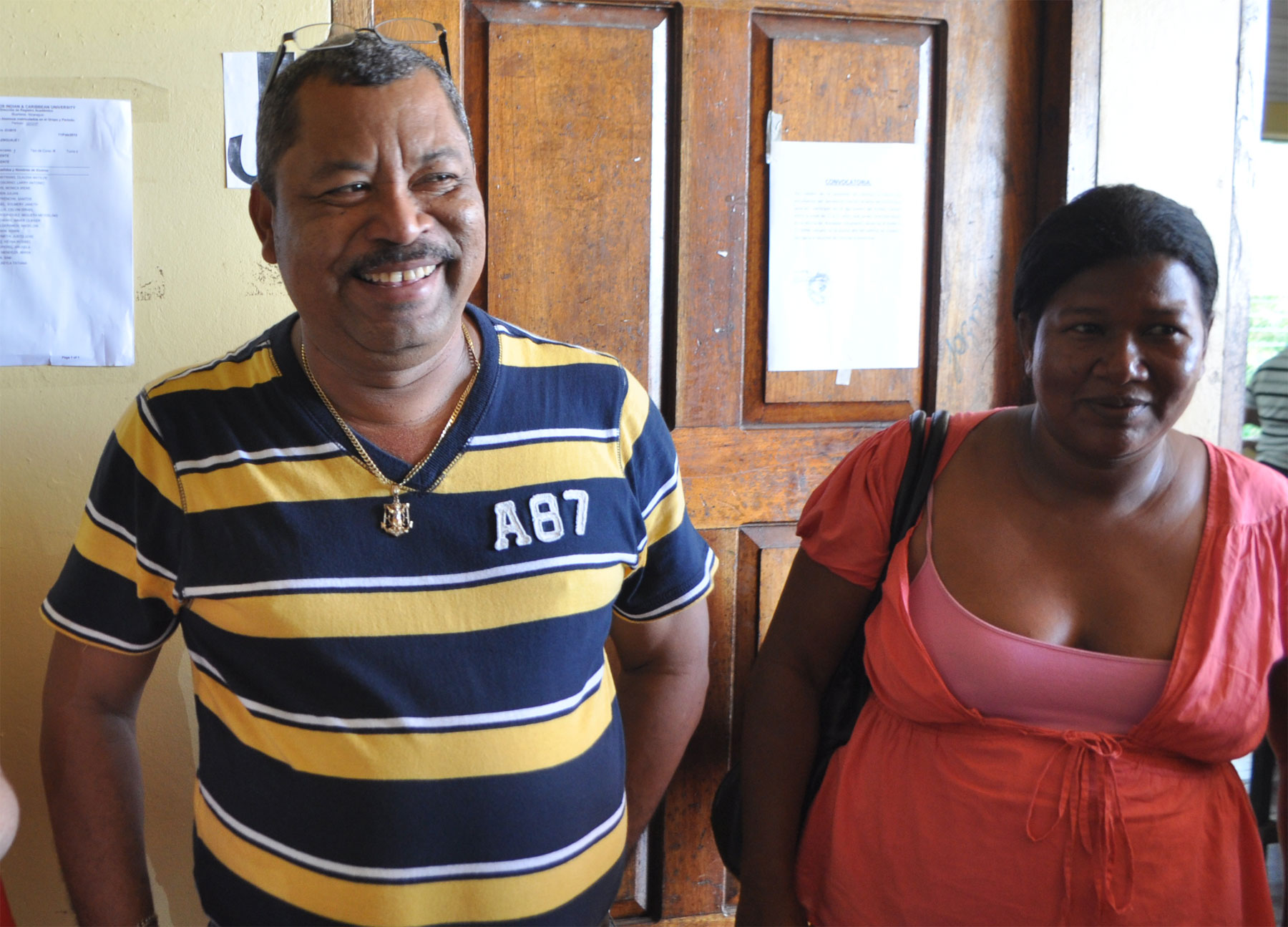
The Mayor of Puerto Cabezas (left) cuts out of class to greet us.

The Mayor of Puerto Cabezas (left) cuts out of class to greet us.

PUERTO CABEZAS – The Mayor of Puerto Cabezas came out of his Saturday law class to greet us in the hallway. As little kids sold us bags of fruit outside the classrooms, arrangements were made for a more formal audience before we left town. Today we were at the local campus of Bluefields Indian Caribbean University where among other things, they are trying to educate local leaders in the law.

The University sees itself as answering the needs of its region accommodating more than 2,500 students in their degree programs. Prior to 1992 no university existed in the Atlantic Coast of Nicaragua. Those with academic ambition had to travel to the Pacific coast to study. Given these are five-year programs, few professionals ever made their way back to Puerto Cabezas.

One official told us “you could count on your fingers the number of professionals” that worked in the region prior to 1992.

Continue reading

Day 5: The other Nicaragua

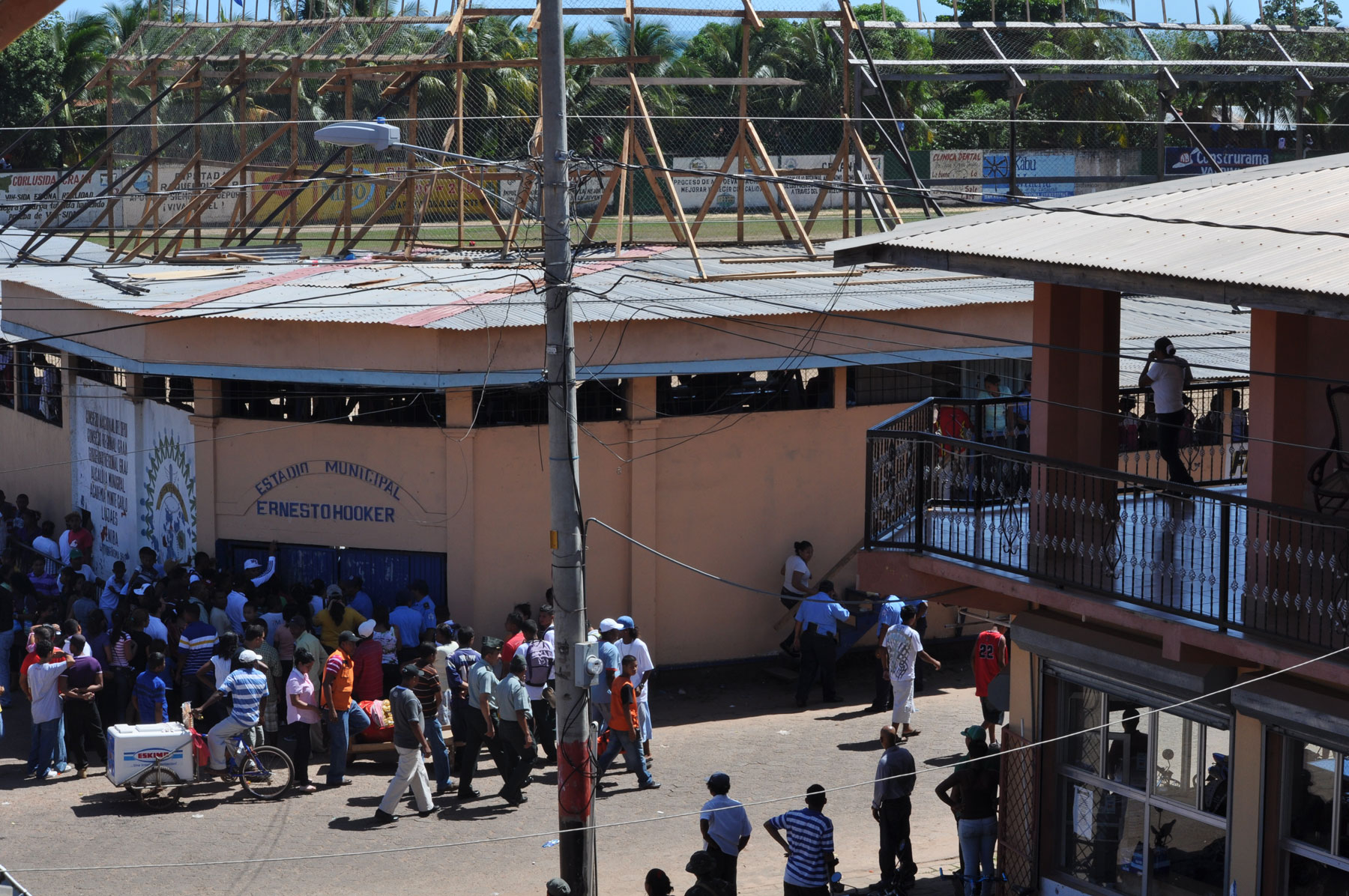
GAme day at the Puerto Carvaza ball park.

Game day at the Puerto Cabezas ball park.

PUERTO CABEZAS – The lobster fisherman of Puerto Cabezas don’t take boats out and cast traps in into the sea. Instead they take groups of men out in boats to dive into the sea to catch the lobsters by hand. It may be less efficient than their counterparts in Atlantic Canada, but it employs nearly 5,000 in this municipality of 320,000.

The problem is there are too many divers and the lobsters in the shallow waters have become less bountiful. That has pushed the divers into deeper waters. We were told that 1,400 divers have become ill from decompression illness. Some have died.

At the offices of the regional government we were told they were like to change the way fisherman gather lobster, but setting traps would employ many fewer in a region that already suffers from high unemployment. Like all Nicaraguan problems, this is one that will have to be solved over time. A new form of employment is needed for those that would be displaced by changing the nature of the fishery.

wordpress_flag_c

Puerto Cabezas is on the northern end of the Atlantic coast of Nicaragua. The colonial powers that have come and gone have left the residents speaking both Spanish and a Creole English in addition to the Miskitu language. It has also influenced the housing, a mix of Caribbean and Spanish styles, that is when the four walls aren’t made up of scrap wood and the roof a hunk of tin. Many of the homes here are up on stilts to avoid the flooding from hurricanes that sweep in from the Caribbean.

Continue reading

Nicaragua Day 4: Love and friendship on Valentine’s Day

A youth dance troupe performs for us at the Oscar Arnulfo Romero Community Centre in Nanaime.

A youth dance troupe performs for us at the Oscar Arnulfo Romero Community Centre in Nandaime.

NANDAIME – Valentine’s Day in Nicaragua is as much about friendship as it is love. Before the day was out, we would be finding both.

Nandaime is a quiet town of 40,000 residents – 20,000 in the so-called “urban area” – located south of Masaya. It fits the form of many other Spanish colonial towns built around an open square with the municipal building on one side and a church on the other.

In a country where people are continually in the streets, there were few people about town until the local high school emptied at about 11:30 am of the first shift of the day.

wordpress_flag_c

Education is a challenge in Nicaragua, and the local high school accommodates the local population by teaching three different groups per day in consecutive shifts.

You also notice that water runs through the streets of the town, turning into a significant flow on the street where the Oscar Arnulfo Romero Community Centre is located. Nandaime cannot afford a sewage system.

Continue reading

Nicaragua Day 3: And Then The Chicken Walked In

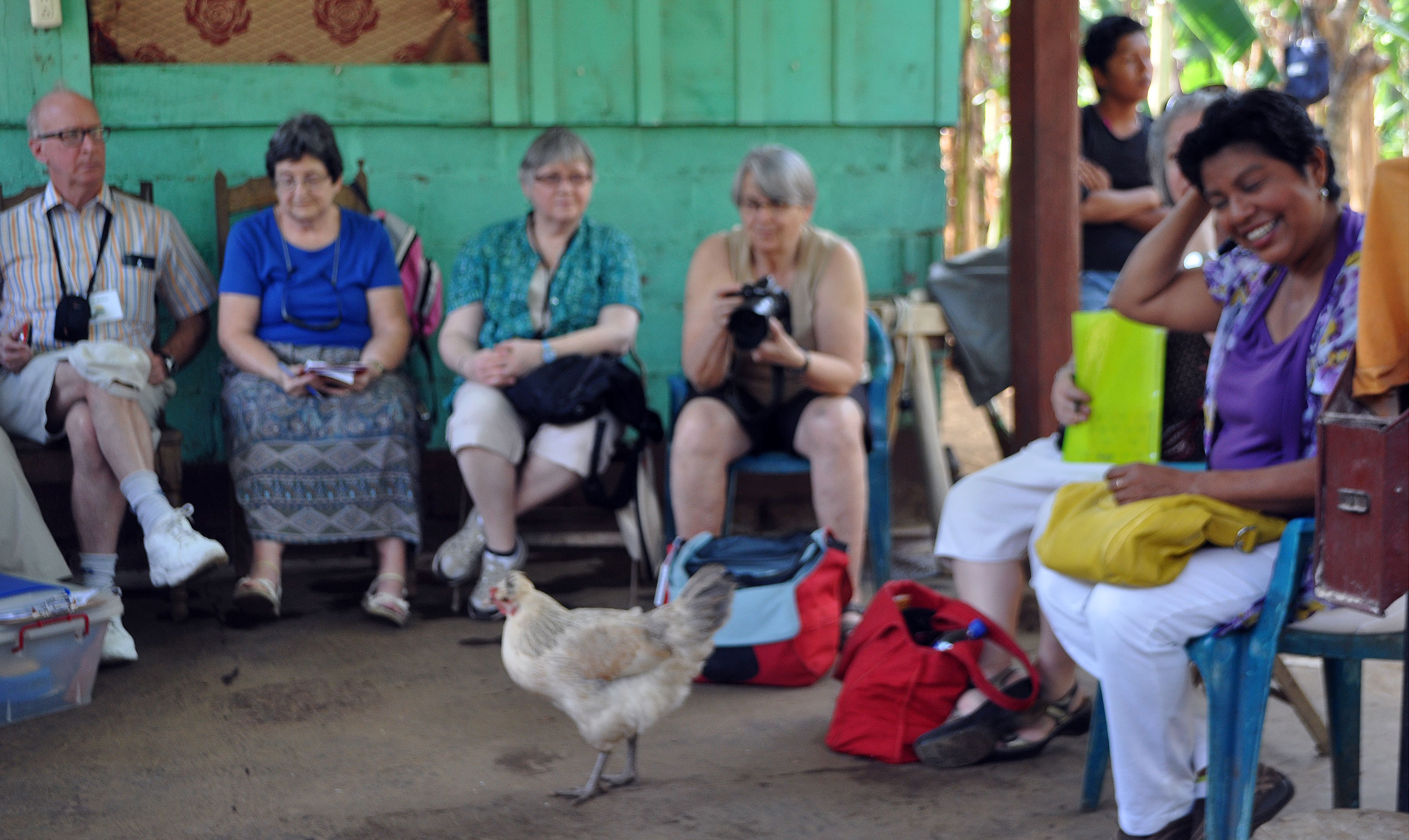
A chicken decided to crash our briefing from the Masaya women's co-op.

A chicken decided to crash our briefing from the Masaya women’s co-op.

MASAYA – It shouldn’t have come as any surprise when the large chicken joined the meeting, striding around as if waiting for her turn to talk.

After all the dog had already done his inspection, and the cat made a brief cameo prior to the chicks deciding they were going to make a crossing. Nobody seemed to mind.

We had travelled from the capital to Masaya to visit a former Horizons of Friendship partnership project that no longer needed Horizons. In the development world, that’s an outstanding success. Goal achieved.

wordpress_flag_c

Fifty-five women belong to the Masaya-based co-op that is involved with everything from mixed farming to embroidered clothes, artwork and producing dolls. The farm was just one site where we could see the co-op at work.

Gathered in a circle in an open shelter, several co-op members introduced themselves and talked about what the co-op meant to them.

Continue reading

No community involvement, details needed when cutting or transferring services to balance a budget

The Local Health Integration Networks were initially set up to involve communities in the decision-making process around delivery of regional health care.

We have witnessed health care providers, such as hospitals, coming forward to the LHINs with proposals to shift services, identifying how they engaged stakeholders in the planning process before coming forward with a plan for integration.

Recently we contacted the Champlain LHIN to ask if the same process is applying to the recently announced changes to service at The Ottawa Hospital, including the so-called “transfer” of endoscopies and cataract services to unidentified providers within the community.

Much to our surprise CEO Chantale LeClerc replied that no integration is triggered because the hospital was making these changes under the terms of its accountability agreement.

Continue reading

Nicaragua Day 2: A sense of persistence against tremendous odds

MANAGUA — The entire Managua tour bus erupted with laughter when the guide suggested that Canada was a balanced country.

The young Nicaraguan was trying to describe how Nicaragua had skittered from the “dictatorship” of Anastasio Somoza to the “dictatorship” of the Sandinistas. Canada was supposed to be a model of what his country truly needed – balance.

Yet he describes Daniel Ortega, recently re-elected in 2011 as Nicaragua’s President, as a champagne socialist who portrays himself as a “practical socialist.”

wordpress_flag_c

That practical side is raising eyebrows as the Sandinistas have a new slogan – Christianity, Socialism and Solidarity – a sign that the Sandinistas were finding new accommodation with the conservative Catholic Church. There is even a faith park near the National Palace with an obelisk commemorating the visit of Pope John Paul II.

Managua is an odd city. Scarred and scared by the 1972 earthquake that devastated the Nicaraguan capital, there are few high-rise buildings despite a population of 1.4 million people. The low-rise capital is spread out overlooking Lake Managua and a distant landscape of volcanos. The guide tells us that earthquakes are a regular part of life here, the ground under their feet rattling at least once a month.

The capital Managua.

The capital Managua.

It is also a young city, but different from our own. When wages are so low, the population doesn’t wander around staring at their smart phones. For most, things are decidedly low-tech here.

While the setting is dramatic, the city is far from attractive, much of the historic architecture that most cities exploit for tourism purposes lost to either natural disaster or revolution. While Nicaragua is a beautiful country, Managua is a visual blight in it.

Continue reading

Plan to radically remake Windsor hospitals

The Windsor Star suggests today that the city is likely to be reduced to one acute care hospital. Hotel Dieu and Windsor Regional have agreed to a partnership that will see all acute services delivered from the Regional. Hotel Dieu would be reduced to the status of an urgent care centre and primarily work on outpatient services. There will be no inpatient beds.

Hotel-Dieu will manage all non-acute programs and services currently offered by Windsor at its west-side Tayfour campus according to the newspaper.

It is interesting that the hospital is quick to note that this is not a hospital merger.

Eventually the two hospitals will be replaced by a large mega hospital. No worries about money when it comes to bricks and mortar. In Ontario this appears to be a bottomless supply.

Details of the proposal have been already sent to the LHIN and the province, which makes us question where the public fits into this scenario? Aren’t integration proposals supposed to show evidence of stakeholder consultation first? Yet clearly this announcement is coming as a big surprise.

Nicaragua Day 1: In the flash of this moment

“In the flash of this moment / you’re the best of what we are / don’t let them stop you now / Nicaragua.” – Bruce Cockburn (1984)

MANAGUA – Nearly 30 years ago I had lunch with Bruce Cockburn as preparation for a feature I was to write about the singer-songwriter’s tour of Guatemala and Nicaragua. Having lunch in the old Hotel Nova Scotian, I asked Bruce about his trip, and it was more than an hour before I got to ask the second question, not that I needed to ask any more.

While I did my best to tell his story of witnessing the early days of the Sandinista revolution and the horrors he learned of in Guatemala, he said it best himself with the album Stealing Fire. One minute he’s angrily pounding out “If I Had A Rocket Launcher,” the next stirring hope with “Nicaragua” or “Dust and Diesel.”

wordpress_flag_c

Cockburn was not the only pop culture artist to get swept up the aftermath of the Sandinista revolution. Rolling Stone magazine still considers the Clash’s “Sandinista” to be among the top 500 albums of all time. It seemed everyone was watching Nicaragua.

Thirty years on you don’t hear as much about this Central American nation wedged between Costa Rica to the south, El Salvador and Honduras to the north, bordered east and west by the Atlantic and Pacific Oceans. As part of my preparations to come here I spoke with someone at my bank, who wanted to know how one spelled ‘Nicaragua’ and where it was.

Continue reading

Hudak mental health white paper ignores existing national and provincial strategies

Earlier this week we were told that the Hudak PC’s were going to release a White Paper on Mental Health this Thursday.

While the paper is still not up on the PC website (as of Friday morning), the news media have suggested that the paper is primarily about building access to services for children and youth.

Wait a minute here – isn’t that exactly what Deb Matthews has been doing?

The headlines have so far been about a small percentage of children that are being treated out of country, amounting to about $5 million on a health budget of $47 billion. In fact, out of province treatments have been shrinking in recent years as Matthews and her predecessors at the Health Ministry have repatriated a number of health services, including increasing local access to bariatric surgery.

It’s not like we haven’t had any good advice about where to drive mental health.

After waiting years for the province’s 10-year mental health strategy, we instead got taken in by a bait and switch and ended up with a three-year plan around mental health for children and youth.

Has everyone forgotten, including MPP Christine Elliott, that all thee parties signed on to an all-party select committee report in 2010 that called for a series of actions, including creating Mental Health Ontario, a kind of Cancer Care Ontario clone that would drive both coordination and access to mental health care? That report also called for an assessment of the complete basket of mental health services in each region.

Has everyone forgotten that just last year that the Mental Health Commission of Canada released its own long anticipated national mental health strategy, that among other things, called for an increase in percentage funding that mental health should occupy?

Children and youth eventually become adults, and while we get it that early detection and treatment is a smart move, the reality is that mental health services for adults are struggling in this province.

We reported last week that the former Kingston Psychiatric Hospital is shedding 60 beds en route to its merger with St. Marys Of The Lake. While beds have been redistributed from Regional Mental Health London-St. Thomas, there are still about 70 beds missing when the new privately developed replacement facilities open there in 2014-15.

While the province likes to talk about services moving to the community, there are examples where these services are also on the chopping block. The latest battle is over keeping the West Toronto Community Legal Services clinic open. The service is best known for covering legal issues, housing and mental health support particularly to Toronto’s homeless community (a petition is on OPSEU’s main site). The clinic serves 1,500 homeless persons per year. Legal Aid Ontario is threatening to stop funding the clinic at the end of this fiscal year (March 31).

Health Minister Deb Matthews must have been amused over the content of the Tories mental health paper. She told the Canadian Press earlier this week that they are already doing “everything” the Tories are calling for in their paper.

While the Tories have borrowed “liberally” for their white papers from Don Drummond’s often contradictory recommendations, they really leave us wondering why they couldn’t have even looked at the all-party committee report they endorsed a little over two years ago for guidance on policy, or the strategy put forward under the sponsorship of their federal cousins.

Could this be a moment where the LHINs turnaround public perception?

Labour has long remained skeptical about the value of the Local Health Integration Networks. From the start the perception was the LHINs would be used to distance government from unpopular decision-making and destabilize the health sector through continual integrations.

With the government now into full-fledged austerity mode, this may be an opportunity for the LHINs to gain currency with labour.

At stake is the government’s claim that cuts to hospitals are no more than a process of restructuring. With a freeze in base hospital funding and no obvious sector to pick up the slack, there appears to be a credibility gap between the rhetoric and the reality on the ground. When home care is the big funding winner with a four per cent increase this year – about 0.8 per cent when you exclude the impact of population growth, aging and inflation – it does leave us scratching our heads.

However, when the government introduced the Local Health System Integration Act, labour fought hard for protections and disclosure so that restructuring wouldn’t simply become an exercise in beating down worker’s wages.

As the regional health planning entities, the LHINs should be active in insisting that hospitals are not furtively closing or transferring services without first going through the integration process. That includes an insistence that the transferring provider, such as a public hospital, puts forward a plan that identifies where these services are going, what the cost will be and an assessment of the impact on access to care. As part of an integration process, the health care provider must also submit a human resources plan and demonstrate that they have undergone stakeholder consultations. Under LHSIA, when the work is transferred, so are the rights of workers presently attached to that work.

If we look at recent hospital announcements in Ottawa as well as in Perth and Smiths Falls, the hospitals are talking transfer but all we see are cuts.

The LHINs should be opening up this process to ensure that services are not just shuffled off into the void.

If the LHINs want to gain credibility with both labour and their regional communities, they need to do more than approve hospital restructuring plans, they need to ensure that the Act is followed and transfers occur in a planned, open and transparent manner.

This could very well be their moment. The question is, will they seize that moment?