Three quarters of names would be eliminated from sunshine list if adjusted for inflation

The end of March might as well as be called bash the public service day.

It’s the day the sunshine list (a list of all public sector workers earning more than $100,000) comes out and right-wing think tanks, politicians and newspapers tell us how out of control public sector spending on wages is.

This year the headline is about a jump of 11 per cent in the numbers on the sunshine list –  a number completely meaningless given the sunshine list is never adjusted for inflation.

If it were adjusted for inflation, we would be seeking the list of those who earn more than $134,000 per year, not $100,000. That would wipe out about three-quarters of the names on it. 

About 1.2 million people are employed in the public sector. There are 71,478 on the sunshine list. If the sunshine list were adjusted for inflation, that number would be reduced to less than 18,000. That is 1.5 per cent.

The sunshine list also distorts reality – that for most of us, our wages have remained relatively stagnant while the province’s elite continue to reap an ever higher percentage of economic growth. Finance Minister Dwight Duncan reported the average public sector wage went up by 1.8 per cent last year. That’s hardly the road to the high life.

Over the past 30 years Canada’s real economic output has more than doubled. Last year the Canadian Centre for Policy Alternatives released a report indicating the richest one per cent grabbed one third of all income growth since 1987. Their average income was $405,000.

The top .01 per cent saw the highest increases to their annual income, from an average of $640,000 in 1982 to $3.8 million in 2007. You won’t find any Ontario public sector workers in that category.

In the legislature the Tories were predictably on the attack. Tory MPP Christine Elliott called the McGuinty government’s spending restraint a “PR scheme.” There is no question that the Tories are looking for much tougher wage restraint in the public sector.

Earlier in the week, R. Michael Warren wrote a lengthy opinion piece in the Toronto Star claiming “over the last two decades public sector unions have used our growing dependence on their services to drive their members’ compensation to questionable heights.” Warren, who calls himself a “corporate director and public affairs commentator,” quotes a questionable study put out by the Canadian Federation of Independent Business (CFIB) that suggests public sector employees “enjoy” a compensation premium of 14.8 per cent.

To the extent that there is a wage premium in the public sector, it’s caused by two things the CFIB doesn’t ever mention: unionization and pay equity. The public sector is highly unionized and predominantly female. Because unions have been successful at enforcing pay equity laws in the public sector, women tend to receive equal pay for work of equal value. That’s not the case in the private sector, where pay equity laws are frequently flouted and women get paid less than they’re worth. The problem is women being exploited in the private sector, not overpaid in the public sector.

Clearly there is a propaganda war on our wages, and the sunshine list is the province’s annual gift to them.

Confusion over the future of executive salaries in health care

This week’s release of the sunshine list also raises the issue of how health care executives are compensated.

As part of the government’s quality improvement plan, as of April 1st CEO salaries will be linked to performance on quality indicators such as progress on wait times and their ability to balance a budget.

However, in the recent budget the government also announced a plan to cut 10 per cent off executive salaries over the next two years.

Not surprisingly, Ontario Hospital Association President Tom Closson told the Globe and Mail that “government policies are colliding with each other. We haven’t even implemented the quality improvement plan and the pay for performance within it, and now we have another idea piled on.”

At the Ottawa Hospital, the number of employees on the sunshine list actually went into considerable decline from the previous year. In 2010 292 employees made the list, down from 349 the year before. The hospital says that virtually the entire senior management group reporter smaller earnings. That includes CEO Dr. Jack Kitts – his salary dropped by $21,000. However, Dr. Kitts should still be able to pay his Cable bill on $642,000 per year.

Kitts doesn’t take the distinction of having the biggest paycheque, that honour remains with Dr. Robert Bell, CEO of Toronto’s University Health Network. Bell’s compensation in 2010 remains unchanged from the previous year at $753,992.

To check out what your CEO made last year, go to
http://www.fin.gov.on.ca/en/publications/salarydisclosure/2011/

Budget 2011: Modest improvements for health care

Budget 2011 may be tough for much of the public sector, but there are some modest improvements in health care. These may be needed as other sectors that impact the social determinants of health continue to be significantly underfunded.

Overall health care will receive an increase of nearly $2.2 billion – about the same as 2010. That brings provincial health spending on health to $47.1 billion.

The good news is struggling Ontario Hospitals will see assistance over the next three years to deal with their accumulated debt. The government has committed $600-$800 million to restore the working capital position of the most financially distressed hospitals. This may be particularly good news for hospitals such as Peterborough Regional Health Centre, the Sault Area Hospital, and the Niagara Health System.

By addressing hospital debt, it may place communities on a more level playing field when it comes to program funding. Hospitals carrying large amounts of debt spend more servicing that debt, giving them less flexibility in providing front line care.

Hospitals will receive a similar base increase to last year – 1.5 per cent. Recently hospitals were asked to project what their situation would look like under a zero per cent funding change. Many projected deficits in the one to two per cent range. It is unclear how much pain would have been involved in reaching those deficit targets. In the South East LHIN, for example, a zero-based budget would have plunged five of seven hospitals back into debt. Seeing this, the government may have been reluctant to see hospitals slip into the red after difficult years of climbing out of it.

For home care and long term care, the government has offered up stable funding increases of three per cent per year over the next three years. While it signals a change in the right direction, it will likely not be enough to meet the expectation that significant numbers of hospital alternate level of care patients will soon find nursing home beds and home care.

The biggest winner is the children’s mental health sector, which has a commitment of $257 million over the next three years. The government says this is the beginning of its commitment to mental health, leading one to question whether adults seeking help will be left waiting. To leave the provinces psychiatric hospitals at status quo and bring community-based agencies up to the 60-40 funding split recommended by the Health Restructuring Commission, it would take an additional $1.3 billion.

Other new money includes $15 million over three years to provide about 90,000 more breast screening exams. This would expand the program to reach women between the ages of 30-39.

The pharmacists are getting a significant reward after last year’s battle over generic drug prices. $100 million is set aside to enhance pharmacy services and support to Ontarians who receive coverage through the Ontario Drug Benefit program.

The government says it is still committed to reducing annual health increases to three per cent despite this year’s overall increase, which is slightly less than five per cent.

Despite the increases, gone is the rhetoric of last year that health care was eating up an ever greater share of provincial program spending. Instead the language is more election hardened, suggesting the McGuinty government is making investments in health and education. According to the 2011 budget, health care takes up 42 per cent of program spending, down from last year’s 45 per cent.

There are some indications of where additional savings in health care are expected to come:

Existing drug reforms are expected to save $249 million per year.

$120 million annually will be saved by “curbing unnecessary testing based on medical evidence.”

By expanding bariatric surgery in province, the province expects to save a further $21 million.

Other laboratory tests and drug therapies are expected to be brought in-province to save a further $29 million.

The budget also suggests there will be further lab consolidation – likely to include public health.

In the last few years hospital funding has been a lightning rod in many communities. The threat of ER closures brought thousands out in towns such as Port Colborne and Petrolia. Mayors in towns like Shelburne and Burk’s Falls expressed frustration over the closure of hospital sites. Thousands came to a spring rally at Queen’s Park, leading to a review of rural and northern health.

For the 2011 budget, clearly the McGuinty government has made no large initiatives with regards to health care. Those will have to wait until after the election.

Who said what:

“The fact that the government has not identified which jobs will be cut says clearly that this exercise is based on political targets, not delivering quality services. The fact that the new Commission on Broader Public Service Reform has been framed as a deficit-reduction exercise is outrageous. Putting a former bank executive in charge with a mandate to privatize at will is part of an alarming and ongoing trend toward corporate influence over democratic governments everywhere.” — Warren (Smokey) Thomas, OPSEU President

“This budget provides a stable increase in hospital operating funding in 2011-12. Although some hospitals may have to make difficult decisions in order to accommodate the costs of certain collective agreements and other inflationary pressures, we believe that this level of funding will help maintain overall health system stability and protect the gains that have been made in improving patient care.” – OHA President Tom Closson

“ONA is also concerned that the budget is silent on whether there is continued funding for the two nursing initiatives that have had some success – the Nursing Graduate Guarantee and the Late-Career Nursing Initiative. It is also silent regarding whether any of the new 60,000 funded post-secondary school seats will include programs for RNs.” — Ontario Nurses Association press release

“The Canadian Cancer Society is pleased women with a family history of breast cancer and other higher-risk women will now have access to high-quality breast screening through the Ontario Breast Screening Program.” — Press Release, Canadian Cancer Society — Ontario Branch

“Given that one in five people in this province will have a mental health illness at some point in their life; this is a good first step. However, it’s imperative that the government extend funding beyond children and youth so that all Ontarians including Aboriginal people who suffer mental health challenges can receive the help they need and deserve.” — Doris Grinspun, Executive Director, Registered Nurses’ Association of Ontario.

“Rather than investing in mega-jails through private-public partnerships (P3s) that will be costly to taxpayers, nurses urge money be invested in social determinants of health such as affordable housing and that the minimum wage be increased again this year.” — David McNeil, President RNAO

“For the second consecutive year, the government has increased Ontario hospitals’ base funding by just 1.5%. This simply does not keep pace with the annual cost increases in most Ontario hospitals today. Unless such an increase is accompanied by corresponding, meaningful investments in home care and long-term care to move us toward a more sustainable health care system, we’re going to see negative impacts on the workloads of nurses and the outcomes of their patients.” — Dianne Martin, Executive Director of RPNAO.

“With wait lists growing and more than 90 per cent of home care workers living in poverty, it is vital these investments go straight to frontline care. We cannot afford to waste money on bureaucracy and CEO bonuses.” – Sharleen Stewart, head of the Service Employees International Union (SEIU).

“This is really a good news budget for long term care home residents. We are very aware of the unprecedented fiscal challenges this government continues to face. This level of investment in the current environment clearly demonstrates the McGuinty government’s commitment to improving the lives of Ontario’s seniors.” — Debbie Humphreys, Acting CEO of the Ontario Association of Non-Profit Homes and Services for Seniors.

Binman rapper attacks UK health care privatization plan

The British binman rapper MC NxtGen has put together a rap video about a white paper that proposes massive privatization of the UK’s National Health System.

The track singles out UK Health Minister Andrew Lansley, who is the subject of the refrain “Andrew Lansley, greedy! Andrew Lansley, tosser.”

NxtGen raps “we’ll become more like the US / and care will be farmed out to private companies, / who will sell their service to the NHS via the GPs / who will have more to do with service purchase arrangements / than anything to do with seeing their patients.”

While well researched, the rap video is not subtle. At one point the camera focuses on a turd atop the white paper “Equity and Excellence: Liberating the NHS.”

Check out the rap video at

Five of Seven SE LHIN hospitals may be unable to balance budgets in 2011-12

You have to pity the hospital administrator this year. Not knowing how much money they are expecting to receive from the provincial government, they are expected to sign extensions to their accountability agreements with the Local Health Integration Networks. This is the second year the LHINs have called for extensions rather than sign new accountability agreements.

Last year hospitals were expected to provide a risk report – stating what would happen if they received no base increase in funding, a one per cent increase, and a two per cent increase.

This year they appear to be going through the exercise again, only this year they called the risk report the “gap based planning submission,” affectionately known as the GAPS (even though the acronym doesn’t quite spell that).

Based on a zero per cent funding assumption, the South East LHIN is recommending that five of seven hospitals in their region receive waivers exempting them from balancing their budgets in 2011-12.

While Quinte Health Care and Lennox-Addington County General Hospital project balanced budgets under this scenario, Kingston Hotel Dieu, Kingston General Hospital, Perth and Smiths Falls District Hospital, Providence Care and Brockville General are expected to slip into the red.

This year two of these hospitals are expected to finish 2010-11 in deficit. Kingston General is expected to be $2.9 million in the hole, while Perth and Smiths Falls will be close to half a million dollars in deficit.

If the provincial government does freeze funding, the region’s hospitals collectively will run up $5.9 million of new debt.

Total funding for the five hospitals is more than $670 million.

The SE LHIN will be meeting to amend the accountability agreements on March 28.

Dr. Jeff Turnbull’s dilemma

Dr. Jeff Turnbull is walking a fine line.

On the one hand he works as Chief of Staff at the Ottawa Hospital where 450 surgeries a year are cancelled due to a lack of available beds.

On the other hand he is this year’s president of the Canadian Medical Association, and in that capacity acknowledges that what we need for health care isn’t necessarily more hospital beds.

There is no question that we spend a lot of money on health care, and that these resources might be better reallocated.

Recognizing that our hospital emergency departments are jammed, the Ontario government set up financial incentives to hospitals to bring down those waits. They have also set up urgent care centers as alternatives to patients who may not have a life threatening illnesses or injury.

Almost half of Ontarians have never heard of these urgent care centres, and 62 per cent of respondents in a May 2010 Vector poll indicated they had no idea where to find their nearest urgent care centre.

For hospital patients who have completed their acute care treatment, but are physically unable to go home, the government has put intense pressure on hospitals to shift these patients elsewhere. Recently Windsor declared a state of emergency, threatening patients with huge daily levies if they refused to go to the first long term care bed that came available. Not only is this not humane, such levies contravene the Canada Health Act according to the Advocacy Centre for the Elderly.

Turnbull says about one fifth of all health care spending is attributable to socioeconomic disparities. However, while Turnbull and others speak about this, the government is going in the opposite direction – providing tax cuts to profitable corporations and their shareholders while imposing restraint on workers.

Home care was supposed to be the solution, but the numbers don’t look good there either. While more money has been put into home care, it is nowhere near enough to handle the influx of patients pushed out of hospitals quicker and sicker. In fact, as a percentage of our overall health care spending, home care has gone down between 1999 and 2010 from 5.5 per cent to 4.5 per cent. Many needy patients waiting for home care have been told they are not acute enough to warrant rationed services.

Canada has the second lowest number of hospital beds per thousand among G7 nations. Only the United Kingdom is slightly lower. There isn’t much room left to reduce the number of beds, although every spring we see announcements about more bed cuts.

Our hospitals are dangerously jammed. We have occupancy rates that other countries would consider to be reckless. Patients in these hospitals face more than cancellation of their surgery, the chances of getting a hospital acquired infection goes up with this crowding.

It’s great to talk about making better use of our health care resources. We heard the same talk in mental health, where reduced beds were supposed to be offset by increased community-based care.

The story of mental health is a cautionary tale that Dr. Turnbull should heed.

In the late 1990s the Health Restructuring Commission set specific targets for how many acute care mental health beds we were supposed to have. However, they said that no beds should be cut until the services were offset in the community.

What happened? Ontario was more than eager to cut the targeted beds, but never established sufficient replacement services in the community. Even after exceeding the bed cutting targets, Ontario now spends 60 cents of every mental health dollar on hospitals, and 40 cents in the community. It was supposed to be reversed.

In a recent all-party report, it was acknowledged that as a share of overall health care spending, Ontario’s financial commitment to mental health was considerably below other countries.

Dr. Turnbull needs to be careful. The government will happily cut more beds as long as he and his colleagues make it the fashionable thing to do.

They may not be so eager to replace those services in other settings. And when that happens, we all know where people will go – to wait in even more crowded hospitals.

Event: Day of Action — April 9

Our cities, our services our future — the broad-based coalition of labour and student groups are calling a day of action in support of public services April 9.

With the new Mayor of Toronto adopting an agenda similar to the U.S. Tea Party movement, the Good Jobs Coalition says there is a lot at stake regardless of whether you live directly in the city or not.

Coinciding with the last day of OPSEU’s Convention, the day of action is asking you to come to Toronto’s Dundas Square on Saturday, April 9 at 1 pm. After a few short speeches, the rally will march the few blocks down Queen Street to City Hall. Send a message to Rob Ford, Dalton McGuinty and every mayor in Ontario.

For more information, contact Rally organizer Laurie Hardwick (OFL) at 416-571-3087 or e-mail lhardwick@ofl.ca

Endorsing organizations include: Ontario Federation of Labour, Good Jobs For All Coalition, Canadian Federation of Students-Ontario, Canadian Labour Congress, Toronto and York Region Labour Council.

Event: Sarnia-Lambton health coalition presents dinner with Ross Sutherland

Ross Sutherland, author of False Positive: For Profit Labs in the Public Health Care System, is speaking Thursday, April 28 at the Wyoming Fair Grounds, Wyoming, Ontario.

Sponsored by the Sarnia-Lambton Health Coalition, the event also includes an update by the Ontario Health Coalition’s Natalie Mehra on upcoming provincial and federal health care election issues.

Cocktails start at 6 pm followed by the dinner at 6 pm. Tickets are $25. Call (519) 542-1895 or (519) 882-0357.

Freezing rain doesn’t deter London mental health demonstration


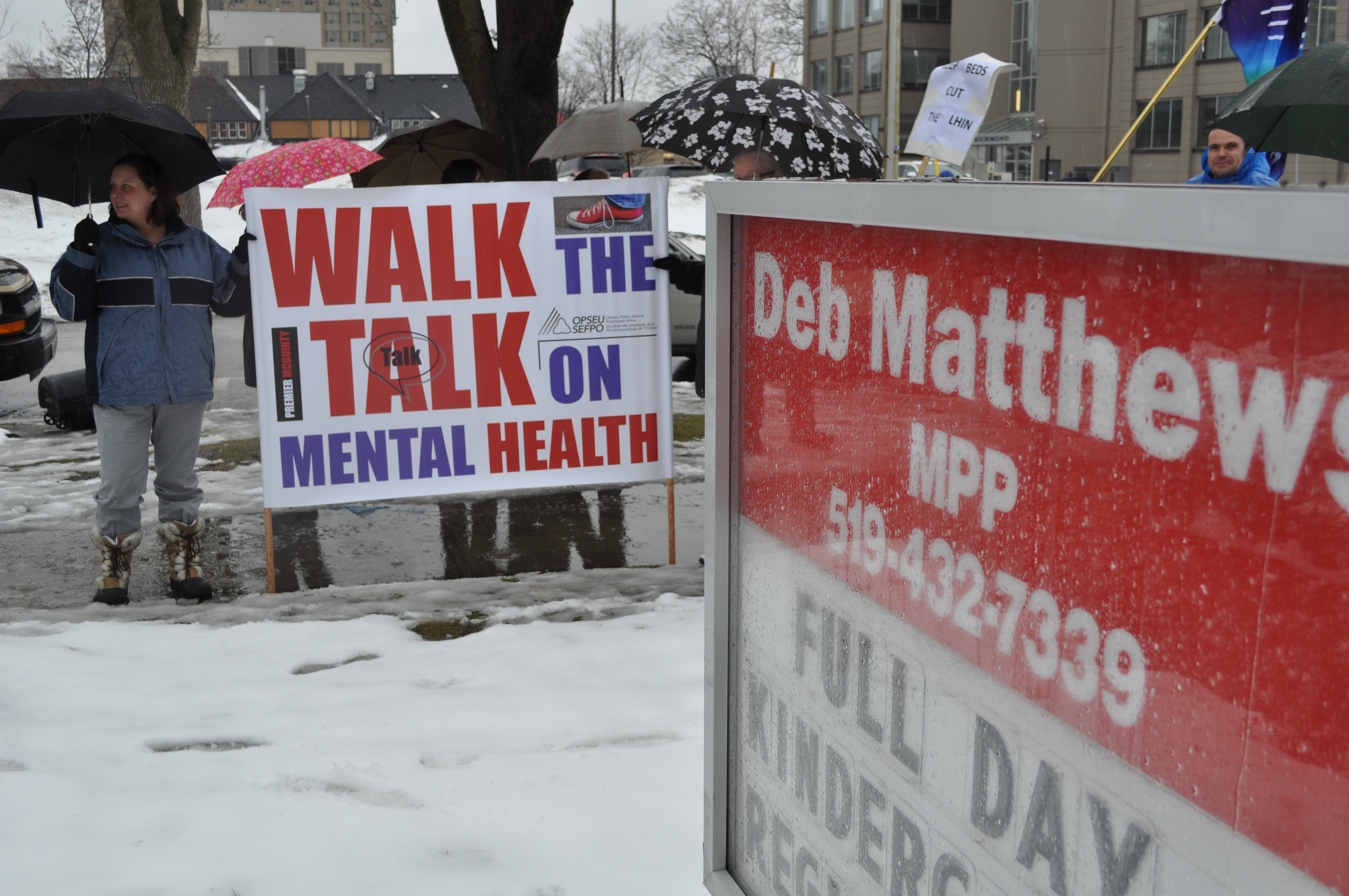
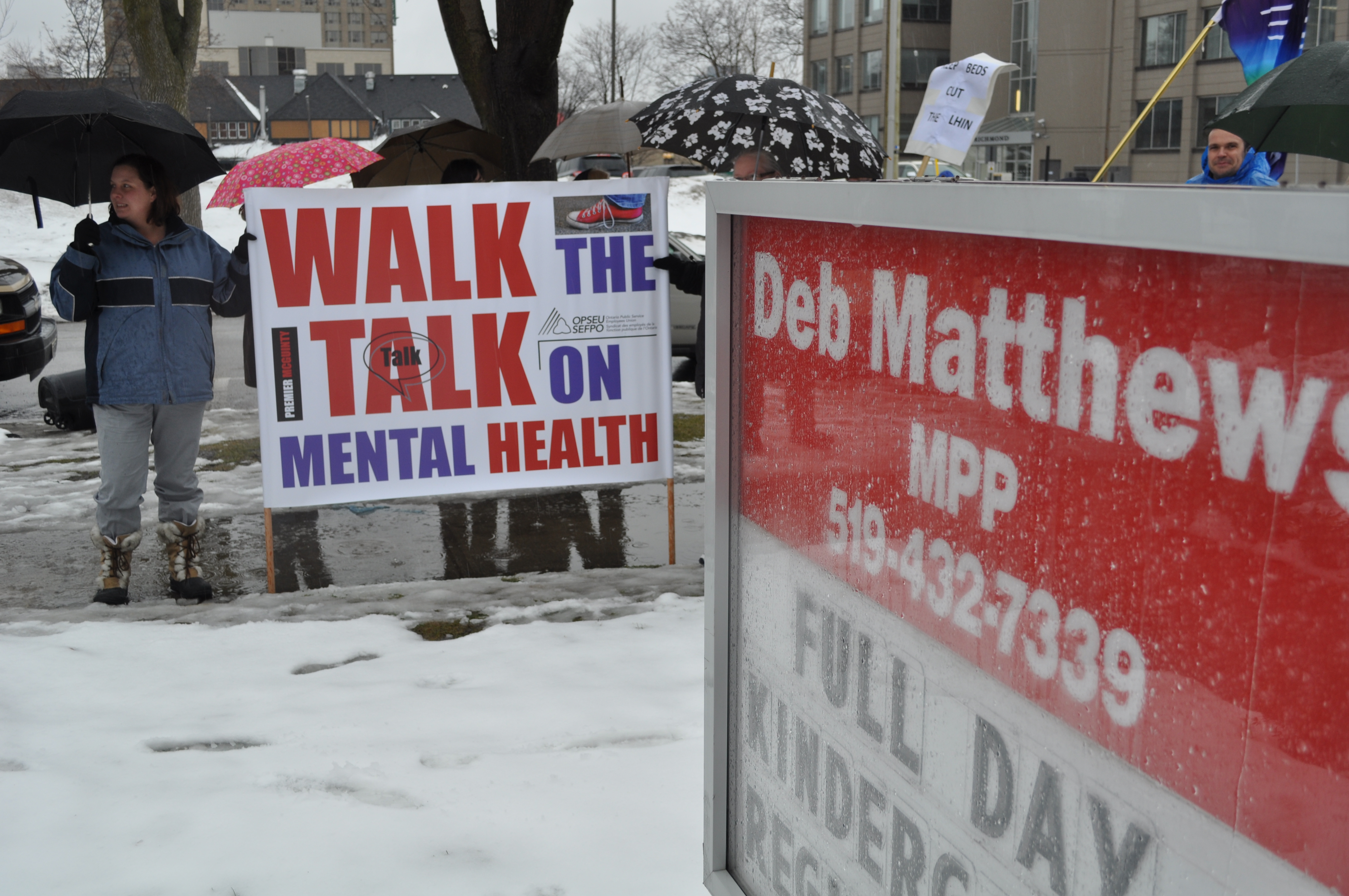
Protesters outside of Health Minister Deb Matthews constituency office in London.

LONDON – Standing in the freezing rain March 9, about 25 OPSEU activists in downtown London, Ontario called upon the McGuinty government to “walk the talk” on mental health March 9th

Organized by OPSEU Local 152, the mobile protest gathered in front of the South West LHIN and eventually marched a few blocks to Health Minister Deb Matthews’ constituency office.

Fifty-nine beds from the London and St. Thomas Regional Mental Health Centre are to be transferred to Windsor later this year, but OPSEU expects that at least another 21 beds will simply disappear.

“We don’t want that to happen. It will affect our clients who need mental health services in London and area,” Elizabeth Craik, vice-president of OPSEU Local 152 told the London Free Press.

When the Regional Health Centre eventually moves into new quarters in three years, there will be at least 70 fewer beds that presently exist in the region.

In addition, the hospital has been cutting staff to deal with underfunding from the province. This year 20 jobs were eliminated, including skills instructors and the only hairdresser serving the two facilities.

Local 152 VP Elizabeth Craik is interviewed by the media outside the SW LHIN offices in downtown London.

OPSEU Regional Vice-President Gino Franche told the gathering that patients will be transferred with the beds to Windsor, “whether they want to go or not.”

Franche said the government failed to follow the plan of the Health Restructuring Commission, which insisted, on cutting no beds until services were replaced in the community.

“Our community-based mental health agencies would need to receive a 50 per cent increase in funding to match the targets set by that Commission,” he said.

OPSEU Region 2 board member Eduardo Almeida said that when the system failed the mentally ill, they would end up in his workplace – corrections.

“Are there no jails, are there no workhouses?” Almeida said, comparing the plight of Ontario’s mentally ill to the poor in Charles Dickens “A Christimas Carol.”

“Criminals belong in jail,” he said, “not people with mental illness.”

When the group arrived at the Health Minister’s Constituency office, a prepared letter from the MPP was distributed to the group.

Matthews said the South West LHIN was working on a community capacity implementation plan for mental health. The plan is expected this summer.

She said that fundamentally moving people out of institutional care is the “absolutely right approach.” She says they are bringing them into the community where a range of supports will be organized around them.

Unfortunately the beds are being cut, and nobody knows where these supports will be.

Local 152 members with a banner asking Dalton McGuinty to "walk the talk on mental health."


McGuinty receives postcards on the floor of the legislature

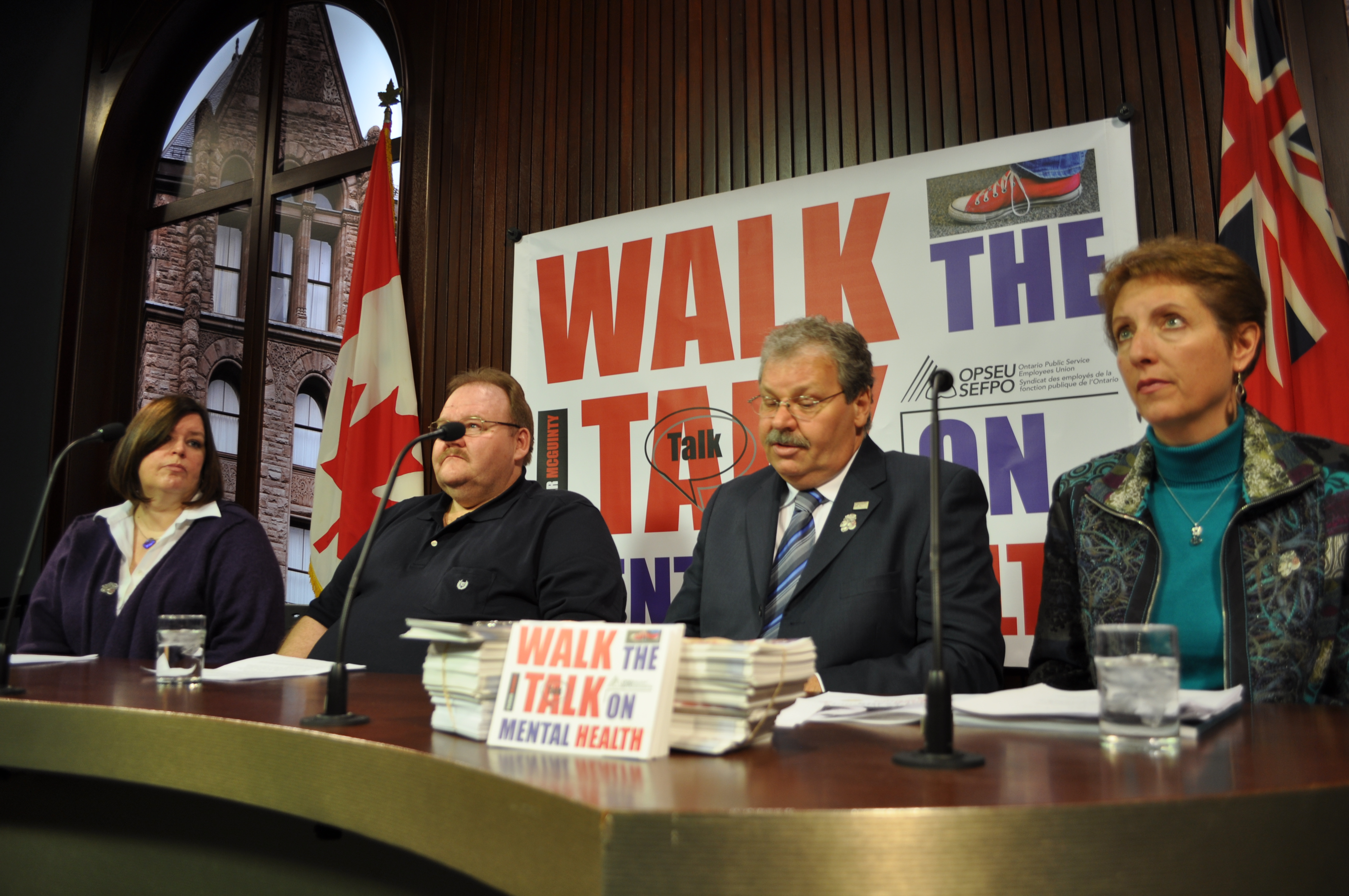
At Queen's Park March 8 -- L to R: OPSEU's Deborah Gordon, Al Donaldson, and Warren (Smokey) Thomas with NDP Health Critic France Gelinas.

Dalton McGuinty personally received more than 600 postcards in the legislature Tuesday signed by OPSEU members asking him to “walk the talk on mental health.” The stack of cards was walked across the legislature floor from the desk of NDP Leader Andrea Horwath.

OPSEU had been at the legislature that day to bring the message that two and a half years of talk about improving mental health had coincided with two and a half years of actual cuts to mental health.

In a press conference earlier that morning, OPSEU President Warren (Smokey) Thomas gave recent examples of a mental health system in decline.

They include:

  • Layoff of 28 child and youth workers at Ontario Shores Centre for Mental Health Sciences, jeopardizing an adolescent residential rehab program that served young adults from across the province;
  • Twenty jobs were recently cut at the Regional Mental Health Centre in London and St. Thomas, and more are expected later this year.
  • Children’s Mental Health Ontario expects they will lose capacity to serve 2,000 children across the province. They have only received two funding increases since 1992.

NDP Health Critic France Gelinas expressed her disappointment in the government’s lack of response to the recommendations of the all-party select committee on mental health. Gelinas had been a part of the committee, which issued its report last August.

“It sounds good to say every door is the right door,” said Al Donaldson, Chair of OPSEU’s Mental Health Division. “In the past decade that door has increasingly been our justice and corrections system. It has also been homeless shelters and the street.”

Deborah Gordon, Chair of OPSEU’s Child Treatment Centre, told the media conference “we now have a generation of children and youth who have not had timely access to treatment – in other words four out of 10 doors have been close for them.”

Gordon said a 14-bed residential home for girls is closing in Sarnia is closing at the end of the month, and other residential facilities are just hanging on.

OPSEU is asking that the government place a moratorium on any further cuts to mental health and restore funding to the Child Treatment Sector.

Health Minister Deb Matthews has promised a 10-year plan for mental health will be introduced later this spring.

OPSEU has received more than 1,000 “walk the talk” postcards from members this week and will continue forwarding them on to the Premier’s office.