Monthly Archives: November 2010

Rachlis says Canadians can fix Medicare by completing it

Dr. Michael Rachlis has got a great story to illustrate the folly of the current hysteria around health care spending. He talks about a family where one of two sons has died. The remaining son is told the family can no longer afford to feed him because he now takes up 33 per cent of the family’s food, compared to 25 per cent of the food when his brother was alive.

Rachlis told an Ottawa meeting of NUPGE’s Canadian Health Professional Secretariat November 25th that public health care spending is only slightly higher than its previous peak in 1992. When the economy shrinks in a recession, health care appears to consume much more as a percentage of that economy. Like the surviving son, it has little to do with increased costs and much to do with the economy it exists within.

As Canada recovers from the recession, already health care spending is decreasing as a share of the economy.

However, there is more to the story than the ups and downs of the Canadian economy.

Since 2000, taxes have been cut by 5.3 per cent of the size of the Canadian economy. That means there is $85 billion less available each year for all public services, including health care. “What if you only cut taxes by half that amount?” he asks. “Imagine what we could with $40 billion more each year?”

Rachlis has heard the stories of how health care is taking money away from poverty reduction, housing and other important social objectives. While health care is continually accused of “eating everybody else’s lunch,” he says, the actual facts tell a different story. Health care spending has slightly increased its share of provincial program spending since the late 1990s. This is mainly due to cuts in other areas rather than increases in health care spending. In the past eight years health care has remained relatively static as a percentage of provincial program spending across Canada. This is contrary to government-led hysteria that suggests 70-80 cents of every health care dollar will soon be consumed by health care spending.

While the United States continues to stand out for its high health care costs, Canada’s spending is comparable to other wealthy nations. Spending in France, Switzerland, Germany and Austria is slightly more than Canada’s. Belgium, Portugal, Netherlands, New Zealand, Denmark and Sweden are slightly less.

Rachlis says we should be proud of Medicare and its principles – but the job is yet complete. Tommy Douglas warned that the second phase would be much more difficult to implement.

“We should acknowledge that there are problems with Medicare,” Rachlis says, “but these problems are because it has never been fully implemented.”

Few Canadians know that the original vision of Medicare went well beyond public payment for the old system. The original vision of Medicare included new ways of delivering care.

Models based on group practice and integration of public health care have been shown also to be cost-effective.

Rachlis says Canadians still believe strongly in Medicare. “We believe strongly all Canadians share access to health care.”

He says immigrants tell him that they chose to come to Canada because of Medicare.

This graph shows public spending has gone from 6% of GDP to just over 8% in 30 years. The last upturn reflects the shrinking of the economy in the latest recession, not a large increase in spending. The dotted line shows where spending would trend had the growth in the economy remained stable -- below 8%. This is hardly the image of health care spending out of control. The level of growth has been particularly flat during the last decade.


Canadian provincial program spending as a percentage of GDP. Public spending on health care has been relatively flat for 30 years. Declines in non-health care expenditures owe more to the impact of tax cuts that increases in health care spending.
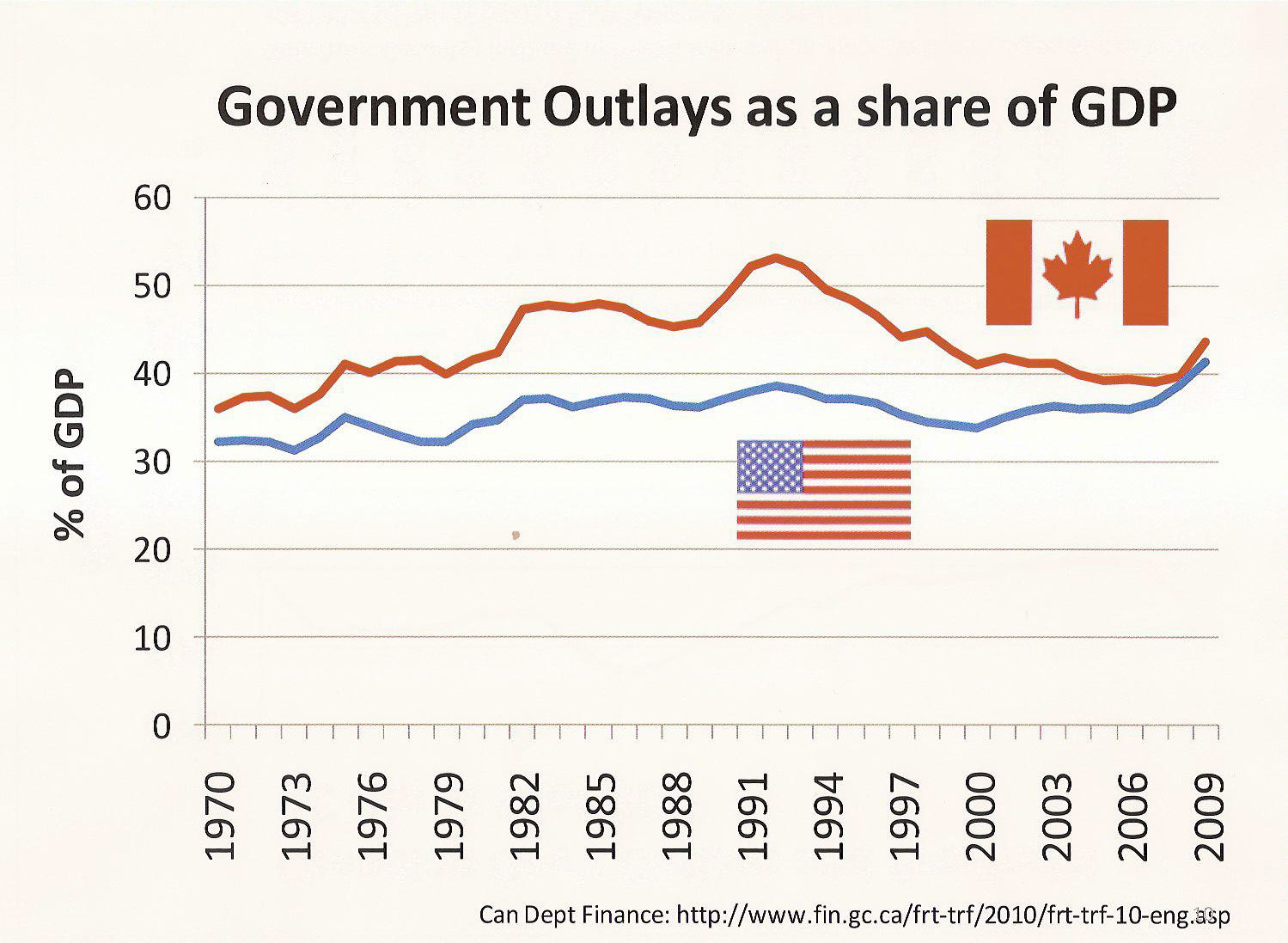

Long thought to have more generous social programs, Canadians have historically spent more of their economy on public services than Americans. In 2009 Canadians and Americans spent about the same percentage of their economy on government services.


Province adds $4.5 million to Muskoka Algonquin’s base funding

Unwilling to choose between its two remaining hospitals, the Muskoka Algonquin Healthcare board held firm in refusing to make cuts recently. Last week they were rewarded for standing by their community.

The province announced November 23 it was adding $4.5 million to MAHC’s bottom line this fiscal year, bringing the hospital to within $1.5 million of balancing their budget.

It is expected an additional $1.5 million will be included in the 2011-12 budget year.

Facing a $6 million shortfall, the Muskoka Region was fearful that one of the two hospitals – Bracebridge or Huntsville – would have to be downgraded to balance the budget.

OPSEU Local 380 President Barb Barry has played a key role in raising awareness about hospital cuts in the communities of Bracebridge, Huntsville and Burk’s Falls. Campaigning hard for the past three years, Barry has rallied the community to demand more funding rather than witness further devastating health care cuts.

South Bruce hospital board won’t eat the food either: OPSEU

CHESLEY, ON – The Board of Directors of the South Bruce Grey Health Centre met Nov. 24 in Chesley and, for the first time, ordered catered food from outside the facility. Staff members previously served home cooked meals from the hospital cafeteria at board meetings.

The union representing the food service workers says this demonstrates what its members have been saying about re-thermed food.

“No wonder the hospital CEO would not accept our challenge; the people who made this decision have no intention of eating the food themselves,” said Warren (Smokey) Thomas, president of the Ontario Public Service Employees Union.

Last month Thomas challenged hospital CEO Paul Davies to eat the food for a week. Although Davies declined the challenge, he did admit he would lose weight eating the food. In conjunction, OPSEU made a donation of $1,000 to the four hospital foundations.

Yesterday the hospital announced that they will no longer be microwaving the food, which they say was often overcooked or undercooked. The hospital says it will be moving to a convection-style oven system for Chesley and Durham which have converted to the re-thermed food structure.

“This is yet another setback for a system that was badly flawed from the start,” said Thomas. “The members have been doing their best in trying circumstances, but they just couldn’t make this work.”

OPSEU says the hospital should scrap its plan completely and make use of Ministry of Agriculture grants to bring in fresh locally-grown food instead.

The union has not been officially informed of the change.

Health Canada funds blueprint strategy for sustaining health professionals

Health Canada is funding a project through the Association of Canadian Community Colleges to develop a blueprint strategy to sustain the supply of allied health professionals.

NUPGE’s Canadian Health Professionals Secretariat had urged Health Canada to develop such a strategy after noting the growing shortages of health professionals across the country.

Allied health providers are defined as “highly skilled health professionals who delivery key diagnostic, therapeutic, rehabilitation, home care, long term care and other clinical services essential to sustaining an efficient and effective health care system.”

The ACCC says factor affecting that demand include changes in patient populations, advances in medical technology and knowledge, patterns of clinical practice and demographics within individual health professions.

To read more about the project, go to http://www.accc.ca/english/services/alliedhealth/index.htm

Video: Saskatchewan draws attention to health professionals

The NUPGE affiliated Health Sciences Association of Saskatchewan has launched a television campaign highlighting the role of health professionals.  The theme is “hidden heroes” :


Video: Funny BC commercials highlights role of modern health team

The Health Sciences Association of BC (NUPGE) has put together two funny television commercials highlighting the role of health professionals in delivering modern healthcare. In the first, a patient is in need of emergency help in a restaurant, and the doctor on the scene realizes he needs considerable help. A second commercial deals with an office environment where a worker has a rather unique heatlh problem. The commercial warns that with fewer health professionals, wait times will increase.

New hospital battles looming – Windsor CEO talks of cuts

Windsor Regional Hospital CEO David Musyj has continually suggested that his workers should effectively pay with their wages for his struggles to balance the budget. While the province tells us they are giving hospitals a funding increase of 4.9 per cent this year, Musyj suggest it is 1.49 per cent. His audited statement says otherwise.

Musyj claims he is stuck between a rock and a hard place. His costs are going up. In real terms, he says his funding is in decline and the LHIN is insisting on balanced budgets.

He says those costs include increases in non-wage expenses that are running between five and seven per cent. He clearly has no zero-based expectations there.

With the downturn in the economy, the hospital is also bringing in less revenue for semi-private and private accommodations – affecting their budget by another $700,000.

Windsor Regional Hospital posts its audited financial and operational highlights on-line. They tell a very different story.

For 2010 the hospital received an increase in provincial revenues of $10.836 million over 2009. That’s an increase in total provincial revenues of 4.62 per cent – not far off the 4.9 per cent figure quoted in the provincial budget. In addition, the hospital shows other revenues increasing by close to $1 million. Eighty per cent of hospital funding comes from the province, albeit more of it is being specifically directed into funding envelopes. It is therefore not a surprise that WRH managed to post a small surplus this year.

Next year the province is planning on reducing the increase in funding for all health care programs by $700 million. This year that increase was $2.6 billion. Next year it will be $1.9 billion according to finance minister Dwight Duncan’s spring budget.

That means there will be about 26 per cent less in new funding – not a decrease in existing funding. If everything else remains the same – Windsor Regional would likely see a funding increase of between $7 million and $8 million, not the $2.7 million Musyj claims. Musyj paints his doomsday scenario by conveniently looking only at the allocation for his global budget, leaving out all the other provincial sources of revenue.

Musyj’s says his staff costs are increasing by $6.2 million, but that includes the cost of adding new staff for rehab and complex care in the Malden building. It also includes $1 million in increases related to workers going up the grid. The actual impact of arbitrated increases is closer to $3.6 million. This is on a hospital with more than $300 million in revenues – slightly more than 1 per cent.

Musyj says he needs the additional money to satisfy increased patient demand, but according to the audited statement, he is budgeting for fewer patient days in 2010.

It would seem that staff increases are not Musyj’s problem. He clearly has other costs that are driving his bottom line. Rather than deal with those, he is scapegoating his own staff to fit a political agenda of making legislative wage settlements acceptable.

Huntsville mayor retracts hospital statement after backlash

Huntsville Mayor Claude Doughty scrambled to issue an apology for his comments regarding a hypothetical hospital-restructuring scenario earlier this month.

Doughty sparked community outrage suggesting that Muskoka Algonquin Healthcare should downgrade one of its two hospitals to deal with a $6 million funding shortfall. He told the local media Huntsville’s District Memorial Hospital should be the acute care centre (full service hospital) while Bracebridge should be downgraded to a chronic care facility.

The comments are likely the beginning of communities battling over increasingly scarce resources brought on by government underfunding.

Doughty said his comments addressed a “worst case hypothetical scenario”, but they still resulted in a flurry of phone calls culminating into a town hall meeting in Huntsville. Attendee’s included regional mayors, Muskoka Algonquin healthcare officials and concerned residents.

The meeting resolved with consensus to work together to maintain both full service hospitals instead of fighting over scarce funding resources. 

Barry Monaghan, interim chief executive officer for Muskoka Algonquin Healthcare said a strong case was made for additional funding from the government.  A number of letters have been sent to the Minister of health Deborah Mathews requesting the necessary funding to address the structural deficit.

The community now awaits a response from the government. 

See (https://opseudiablogue.wordpress.com/2010/10/26/lhin-likely-not-going-to-play-%e2%80%9cchicken%e2%80%9d-with-muskoka-hospitals/)

National Medicare Week — Letters to the PM

It’s National Medicare Week this week. The Canadian Health Coalition is using social media to encourage supporters to write to Prime Minister Harper to urge the federal government to enforce the Canada Health Act. So far the campaign has generated thousands of letters.

The letter reads:

This week is National Medicare Week and I urge you to use the occasion to show federal leadership on health care.

There are serious problems that need to be urgently addressed, including lack of access to timely care, home and continuing care, and affordable prescription drugs.

Further, you have stood idly by as provinces de-listed services, allow extra-billing by physicians, and permit the selling of medically-necessary diagnostic services and queue-jumping. I expect your government to uphold its legal duty and enforce the Canada Health Act in these well documented violations.

I call upon you to celebrate National Medicare Week by enforcing the Canada Health Act. I also call on you to secure Medicare for future generations by committing to adequate federal funding, and initiating a national public drug plan (Pharmacare) that will save billions while providing Canadians with better access to prescription drugs.

Mr. Prime Minister, defend our health care system. Stand up for Medicare.

To send your letter, go to:

 http://medicare.ca/defend-health-care-letter/langswitch_lang/en

Flaherty non-committal to future CHT increases

Federal Finance Minister Jim Flaherty gave an economic update recently that hinted towards adjusting the Canada Health Transfer after 2014.  

With the CHT renewal up in 2014, Jim Flaherty has hinted the formula may be changed to match inflation combined with economic growth. Over a projected three year period this could mean as much as $5 billion less transferred to the provinces.

Under the 10-year Federal-Provincial agreement, Canada’s Health Transfer to provinces increases by 6 per cent per year.  Paul Martin’s government signed  the federal-provincial-territorial Health Accord with the intention to “heal health care for a generation”.

Any changes that would reduce federal contributions would contradict the Harper government’s pledge in the 2010 budget to maintain equalization payments to have-not provinces and not to cut health care or social services.

Conservative Quebec MP Maxime Bernier has broken ranks suggesting the CHT agreement should be scrapped and replaced with the equivalent tax cut to each province.

Bernier told the Globe and Mail that instead of sending money to the provinces, Ottawa would cut its taxes and then the provinces would use the vacated fiscal room. “Such a transfer of tax points to the provinces would allow them to fully assume their responsibilities without federal control,” he said.

Critics say basing health care funding on fiscal capacity would be a regressive move that would leave provinces and territory health care funding based solely on their ability to generate income. 

The creation of transfer payments was intended to eliminate the disparity between have and have-not provinces and territories. Delivery of health and social services would solely rely on the provinces or territories income ability.

If Bernier’s idea gains traction it would end the principal of fiscal equity between provinces and territories in Canada.