Category Archives: Hospitals

Confusion over the future of executive salaries in health care

This week’s release of the sunshine list also raises the issue of how health care executives are compensated.

As part of the government’s quality improvement plan, as of April 1st CEO salaries will be linked to performance on quality indicators such as progress on wait times and their ability to balance a budget.

However, in the recent budget the government also announced a plan to cut 10 per cent off executive salaries over the next two years.

Not surprisingly, Ontario Hospital Association President Tom Closson told the Globe and Mail that “government policies are colliding with each other. We haven’t even implemented the quality improvement plan and the pay for performance within it, and now we have another idea piled on.”

At the Ottawa Hospital, the number of employees on the sunshine list actually went into considerable decline from the previous year. In 2010 292 employees made the list, down from 349 the year before. The hospital says that virtually the entire senior management group reporter smaller earnings. That includes CEO Dr. Jack Kitts – his salary dropped by $21,000. However, Dr. Kitts should still be able to pay his Cable bill on $642,000 per year.

Kitts doesn’t take the distinction of having the biggest paycheque, that honour remains with Dr. Robert Bell, CEO of Toronto’s University Health Network. Bell’s compensation in 2010 remains unchanged from the previous year at $753,992.

To check out what your CEO made last year, go to
http://www.fin.gov.on.ca/en/publications/salarydisclosure/2011/

Five of Seven SE LHIN hospitals may be unable to balance budgets in 2011-12

You have to pity the hospital administrator this year. Not knowing how much money they are expecting to receive from the provincial government, they are expected to sign extensions to their accountability agreements with the Local Health Integration Networks. This is the second year the LHINs have called for extensions rather than sign new accountability agreements.

Last year hospitals were expected to provide a risk report – stating what would happen if they received no base increase in funding, a one per cent increase, and a two per cent increase.

This year they appear to be going through the exercise again, only this year they called the risk report the “gap based planning submission,” affectionately known as the GAPS (even though the acronym doesn’t quite spell that).

Based on a zero per cent funding assumption, the South East LHIN is recommending that five of seven hospitals in their region receive waivers exempting them from balancing their budgets in 2011-12.

While Quinte Health Care and Lennox-Addington County General Hospital project balanced budgets under this scenario, Kingston Hotel Dieu, Kingston General Hospital, Perth and Smiths Falls District Hospital, Providence Care and Brockville General are expected to slip into the red.

This year two of these hospitals are expected to finish 2010-11 in deficit. Kingston General is expected to be $2.9 million in the hole, while Perth and Smiths Falls will be close to half a million dollars in deficit.

If the provincial government does freeze funding, the region’s hospitals collectively will run up $5.9 million of new debt.

Total funding for the five hospitals is more than $670 million.

The SE LHIN will be meeting to amend the accountability agreements on March 28.

Dr. Jeff Turnbull’s dilemma

Dr. Jeff Turnbull is walking a fine line.

On the one hand he works as Chief of Staff at the Ottawa Hospital where 450 surgeries a year are cancelled due to a lack of available beds.

On the other hand he is this year’s president of the Canadian Medical Association, and in that capacity acknowledges that what we need for health care isn’t necessarily more hospital beds.

There is no question that we spend a lot of money on health care, and that these resources might be better reallocated.

Recognizing that our hospital emergency departments are jammed, the Ontario government set up financial incentives to hospitals to bring down those waits. They have also set up urgent care centers as alternatives to patients who may not have a life threatening illnesses or injury.

Almost half of Ontarians have never heard of these urgent care centres, and 62 per cent of respondents in a May 2010 Vector poll indicated they had no idea where to find their nearest urgent care centre.

For hospital patients who have completed their acute care treatment, but are physically unable to go home, the government has put intense pressure on hospitals to shift these patients elsewhere. Recently Windsor declared a state of emergency, threatening patients with huge daily levies if they refused to go to the first long term care bed that came available. Not only is this not humane, such levies contravene the Canada Health Act according to the Advocacy Centre for the Elderly.

Turnbull says about one fifth of all health care spending is attributable to socioeconomic disparities. However, while Turnbull and others speak about this, the government is going in the opposite direction – providing tax cuts to profitable corporations and their shareholders while imposing restraint on workers.

Home care was supposed to be the solution, but the numbers don’t look good there either. While more money has been put into home care, it is nowhere near enough to handle the influx of patients pushed out of hospitals quicker and sicker. In fact, as a percentage of our overall health care spending, home care has gone down between 1999 and 2010 from 5.5 per cent to 4.5 per cent. Many needy patients waiting for home care have been told they are not acute enough to warrant rationed services.

Canada has the second lowest number of hospital beds per thousand among G7 nations. Only the United Kingdom is slightly lower. There isn’t much room left to reduce the number of beds, although every spring we see announcements about more bed cuts.

Our hospitals are dangerously jammed. We have occupancy rates that other countries would consider to be reckless. Patients in these hospitals face more than cancellation of their surgery, the chances of getting a hospital acquired infection goes up with this crowding.

It’s great to talk about making better use of our health care resources. We heard the same talk in mental health, where reduced beds were supposed to be offset by increased community-based care.

The story of mental health is a cautionary tale that Dr. Turnbull should heed.

In the late 1990s the Health Restructuring Commission set specific targets for how many acute care mental health beds we were supposed to have. However, they said that no beds should be cut until the services were offset in the community.

What happened? Ontario was more than eager to cut the targeted beds, but never established sufficient replacement services in the community. Even after exceeding the bed cutting targets, Ontario now spends 60 cents of every mental health dollar on hospitals, and 40 cents in the community. It was supposed to be reversed.

In a recent all-party report, it was acknowledged that as a share of overall health care spending, Ontario’s financial commitment to mental health was considerably below other countries.

Dr. Turnbull needs to be careful. The government will happily cut more beds as long as he and his colleagues make it the fashionable thing to do.

They may not be so eager to replace those services in other settings. And when that happens, we all know where people will go – to wait in even more crowded hospitals.

“False Positive” new book on Canada’s medical laboratories

Ross Sutherland, the Community Co-Chair of the Ontario Health Coalition, has just published a new book on Canada’s Medical Laboratories.

False Positive: Private Profit in Canada’s Medical Laboratories uses the history of laboratory services in Canada to demonstrate that ownership of health services matters. The history of medical laboratories is a cautionary tale: it is a warning to those who would allow private surgical clinics, for-profit MRIs and CT scans, corporate family medical practices and a variety of other private enterprises to provide services to patients at public expense.

In addition to the book, Ross has also set up a BLOG to begin a dialogue on medical laboratories — http://forprofitmedicallabs.wordpress.com.

You can order Ross’ book for $17.95 through Brunswick Books, 20 Maude St., Suite 303, Toronto, Ontario M5V 2M5 — orders@brunswickbooks.ca

Video: CSMLP produces commercial to highlight role of lab professionals

The 14,000-member Canadian Society of Medical Laboratory Professionals has produced a commercial to highlight the role lab professionals play in health care. Titled “Knowing Matters,” the CSMLP has posted the commercial on-line with an incentive for their members to click on the video: if it gets 25,000 views CBC’s The National will air the commercial during National Medical Laboratory Professionals Week (April 24-30). To see the video, and add to the count, click on the window below:

Video: Natalie Mehra on P3 Hospitals

Natalie Mehra, Director of the Ontario Health Coalition, speaks about the high costs and secrecy of public-private partnership (P3) hospitals in this new Operation Maple video.  Operation Maple makes on-line videos about issues important to Canadians. Check it out below:

Lack of policy on surge capacity may come to bite us this flu season

Could this be the season where our reckless policy of removing all hospital surge capacity comes to bite us?

The Toronto Star recently reported of a Canadian man stuck in a St. Louis hospital because there are no beds available for him back in Toronto.

The man had a heart attack while in the US Midwest, where he has admitted to hospital in St. Louis. His wife has been trying to get him transferred back home without any luck. In fact, the stress was so much for her, that she was also felled by a heart attack in St. Louis, and wound up for three days in the same hospital.

“The flu season has overwhelmed hospitals and we have to take our patients who are in the emerg first,” Scarborough hospital spokesperson Tracy Huffman told the newspaper.

Dr. Ian Fraser, chief of staff at Toronto East General told the Star: “There is not a lot of surge capacity within the whole system and that is a challenge.”

Meanwhile, Windsor-area hospitals have declared a state of emergency, threatening alternate level of care (ALC) patients with charges of $600 per day if they refuse to take the first long term care bed available to them. Likely not many will be faced with that choice – only six beds are available in the region.

In Ottawa spouses are unable to be reunited with their partners in the city’s nursing homes despite a policy that makes such transfers a priority. Why? The city’s hospitals are filling up any available nursing home bed to move out their ALC patients.

Several years ago we asked an advisor with then Health Minister George Smitherman’s office what the government was doing about the shortage of acute care beds.

We had disclosure from the Rouge Valley Health System on a challenge we were taking before judicial review. The hospital provided us with a number of comparisons with peer hospitals to suggest they could close down more acute care beds to save money. Most of the peer hospitals in the comparison were well over 90 per cent capacity, and about 25 per cent were over 100 per cent capacity. When you exceed 100 per cent, it means you constantly have patients in your hallways.

The advisor admitted that the numbers were correct, and in fact, might even be a bit higher. However, he expressed no concern about the lack of surge capacity.

This is not how it works in other countries, where the possibility of a bad flu season or pandemic could throw the health system in crisis.

In the UK, the only G7 country that has fewer acute care beds per capita than Canada, they set a target of 82 per cent average occupancy. When a media report showed that there were a significant number of hospitals over 85 per cent, it was considered a scandal.

High occupancy rates have been proven to be linked to an increase in mortality rates, longer waits and a spread of hospital-borne infections.

In 2005 the average bed occupancy in 30 OECD countries was 75 per cent. The Australian Medical Association has warned that bed occupancy rates above 85 per cent negatively impact on the safe and efficient operation of a hospital.

The Irish Medical Association recognizes 85 per cent as an “internationally recognized measure” that should not be exceeded.

Yet here in Ontario we are over 90 per cent, and for many hospitals, they exceed 100 per cent.

In Canada we have 2.7 acute care beds per 1,000 population. In Japan it’s 8.2 and in Germany it’s 5.7 beds. Yet Germany spends about the same as Canada on public health care, and Japan spends less. Both rely less on private health care.

The present mania for emptying ALC beds raises an interesting question – once these patients are no longer in the hospital, and the beds are filled by acute care patients who cannot be moved elsewhere, where does the surge capacity come from in the event of a crisis? Without the options of moving these patients to alternate settings, there will simply be no room.

Having a hotel at 100 per cent capacity is efficient. Having a hospital at 100 per cent capacity is a recipe for disaster, as we are beginning to see this month.

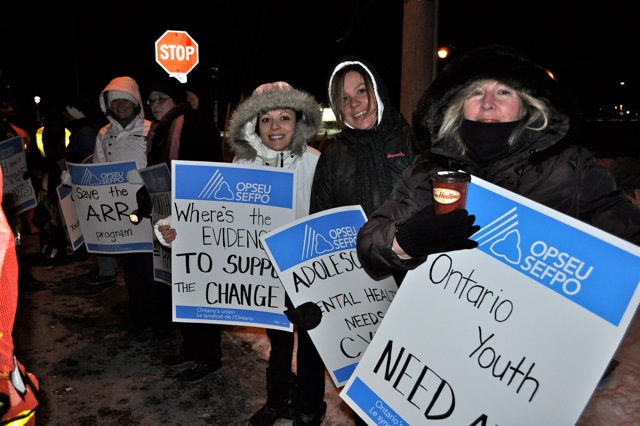
Right night, wrong time – Ontario Shores struggles with the idea of being public

Workers brave the freezing cold to greet arriving board members at Ontario Shores. Most board members ducked the demo by arriving early.

Wednesday night OPSEU Local 331 set up a welcoming party outside of the Ontario Shores Centre for Mental Health Sciences. Standing in the freezing cold, the members hoped to give a package about cuts to the adolescent unit to board members arriving for their February meeting.

Problem was, the hospital told the union the board meeting was half an hour later starting than it really was. Only a handful of late arriving board members encountered the union picket line.

Ontario Shores has had issues with being a public hospital.

While the Ontario Hospital Association has called for greater transparency and has long established guidelines around open board meetings, Ontario Shores has been reluctant to sign on.

When we inquired about the board meeting, we were told that attendance was by invitation only. While they did extend an invitation to the union, we were given the wrong time despite the fact that the only in camera session on the agenda didn’t occur until the end of the meeting.

The hospital claims it wasn’t an error. The first item on the agenda, they say, was educational, and that the real meeting didn’t formally start until the agenda was adopted. Which raises the question, if the first item on the printed agenda was educational, how did they proceed with that item without first approving the agenda?

Arriving while the meeting was in progress, having to leave due to the in camera session, there was no actual time to informally speak to board members.

Ironically, the first item we missed on the agenda was a briefing about the hospital’s obligations under Freedom of Information legislation. Bill 122 will require hospitals to open up their files to Freedom of Information requests beginning January 2012.

Meanwhile, our Freedom of Information Request to the Central East LHIN still awaits an answer regarding any documentation to show some due diligence on their part as Ontario Shores radically changes the parameters of an important adolescent mental health program that serves youth from across Ontario.

To date the LHIN has maintained that the changes are within the hospital’s decision-making scope.

Ontario Shores maintains that the decision to change the delivery model for the Adolescent Residential Rehab program is based on best practices and evidence. However, we have been asking for documentation to support their claims since December.

Recently a meeting was offered to go over the evidence that they have so far denied us.

For more on this story, go to:
No Evidence, But Plenty of Runaround

NDP Leader Critical of Ontario Shores Decision

OHA Vice-Chair says Ontario needs health strategy

Janet Davidson uses her fingers to describe how thick her hospital’s accountability agreement with the Local Health Integration Network is. “If everything is important, then nothing is important,” she says. “Pick a few and drive it.”

Speaking in conversation with Saskatchewan health policy consultant Steven Lewis, the CEO of Trillium Health Care was featured January 24 at Longwood’s Breakfast with the Chiefs. Davidson is also the Vice-Chair of the Ontario Hospital Association, and will be Chair next year.

Davidson describes herself as  “a fan of better integration,” but had hoped Ontario’s regionalized model would have been better than it is.

“I don’t think we’ve allowed it to be what it can be,” she told the forum. Davidson said that the focus has been on structures. “We don’t need structures, what about incentives?”

When Davidson was the assistant deputy minister of health in Alberta, she said “Alberta created regions that wouldn’t talk to one another.”

“I think we have to spend more time understanding what it takes to get integration, cooperation and coordination,” she said.

Asked about PC Leader Tim Hudak’s promise to scrap the LHINs, she asked, “what are you going to replace it with?”

She said her LHIN was successful in reducing the alternative level of care (ALC) rates in hospitals to the lowest in the province. She said the effort could be taken further than hospitals, including long-term care and rehab. She also said consolidation of services within her region could not be possible without the LHIN.

Davidson questioned what the province’s health care strategy was. “Without a strategy on health it becomes difficult to know exactly what we are trying to do,” she said.

She gave Ontario’s diabetes registry as an example. While the province was trying to deal with the downstream effects of diabetes, at the same time it dumped upstream prevention through Participaction and gym class in our schools.

She also called for a greater hand in determining what health professionals were being turned out by Medical schools, but cautioned this would be difficult given there is no agreement among provinces.

In response to a question about whether hospitals should even try to be everything to everyone, Davidson said “anybody who comes in our door deserves the best quality we can give them.”

Dr. Michael Rachlis asked about the role of public health in a regionalized health system.

“Public health drives me bananas here,” she said. “The fact that public health is separate. They provide a perspective we just don’t have.”

Davidson said you can’t create a system where people are healthier without the involvement of public health. She spoke about the prevalence of C-Difficile in the community and the impact it is having on hospitals. “You have to have public health to resolve it.”

Saskatchewan’s Steven Lewis was asked about the role of small and rural hospitals and the province’s closure of 52 hospitals in the early 1990s.

Lewis said the hospitals closed by the province were very small – some as few as four beds. Every town of 15,000 felt they deserved a hospital. These closures “changed the political landscape forever, creating a rural urban divide that exists to this day.”

He said it comes down to capacity of the system, pointing out that small hospitals could do some things better. Decanting work upwards had two problems – larger hospitals tended to be high cost places, and patients often had difficulty navigating more complex environments.

To watch the Longwood’s video of this full presentation, go to:

http://www.longwoods.com/audio-video

Four more consultation roundtables set up on rural and northern health care

Four more round table consultations are taking place on Ontario’s rural and northern health care panel report. 
 
The first two consultations have already taken place in New Liskeard and Burford.  Reports from members of the Ontario Health Coalition suggest that these consultations are heavily moderated.  The OHC encourages attendees to think about the key points you would like to make beforehand and to be insistant about having your voice heard. 
 
Registration for these events is encouraged, but are NOT mandatory.  Those who wish to register can do so by calling 1-800-503-8654 or by completing the online form at http://www.health.gov.on.ca/en/public/programs/ruralnorthern/register.aspx To view the government’s report, go to: http://www.health.gov.on.ca/en/public/programs/ruralnorthern/consultations.aspx
Our Diablogue post on the committee report can be found at
 
Upcoming Roundtables
Shelbourne:
January 31st, 7:00 – 9:30 pm
Centre Dufferin Recreation Complex, Poolside Room, 200 Fiddle Park Lane
Please register by January 27th
 
Hanover:
January 31st, 11:00 – 3:30 pm
Hanover Regional Aquatic Centre, Lion’s Den Room,  269 7th Avenue
Please register by January 27th
 
Drayton:
February 1st, 1:00 – 3:30 pm
PMD Arena, Banquet Hall, 68 Main Street
Please register by January 29th
 
Petrolia:
February 2nd, 1:00 pm – 3:30 pm
Lambton Central Collegiate & Vocational Institute, Gymnasium,
 4141 Dufferin Avenue
Please register by January 31st
 
Haliburton
February 8th, 1:00 – 3:30 pm
Legion Hall, 719 Mountain Rd.
Please register by February 4th
 
Orillia 
February 8th, 7:00 – 9:30 pm
Soldiers’ Memorial Hospital, Dr. Brian McGugan Education Room,
17 Colborne Street West 
Please register by February 4th
 
Renfrew
February 7th, 10:00 am – 12:30 pm
Mateway Activity Centre, Mateway Hall
1 Mateway Park Drive
Please Register by February 4th
 
Dryden
February 10th, 1:00 – 3:30 pm
Eagle’s Landing Golf & Curling Club, Dining Room 
500 Sandy Beach Road
Please register by February 7th