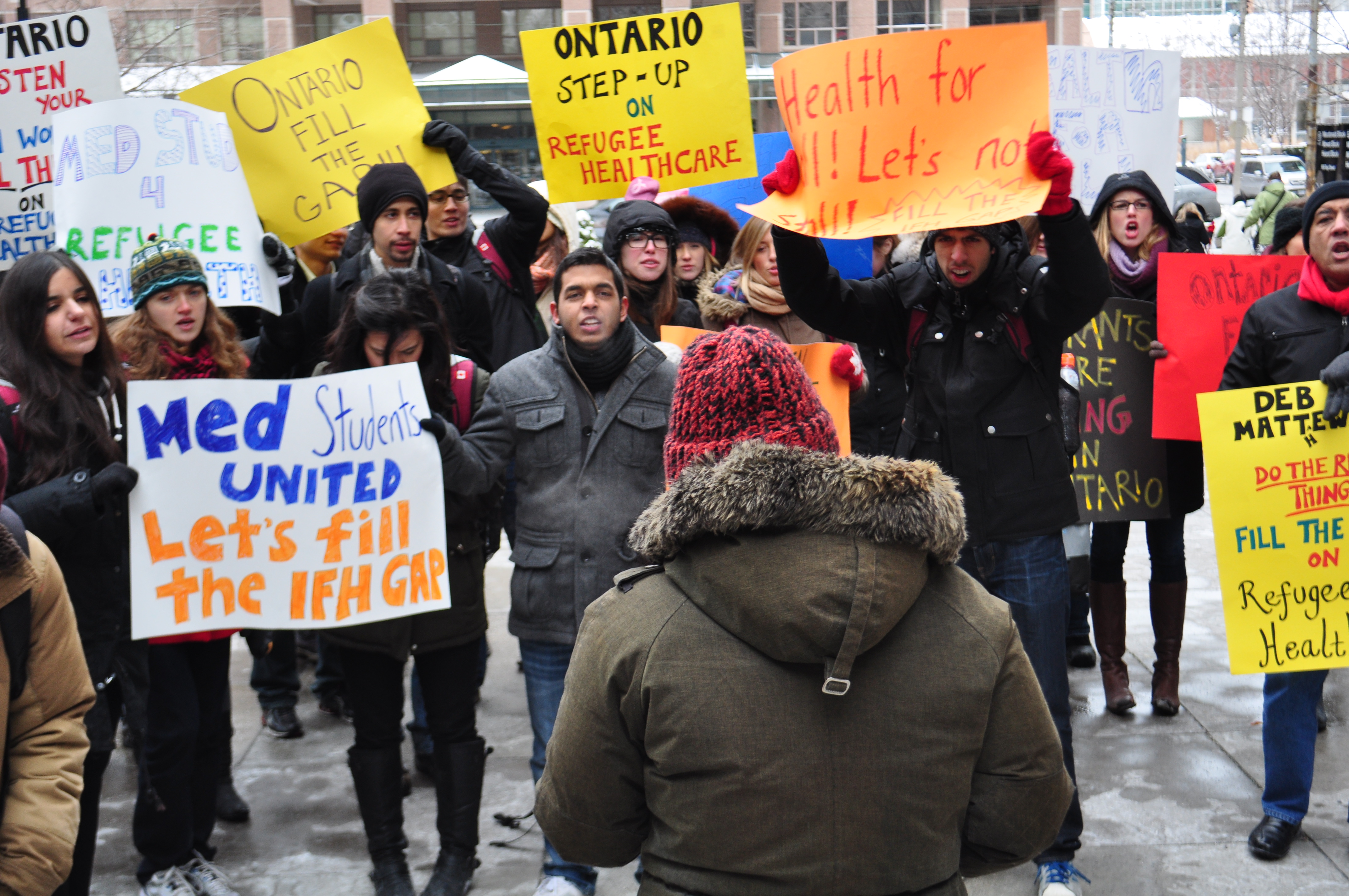
Protesters demand Deb Matthews fills the gap in health care coverage created by Federal cuts to refugees.
There were hard lessons learned today about how democracy is practiced in this province.
About 60-70 protesters, most young health care workers and students, spent more than an hour and a half today outside the downtown Toronto offices of the Ministry of Health. They waited in the bitter cold, hanging on for a possible meeting with Minister Deb Matthews. The size of the crowd varied as participants left and returned again in an effort to keep warm.
Upset about last year’s changes to the Interim Federal Health Plan that would deny many desperate refugees access to our health system, the protesters wanted Ontario to fill the gap left behind by the senior level of government. Several other provinces – including Saskatchewan, Manitoba and Quebec have already done as much. Manitoba said it would send the bills back to Ottawa.
So why is Ontario waiting?
Health Minister Deb Matthews had already provided the group with all the arguments they needed. She wrote to Federal Citizenship and Immigration Minister Jason Kenney back in December, suggesting that such cuts not only represent downloading to the provinces, but risked escalating the cost of care for these individuals as small problems turned into larger ones without access to reasonable health care coverage.
Pop quiz: who wrote this: “Our government expects – as do health care providers – that this change will exacerbate the health conditions of patients with chronic conditions and those who are at risk of developing such conditions. In addition, given preventative care is less costly that emergency or acute care treatment, your policy represents a significant download to provinces and especially Ontario, where the vast majority of refugee claimants reside.” If you guessed Ontario Health Minister Deb Matthews, you’d be correct. Matthews’ wrote Federal Citizenship and Immigration Minister Jason Kenney in December over the impact of cuts to the Interim Federal Health Program for refugees. Tomorrow (Wednesday) opponents of the federal cuts will be meeting outside of Deb Matthews’ downtown Toronto office to ask Ontario to have a heart and provide stop-gap coverage for these disenfranchised refugees left without coverage. Demo starts at 11:30 am near Bay and Wellesley Streets in Toronto.
Windsor Regional Hospital is closing its long-standing Acute Injuries Rehabilitation and Evaluation Centre after the facility lost $300,000 last year. Once a revenue-generator for the hospital, the centre provides assessment and treatment services to people injured in automobile accidents or on the job. Revenues came from WSIB and other private insurance providers. The hospital claims two other private centres have meant that this insurance work done by the hospital has “dried up.” Curiously Windsor lawyer Suzanne Dajczak told the CBC that the closure would mean costs would shift to the patients. “When you’re injured, you’re under stress, finances generally are cut – in the cases that I see, substantially. They usually come when they’re denied and, yes, they’re going to struggle, and it’s going to be more difficult for injured workers” (Emphasis added). Is Ms. Dajczak suggesting that these private clinics may be less supportive of injured worker claims than the public hospital?
The Ottawa Hospital was attempting to fix a problem that didn’t exist when it unilaterally imposed a new dress code on employees according to a recent arbitration decision.
Most contentious was a requirement that workers at the hospital cover up large tattoos as well as prohibiting “visible, excessive body piercings.”
The Ottawa Hospital also stopped certain workers from wearing jeans and Bermuda shorts and insisted nurses wear lab coats in the hospital while off duty.
All of these restrictions were struck down in the January 14th decision following a 2010 policy grievance by CUPE Local 4000.
Arbitrator Lorne Slotnick stated in his ruling: “the employer’s argument is explicitly based on its willingness to accept and acquiesce to patients’ perceived prejudices and stereotypes about tattoos and piercings, even as it offers no evidence that these have any impact on health outcomes… The hospital could not and would not accede to the wishes of a patient who might be uncomfortable with a care provider based on the employee’s race or ethnic identity, even though some patients might harbour those types of prejudices.”
Slotnick said that no patient was being forced to “accept” tattoos, but instead were receiving care from many individuals who reflected the diversity expected in a big city.
Nobody believes a hospital ward is a long-term solution for patients who have completed their acute care treatment but due to their medical frailty are unable to go home without support. The question is, where are the appropriate resources for these patients? Public home care and nursing homes have significant waits. Some nursing homes can take as long as seven years to get into.
Some hospitals are trying to push patients into retirement homes to wait until public services are made available, sometimes with threats of levying illegal and sizeable daily fees. If they do follow to a retirement home, the private costs may be prohibitive and there is no guarantee of receiving appropriate care. These are not nursing homes.
Often the frail and elderly are left with nowhere to go.
Jane Meadus says these individuals need to know their rights. A lawyer with the Advocacy Centre for the Elderly (ACE), Meadus says the legal clinic receives about 250 complaints per year.
Yesterday Health Minister Deb Matthews announced the first specific initiatives following the release of Dr. Samir Sinha’s summary of recommendations for Ontario’s Senior Strategy.
You may have missed the headlines largely because it mostly attracted a big shrug, aside from our colleagues at SEIU. They issued a news release to praise the offer of additional training for 200 personal support workers (PSWs) to help these workers provide support for seniors with dementia and challenging behaviors. There is no denying it is at least a step in the right direction. Nobody knows exactly how many PSWs there are in the province – estimates range from a low of 60,000 to a high of 100,000. There are said to be 26,000 PSWs working just in the home care sector. When we saw the offer to train 200, our first reaction was to wonder whether some zeros were missing?
The Minister did also make a less specific commitment to improve resident safety, quality of care and abuse prevention through new staff training and development. Let’s hope it’s on a much larger scale than their plan for PSWs.
The announcement also called for a 50 per cent expansion of the number of short-stay beds in long-term care to help transition seniors from hospital. While that may sound very impressive, the actual numbers amount to just 250 more beds, and we’re still waiting to find out whether these are new licensed beds or merely being carved out of the existing stock of about 76,000 long-term care beds in Ontario. Dr. Sinha had suggested to the Toronto Star that the number of nursing home beds needs to triple over the next 20 years. That means Deb Matthews needs to announce something more on the scale of 7,600 new beds per year to make that happen.
Earlier this week we reported Thunder Bay was in a bed crisis and was looking for alternate care for 86 ALC patients. That’s just one hospital out of more than 150 that may be looking for these 250 beds.
Cuts to nursing positions in Southern Ontario do apparently have a silver lining.
Sudbury’s Health Sciences North says hard times for health care workers in the south are solving some of that hospital’s recruitment problems in the north.
Whereas the hospital normally maintains a vacancy rate for nursing positions of five percent, it has recently dropped to three per cent with new hires. Not only that, but they are having better luck filling allied health positions, including social workers, occupational therapists, physiotherapists, chiropodists, psychologists and speech language pathologists.
Rhonda Watson, VP of Human Resources at the hospital, told Northern Life that the only difficulty they presently have is in recruiting pharmacists.
You’ve got to love George Monbiot, the UK author, journalist and activist. His engaging BLOG is high on our list of regular must-reads.
This is how George describes his role:
“Here are some of the things I try to fight: undemocratic power, corruption, deception of the public, environmental destruction, injustice, inequality and the misallocation of resources, waste, denial, the libertarianism which grants freedom to the powerful at the expense of the powerless, undisclosed interests, complacency.
“Here is what I fear: other people’s cowardice.”
This week George leafs through the pages of the kind of UN report that most of us would require a big container of No-Doze to get through. The result is a great post highlighting evidence of how 30 years of neoliberalism has trashed our lives and made the super rich even richer.
While we spent the last year hearing how there is no money and witnessing the assault on our public services, Monbiot reminds us that the globe’s 100 richest people became $241 billion richer last year (yes, billion with a “b”).
Yum. Actual meal at one of Ontario’s psychiatric hospitals.
The nurse thought it was a mistake. A large patient at Ontario Shores Centre for Mental Health Sciences was given a plate with six pieces of ravioli on it as that day’s lunch. The nurse on the unit thought it was not going to be nearly enough. When she contacted the dietary department they said there was no mistake, these are proper portions.
Staff at Ontario Shores tell us that such portions mean the same patients are down at the canteen later on filling up on less healthy foods.
Recently we asked representatives from our mental health sector if they had similar experiences to their colleagues at Ontario Shores. The answer was yes.
By being strict about calorie counts, you would think that patients would be losing weight. However, when the evening meal leaves you hungry, there are other options, unhealthy options that result in patients actually gaining weight.
In another psychiatric hospital we were told of patients ordering in fast food to fill that hunger. While delivering a pizza or Chinese food to a public hospital may appear odd, it is not uncommon.
We were told these hospitals are taking it right to the line with regard to portion size and calorie count.
UBC professor Steve Morgan has been writing a series of excellent BLOGs on Healthy Debate this month about the need for Pharmacare in Canada.
As Morgan stated last November, our Medicare system stops the minute a doctor writes a prescription.
While organized labour has been reasonably successful in getting pharmaceutical coverage for their members, one in ten Canadians do not fill prescriptions due to cost. This is much higher than many of the countries and health care systems we frequently compare ourselves (with the exception of the United States). The impact is often felt as symptoms get worse without medication and the patient makes greater use of the public health system as a result.
Morgan is among the organizers of a national symposium at the end of February in Vancouver on the subject, arguing that Canada pays a significant premium for drugs by not moving to a universal model.
“We are probably the only country in the world that offers a universal healthcare system of financing that excludes prescription drugs,” he said in November.
If we moved to the Pharmacare system Germany has, for example, Canadians would collectively save $4 billion in drug costs. If we moved to the UK model, the savings would be on the order of $10 billion. If the government is serious about sustainability of health care, this should be a wake up call.
To watch Morgan’s 10-minute speech from last November, click on the window below. Also included is one of the excellent short videos posted in the run up to Morgan’s Vancouver symposium later this winter. The link to Healthy Debate is also on our blogroll to the right.






 OPSEU Diablogue