Category Archives: Uncategorized

OHC writes an open letter re the Drummond Commission

May 31, 2011
Premier Dalton McGuinty
Room 281, Main Legislative Building, Queen’s Park
Toronto, Ontario M7A 1A1
By email: dmcguinty.mpp.co@liberal.ola.org

Dear Premier,
We are writing to express our deep concern about the “Commission on Broader Public Service Reform” announced in the provincial budget in April. According to the initial announcement, the Commission has been struck to review all of Ontario’s public services. Our concerns are threefold:

The mandate of the Commission and the ideas for public sector reform as outlined in the 2011 Provincial Budget reflect a pro-privatization and pro-marketization ideology that is not based on evidence. Some of the privatization measures proposed in the budget have an indisputable track-record in England and in other countries, where privatizing public services to profit-seeking corporations has driven up costs, fostered inequity and reduced quality. This ideology is incompatible with both the stated goal of sustainability and with public values.

Don Drummond, who has been named to lead the Commission, has made repeated public statements in support of privatizing our public not-for-profit health care institutions and services. These statements are in direct contradiction to both your government’s promise to safeguard public/non-profit health care in Ontario and the stated parameters of the Commission as outlined in the Budget Speech by your Finance Minister.

Don Drummond comes from TD Economics and we believe that his appointment to review the entire public service to determine what services are to be privatized puts him in a conflict of interest. TD Economics is part of the TD Bank Financial Group. TD Bank and TD Securities Inc. are investors in the Niagara privatized P3 hospital. TD Insurance sells private health insurance.

Premier McGuinty, this Commission should be disbanded. If your government is seeking ideas for improving public services and reducing waste, such a project must thoughtful and balanced. Principles that reflect the values and priorities of Ontarians should guide the process and frame the options considered. These principles should include cornerstone public values of equity and accessibility. The leader of the Commission should be seen to embody these values, not to act as a pundit for the private interests of Ontario’s financial and insurance sectors. In fact, Don Drummond actually argued against principles of accessibility, universality and equity in his paper on health care commissioned by the Ministry of Health released last autumn.

Furthermore, any process to generate ideas and recommendations for reform should be democratic and engage the expertise and experiences of citizens and public servants. So-called evidence on international experiments with public sector reform should be subject to open discussion to test the validity of the claims. The issues at stake are serious and the public assets at threat of privatization are significant. These decisions about the future ownership and control could be difficult if not impossible to reverse. They should not be entrusted to a biased process.

Your government ran two elections with protecting public non-profit health care as a central campaign promise. In his Budget Speech, Finance Minister Dwight Duncan stated that the Commission would not recommend privatization of health care and education. Yet Mr. Drummond continues to use the platform afforded to him by your government’s appointment to repeatedly promote the privatization of health care delivery.

In a Globe and Mail interview published shortly after the budget was released, Don Drummond is quoted as stating that despite the restrictions announced by the Finance Minister, his was willing, to look at “almost anything”, including health care and education:

“While it is clear that politicians and citizens want a single public payer for health care – in other words, a publicly funded system – “people are much less troubled right now by private-sector delivery,” he said.

Lest you believe that this is simply an objective observation, in a Toronto Star Opinion Piece in February, Drummond made this same assertion about health care privatization and called it “good news”. He reiterated this pro-privatization rhetoric in recent speeches at Queen’s University and in Ottawa. All this, despite evidence that profit-driven clinics have engaged in promoting user fees and extra billing of patients, undermining single-tier Medicare and violating the Canada Health Act.

In fact, Mr. Drummond co-wrote the TD Economics’ report on health care commissioned by the Ministry of Health last year, in which the authors recommended that your government “throw the door open” to the privatization of health care delivery systems and experimentation with two‐tier health care (see pages 8,9,20 and 23).

In fact, Mr. Drummond and his co-authors criticized the Romanow Commission for putting access to health care at the centre of their study on the future of health care in Canada. Mr. Drummond’s report was ideological and rife with inaccuracies and contradictions. A number of recommendations were made without any supporting evidence whatsoever. We have provided you with our analysis of that report last fall and we enclose it here again. (a link is here: http://www.web.net/~ohc/healthspendingreportsep2010.pdf)

Premier, it is not acceptable for a figure promoted to a prestigious position by your government to repeatedly use over-the-top crisis rhetoric (health care is a “Pac Man” eating the provincial budget) that is false (if anything is “eating the provincial budget” it is tax cuts, not health care) and propound privatization. All this while your government claims at the same time to support public health care. In light of his appointment, are we to treat Mr. Drummond’s public comments as a change in your government’s stated policies?

Premier, we are asking that you release the Mandate and Terms of Reference for this Commission. Further, we request information as soon as possible on how organizations such as ours will be consulted and what the projected timelines for the Commission’s work will be. Finally, we request the names of individuals and organizations that Don Drummond and any of the Commission staff meet with, along with copies of any submissions received by the Commission. At the very minimum, the activities of the Commission should be on the public record with robust opportunity for public scrutiny.

Regards,
Natalie Mehra
Director, Ontario Health Coalition
Students for Medicare look behind headlines this weekend

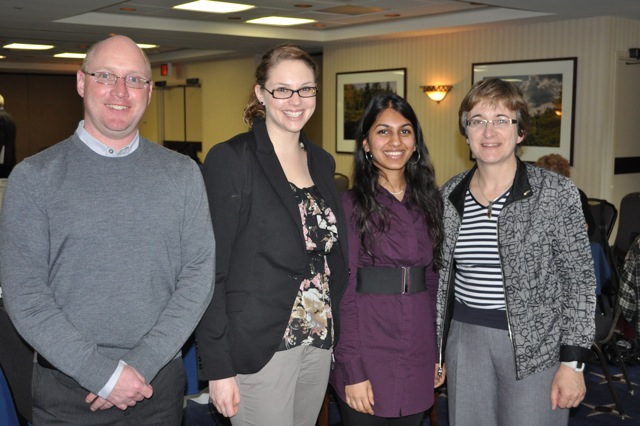
Students for Medicare recently presented in Ottawa at the Canadian Health Professionals Secretariat (NUPGE). L to R: Mike Luff (NUPGE), Jillian Alston (SFM), Ritika Goel (SFM) and Elizabeth Ballerman (CHPS Chair, HSAA).

Students for Medicare (SFM) are Canada’s future health professionals. Not only are they preparing themselves for careers in health care, but are taking a proactive stand about the kind of system they want to work in.

This Saturday SFM is holding a half day mini-conference featuring some very familiar names in health care: Dr. Michael Rachlis (Health Policy Analyst, Author), David McNally (Political Science Professor, York University), Dr. Gordon Guyatt (Researcher, Medical Reform Group), Sara Clemens (Health Policy Analyst, Registered Nurses Association of Ontario) and Dr. Ahmed Bayoumi (Researcher, Medical Reform Group).

Topics will look at issues of sustainability, user fees, private clinics retirement homes and a keynote examining where Canada fits within changes affecting global health care delivery.

When: Saturday, May 28 / 12 Noon – 4:30 pm
Where: Li Ka Shing Knowledge Institute, 209 Victoria St., Toronto
(Across from St. Michael’s Hospital)
Admission: Suggested donation of $5 at the door

Students for Medicare is an organization that advocates for strengthening Canada’s publicly-funded, not-for-profit health care system. SFM has a strong commitment to equity and addressing the social determinants of health. They believe health care is a right and should not be treated as a market good.

OPSEU’s Hospital Professionals Division is among the sponsors for the event.

For more information, go to www.studentsformedicare.ca

Burk’s Falls looking for input to establish community health centre

Whether or not Burk’s Falls has access to a hospital-run health facility depends on who is in government. The Liberals have closed it under David Peterson. The Tories re-opened it under Mike Harris. The Liberals closed it again under Dalton McGuinty.

Now the community is putting together a business case to establish a full community health centre. As part of that development, the community is hoping to get an urgent care centre as part of the package.

Local mayors and councillors are behind the project, along with a representative from the Burk’s Falls Family Health Team. The McGuinty government argued that the FHT would replace the Burk’s Falls facility operated by Muskoka Algonquin Healthcare. Since that time, the community has been without nearby access to urgent care. The fact that the FHT is involved with the project speaks volumes as to whether they regard themselves as a “replacement” to what was lost.

The Burk’s Falls area has a full-time population of 12,500 but swells in the summer to 25,000. It is located north of Huntsville en route to North Bay.

The municipal committee looking to establish an Amalguin Health Centre have put up an on-line survey as part of the business case they are developing for the centre.

You can access it by going to  http://www.surveymonkey.com/s/WLTKSJW

The community has also established a web site at http://www.almaguin-health.org/4828.html

 Community Health Centres are an excellent model of health care delivery. Not only are they models of integrated health care, but CHCs often are involved in community building, from literacy programs to diabetes education.

The committee looking to establish a CHC is Burk’s Falls may want to look at Etobicoke’s LAMP Community Health Centre, which mixes core health services with immigrant settlement services, kids nutrition programs, a youth drop-in centre and more. It takes the social determinants of health seriously and provides real “upstream” services aimed at not just treating illness and injury, but preventing it in the first place.

OPSEU members toured LAMP several years ago as part of a conference staged by the Association of Ontario Health Centres.

Mr. Lahey says get out and vote

Mr. Lahey from the Trailer Park Boys (John Dunsworth) tells students to get out and vote in his own unique way. You don’t have to be a student to take Lahey’s challenge! Warning: Coarse language!

Canadian Health Coalition puts together federal election primer

The Canadian Health Coalition has put together a primer for the Federal election. The CHC raises several issues you can ask Federal candidates about, including where they stand on:

  • Enforcement of the Canada Health Act so Canadians don’t face user fees, illegal bills and queue-jumping.Establishment of  national standards for an integrated, seamless system of care that includes long-term care, home care and palliative care.
  • Creation of a universal public drug plan – Pharmacare –so all Canadians have access to safe, appropriate and affordable medicines.
  • Commitment to the renewal of the Health Accord in 2014 with adequate federal funding, national standards and accountability for how the money is spent.
  • Ensuring national standards and accountability through federal leadership.

Event: Day of Action — April 9

Our cities, our services our future — the broad-based coalition of labour and student groups are calling a day of action in support of public services April 9.

With the new Mayor of Toronto adopting an agenda similar to the U.S. Tea Party movement, the Good Jobs Coalition says there is a lot at stake regardless of whether you live directly in the city or not.

Coinciding with the last day of OPSEU’s Convention, the day of action is asking you to come to Toronto’s Dundas Square on Saturday, April 9 at 1 pm. After a few short speeches, the rally will march the few blocks down Queen Street to City Hall. Send a message to Rob Ford, Dalton McGuinty and every mayor in Ontario.

For more information, contact Rally organizer Laurie Hardwick (OFL) at 416-571-3087 or e-mail lhardwick@ofl.ca

Endorsing organizations include: Ontario Federation of Labour, Good Jobs For All Coalition, Canadian Federation of Students-Ontario, Canadian Labour Congress, Toronto and York Region Labour Council.

Video: Operation Maple focuses on Ontario Shores

Operation Maple makes on-line videos of issues important to Canadians. Recent they posted a video about the situation at Ontario Shores Centre for Mental Health Sciences. A parent speaks about taking her son out of the rehab program if the Child and Youth Workers are gone. At present 28 of these specialized and highly skilled workers will be out of a job by mid-April if the hospital doesn’t change course. See this video:

In Brief – “A concerted corporate attack on independent groups” – BC pharmaceudical researcher

BC is ending its contract with Therapeutics Initiative — an independent drug watchdog organization and is instead substituting a Drug Review Council which allows individuals with drug company ties to participate in the review process. Based at the University of British Columbia, Therapeutics Initiative had enjoyed an excellent international reputation and is widely credited with saving more than 500 lives in the province after it warned about the dangers of rofecoxib (better know under its trade name Vioxx) and rosiglitazone. This was long before reports linked the drugs to an increased risk of heart attacks. James Wright, managing director of the Therapeutics Initiative, told the British Medical Journal “our job was to assess the evidence and provide unbiased information to the government so they could make a funding decisioin. You need an independent group that provides you with the information, and that’s what they have abolished.” Alan Cassels, a pharmaceudical policy researcher at the University of Victoria, told the BMJ “I see this as a global problem, a concerted corporate attack on independent groups.”

Addressing poverty would pay off in reducing health care costs – Stanford

CAW economist Jim Stanford writes in Wednesday’s Globe and Mail that Canada could cut diabetes costs in half by improving the living conditions of our poorest citizens. “There is now hard medical evidence that a person’s economic status and social participation directly affects their physical health,” he writes. “And that, in turn, affects the cost of health care. This is not vague, bleeding-heart sentimentalism; it is hard scientific proof.” Stanford says countries with very low poverty rates experience less than half the rate of diabetes as Canada. Matching their performance would save Canada $7 billion in health costs annually. He says the same math could apply to other socially determined diseases, such as hypertension, digestive maladies and mental health.

American unions also fighting back against attacks on public sector

Canadian unions are not the only ones to be addressing the scapegoating of public sector employees. The American Federation of Federal, State, County and Municipal Employees has launched its own campaign “Stop the Lies.” Check out their video below:

Video: Funny BC commercials highlights role of modern health team

The Health Sciences Association of BC (NUPGE) has put together two funny television commercials highlighting the role of health professionals in delivering modern healthcare. In the first, a patient is in need of emergency help in a restaurant, and the doctor on the scene realizes he needs considerable help. A second commercial deals with an office environment where a worker has a rather unique heatlh problem. The commercial warns that with fewer health professionals, wait times will increase.

Does Windsor Hospital CEO know what’s going on?

Submitted as a letter to the editor, Windsor Star.

David Musyj, President and CEO of the Windsor Regional Hospital, asks last week “(don’t unions) know what’s going on in the world?” One could very well ask the same of him.

Musyj should have known what the outcome of last week’s arbitration decision would be. After all, the OPSEU arbitration was not the first to be decided upon since the government introduced its wage restraint legislation. It was evident all along that the arbitrators would use last November’s OPSEU hospital professionals’ arbitrated central agreement as its guide.

If he had read the legislation, he would have learned it didn’t legally cover these workers nor the time frame the collective agreement covered.

If he was so short of money, he could have arrived at the same destination without the considerable costs and efforts surrounding the arbitration process by agreeing to these inevitable terms beforehand. Other hospitals did.

Musyj might have also looked to the more than 150 other public hospitals across the province which are receiving similar funding levels and are mostly managing to balance their budgets despite such rulings.

Yes, he signed an accountability agreement with the Local Health Integration Network legally requiring him to balance his budget, but had he read the fine print, there is an exemption in that language to allow for arbitrated decisions.

Finally, while he was crying on behalf of the province that the cupboard was bare, he appears to have no comment when it comes to the $2.4 billion per year in corporate tax cuts the government is phasing in. Seems the cupboard is only bare for some, not others.

Musyj could have had an agreement at the bargaining table. Instead he rolled the dice on long odds and predictably lost. Now we’re supposed to feel bad for him?

Warren (Smokey) Thomas

President, OPSEU