Category Archives: Uncategorized

New head of UK health system says centralization of hospital services a mistake

The Ontario government has frequently looked to England in setting the course of health care reform.

From public-private partnerships to “commissioning” of private clinics to deliver public care, the model has also given us a preview of what mistakes are about to be repeated here.

This week as Georgina Bay General Hospital announced it would be shuttering the tiny hospital serving Penetenguishene, the new head of England’s National Health System is saying his country should stop closing “cottage-style” hospitals and instead treat patients in their own communities.

UK’s The Telegraph reports that Simon Stevens has recognized that British hospitals are now among the worst in Western Europe at caring for local populations because too many services have been stripped and centralized.

“Most of western Europe has hospitals which are able to serve their local communities without everything having to be centralized.”

Stevens says the UK needs to abandon its fixation on “mass centralization.”

Continue reading

Liberals promise to cap hospital parking fees after pushing them upward

After years of telling hospitals to raise the price of parking to make ends meet, the Liberals are now saying they will cap such costs for frequent users should they be returned to office.

The cost of parking tends to get little attention by policy makers, but for someone with a chronic condition this can add up to a levy of thousands of dollars depending on how often they have to return to the hospital for appointments.

When the Rouge Valley Health System ended its discounted rates for frequent users of the hospital back in 2011, we calculated that cancer patients attending three times a week would experience $2,400 in additional yearly costs for their care. For those attending the weekly cardiac rehab program, it added up to $800 more per year.

Compare that to the much resented McGuinty health tax which topped out at $900 a year for the wealthiest of citizens.

Continue reading

Bell starts as deputy minister days before Ontario goes to the polls

Just days before an Ontario election Dr. Bob Bell is taking up the post of Deputy Minister of Health.

A former orthopaedic surgeon, Bell is likely most familiar to Ontarians for his place on the annual sunshine list. In 2012 Bell was top earner among Ontario hospital CEOs, drawing $753,992 in pay at Toronto’s University Health Network.

Now he will be the highest paid deputy minister, albeit earning $436,488 in salary and taxable benefits – or slightly more than half of his previous compensation.

Bell also recently waded into the controversy around Medical tourism, telling the Toronto Star that health care is a “potential source of wealth for Ontarians.”

The Star reports the UHN made $50 million over three years treating 380 international patients in Toronto as well as offering consulting services.

Continue reading

“We hope the OPP is taking note” — Meagher

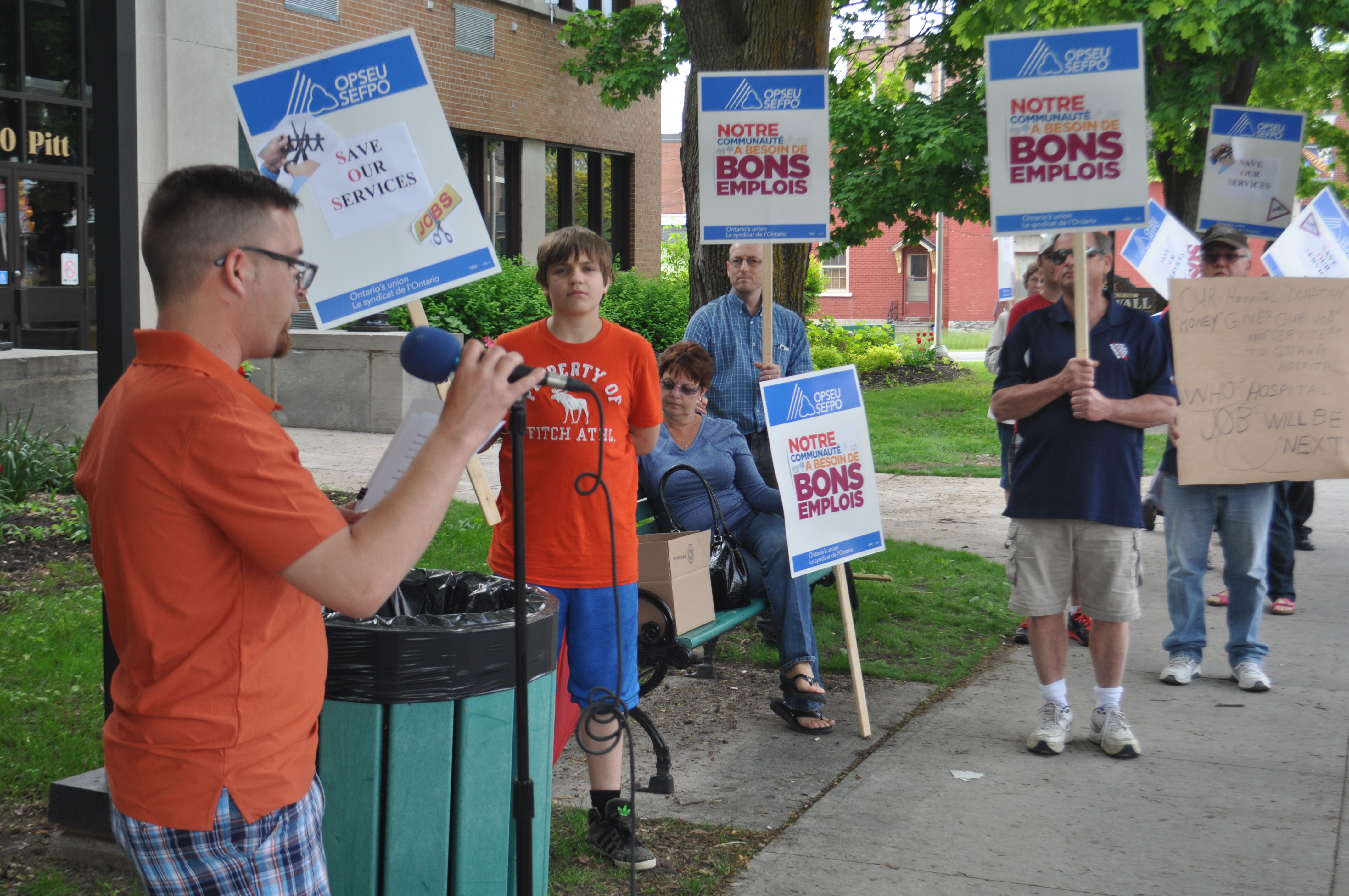
Protesting cuts to the Cornwall Community Hospital lab Monday night.

Protesting cuts to the Cornwall Community Hospital lab Monday night.

CORNWALL – Residents and laboratory staff at the Cornwall Community Hospital marched outside of city hall last night to try and save local histology services in the St. Lawrence Seaway community.

The Eastern Ontario Regional Laboratory Association is cutting four laboratory jobs in Cornwall and sending tissue samples to Ottawa to be prepared and then sent back to Cornwall for analysis. That’s a round trip of 212 kilometers.

Noting the hospital’s claims that the round trip will somehow speed up the process, OPSEU Local 475 President Richard Meagher says “EORLA must have some very fast drivers. We hope the OPP is taking note.”

The union is arguing the cuts are motivated by money, not by service quality.

Meagher questions the claims made by EORLA President Craig Ivany that preparing the tissue slides in Ottawa would be “better.”

“How so?” asks Meagher. “Is EORLA now saying there is a problem with the slide preparation here in Cornwall?”

The protesters were greeted last night by a number of Cornwall City Counsellors, including provincial NDP candidate Elaine MacDonald.

Council later decided to seek legal opinion on an injunction to stop the transfer of histology lab services out of the city. They continue to ask for a briefing by hospital CEO Jeanette Despatie. Despatie has to-date refused to meet with the Council.

See also: Cornwall: Tonight’s rally asks Despatie to stop hiding behind EORLA

OPSEU Local 475 President Richard Meagher addresses the group gathered outside Cornwall City Hall.

OPSEU Local 475 President Richard Meagher addresses the group gathered outside Cornwall City Hall.

Party Platforms – New Democrats pledge to address health care wait times

The New Democrats health platform is about addressing wait times.

They say they will cut ER wait times in half and make health care a priority.

This is their four-year plan to reduce ER waits:

• They plan to open 50 24-hour family health clinics across the province. This is in addition to existing urgent care centers and walk-in clinics. About 25 per cent of Ontarians presently access a walk-in clinic at least once each year.

• They plan to add 1,400 new long-term care beds to the present stock of 77,000.

• They also plan to recruit 250 nurses practitioners to assist in the hospital ERs. This has been costed at $30 million per year. In their platform they note that St. Michael’s has been successful in reducing ER waits using three nurse practitioners in a fast track process.

The New Democrats have brought back their earlier pledge to establish a “five-day” guarantee for home care service. They intend to do this by adding $30 million a year to the home care budget. At present about half of the provinces Community Care Access Centres are reaching that target as an average, the other half are still struggling to meet demand. The annual budget for Community Care Access Centres to deliver home care is $2.2 billion.

Other initiatives

Beginning in 2015-16 they would set aside $5 million a year to forgive student debt for doctors who agree to practice in underserviced areas.

They would also set aside $230 million in 2015-16 towards a family caregiver health credit and increase it by $10 million per year. Primary caregivers who help with basic functions of daily living would receive a tax credit of $1,275 per year.

Andrea Horwath has also pledged to extend the Ontario Ombudsman’s jurisdiction to cover health care. The Wynne government had recently announced it was expanding the ombudsman’s reach to the MUSH sector – Municipalities, Universities, School Boards and Hospitals – but had excluded health care. Instead the Liberal plan would create a separate patient ombudsman.

For more information regarding party positions on health care, click here.

Cornwall: Tonight’s rally asks Despatie to stop hiding behind EORLA

CORNWALL — Jeanette Despatie needs to stop hiding behind the Eastern Ontario Regional Lab Association and answer the community’s questions about the transfer of medical laboratory tests to Ottawa.

Despatie, the CEO of the Cornwall Community Hospital, was originally expected to appear before Cornwall’s City Council tonight to explain how the transfer in service reflects an improvement to local residents. The city donated $12 million towards the hospital’s redevelopment project under the understanding that services would improve. Despatie has refused to show up to answer questions from Cornwall’s elected representatives.

It begs the question: what has she got to hide?
Continue reading

Promises to fix long term care tepid despite 29 violent deaths

We hope they will take time to remember the 29.

Diablogue Election Primer graphicToday the Ontario Health Coalition is launching their rocking chair tour across the province to draw attention to the lack of staffing in the province’s nursing homes.

Lack of staffing means missed baths, long waits in soiled incontinent pads, rushed feedings and too little time to pause for a friendly bit of conversation with a frail and often isolated senior. It also means danger.

Between 2003 and 2012 there were 29 seniors killed in resident-on-resident assaults in Ontario’s nursing homes.

Last year it was Francisco DaSilva and Jocelyn Dickson. He was age 87, she 72.

There are numerous remedies that have been proposed, including better staff training and specialized facilities for persons with cognitive impairment.

Every report that has looked at the situation has come back with a recommendation to increase staffing in these homes.

Continue reading

Election 2014: Conservative media turn against 100,000 job cut plan

Tim Hudak’s promise to cut 100,000 jobs in the public sector is worrying even fellow Conservatives.

Diablogue Election Primer graphicIn today’s National Post, right-wing columnist Tasha Kheiriddin says she can’t vote for Hudak because his education cuts would threaten kids with special needs, including her own four-year old daughter. “One in 68 kids is now autistic,” writes Kheiriddin. “We need more support workers and early childhood educators, not just for the kids who have difficulties, but to make sure they don’t draw all the teachers’ attention away from the kids who don’t.”

Newstalk 1010 is known for its over-the-top Conservative vitriol, but today Dave Agar started to do the math on what a cut of 100,000 public sector jobs would mean. “That’s a hundred thousand fewer people spending at the grocery store and the Canadian Tire and the Home Depot, at your favorite restaurant or bar or movie theatre,” Agar said, noting a Canadian Centre for Policy Alternatives report that indicates 50,000 private sector jobs would also get side-swiped by such a public sector cut. Asking what would we get, Agar says “the only thing that seems certain is the province’s books would be balanced one year earlier than the Wynne government plan.”

The Globe and Mail, no fan of progressive politics either, said in its May 12 editorial the 100,000 job cut plan “looks ill-considered and excessive.” They note “at current deficit levels, the province’s debt-to-GDP ratio is barely rising,” highlighting the fact that Ontario remains one of the lowest spending provincial governments. By the time you calculate public sector jobs beyond Hudak’s reach (municipal, federal) and those he has vowed not to touch (doctors, nurses and OPP) that leaves 650,000 public sector workers at risk, most, the Globe warns, of whom work in education, health and social services. That would amount to a cut of about one in six jobs.

Election 2014 Briefs: Hudak as Donald Trump? Let the wild rumpus begin

Kathleen Wynne certainly has someone on staff who is working overtime coming up with bon mots for the Premier. The media reported Wynne’s comments on Tuesday about PC Leader Tim Hudak’s plan to slash 100,000 public sector jobs. She said “no one since Donald Trump has been as eager as Tim Hudak to say the words ‘you’re fired.’” The Premier likely senses that the extreme pledge to cut jobs – more than double Mike Harris’ public sector roadkill – is unpopular and likely to be a wedge issue. Last Friday she succinctly suggested that Hudak was converting “paycheques into pink slips.” We’ve noticed that our friends at CUPE also thought that summary phrase a good one and are urging their members to stop Tim Hudak’s “pink slip pledge.” Has anyone calculated just what the severance alone will be, much less the cost of recruitment when we truly find out how many really were essential?

Just prior to the Sousa budget, Kathleen Wynne had announced that the province’s lowest waged personal support workers (PSWs) were going to get a retroactive raise. The minimum wage for PSWs has been stuck at $12.50 per hour since 2006. The government said it would raise that amount by $1.50 retroactive to April 1st. The Personal Support Network of Ontario issued a bulletin this week saying they have been leaving messages with the Health Minister’s office to clarify the status of the raise. The PSNO said they spoke with a political staffer and expressed their disappointment, saying this “was a serious letdown to the sector and to the workforce.” In reporting on the original  announcement, the Globe and Mail said given the first $1.50 raise is retroactive, “it would take effect even if the budget falls, forcing a snap election.” That raise is expected to cost the government $50 million this budget year.

Continue reading

Nursing Week award winners prove system is far from broken

On Monday night in introducing Dr. Danielle Martin to his speaker series, Bob Ramsay suggested that Ontario’s health care system is broken.

It’s a bit of a stretch to look at the challenges we face and conclude the system is entirely broken. As Dr. Martin herself said, you can find failures in any health system.

What is often hard to measure is the commitment by those working within the system. Most of the front line staff we speak with have chosen these professions precisely because they are caring occupations.

Patients and families still recognize the effort, especially facing constrained budgets and escalating workload. We’ve seen more than a handful of letters in the media that express surprise with the quality of patients’ care experience. Like Ramsay, the publicly expressed concerns about system often lead patients to conclude the worst.

This afternoon we got news that four OPSEU nurses have received “caring” awards as a result of testimonials by listeners of a regional chain of radio stations.

Bayshore Broadcasting is profiling the winners on their radio station as well as on-line at their Healthy Tomorrow’s website. Click here to read the detailed comments about each.

The four OPSEU RPNs are among 26 award-winners this year.

OPSEU winners are:

Helen Rice, RPN, Participation Lodge (Local 235)
Lisa Slot, RPN, Wiarton Hospital (Local 260)
Jennifer Wonch, RPN, Lee Manor (Local 299)
Holly Bowen, RPN, Meaford Long Term Care (Local 289)

Congratulations to all.


If you liked this story, please share it with others using the button below.