Going backwards — Fresh food preparation may be lost in Scarborough-Rouge merger

The Scarborough Hospital has been an innovator in food services at its main campus. Last year it garnered considerable media attention by bringing in a consulting chef to work with the hospital in developing a menu that would feature locally grown foods that are prepared from scratch in their kitchens.

Toronto Chef Joshna Maharaji told the Toronto Star last year “now their humanity is required when they work. Now they have to smell and taste and make judgments instead of just executing a very standardized plan. That’s real evidence of change.”

Now that change may be under threat as The Scarborough Hospital looks to standardize food services with its potential merger partner, the Rouge Valley Health System.

Instead of going to the innovative service Scarborough began, merger talks appear to be leaning towards the less-than-optimal rethermalized food service at Rouge.

Continue reading

Video: The incredible shrinking Kingston hospital

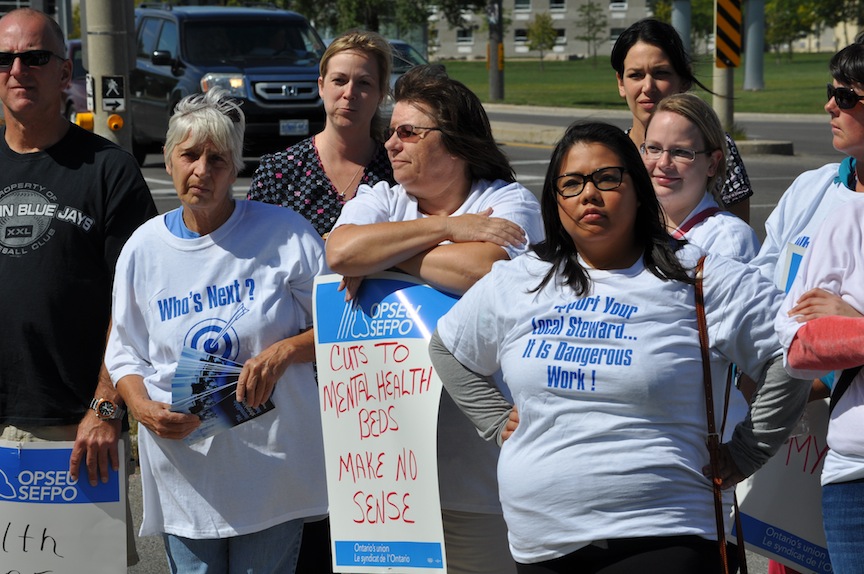
Following Monday’s demonstration outside the former Kingston psychiatric hospital, Providence Care is now telling staff that the job cuts and bed closures are not about funding. Really? Even though the hospital is running at capacity, even though it is next to impossible to get a loved one admitted to a bed, even though long-term projections suggest greater need for mental health services in Kingston, even though the situation has become volatile with overcrowding and understaffing, the hospital expects us to believe that this is all part of the plan.

Sigh. If this is the plan, Providence Care desperately needs a new one.

On Monday we shot video of the demonstration outside the centre (below). If you live in Kingston, please share our video with others. The campaign to reverse the cuts continues. It’s time the LHIN involves the community in a plan that actually makes sense. Stay tuned for more events.

Perram House – Oct 5 public memorial of services lost

Public services are lost one at a time, often incrementally.

Take the Shelburne Hospital. Once a partner site of Headwaters Health Care, services were removed from the community one-by-one until eventually the entire hospital closed with barely any protest.

The Ministry of Health prefers to place health services into community-based settings, but the sector is notoriously unstable, often reliant on volunteer donations to make up a percentage of operating costs. When those volunteer donations dry up, many small agencies shutter their facilities before the LHINs can even assess the impact on access to local health services.

Two Toronto artists who call themselves the “Department of Public Memory” are commemorating public services lost in their municipality. That includes placing signs around the city reminding residents of what was once there.

It’s a brilliant idea to illustrate how our city is changing and who is being left out in the process. Their latest project is one such small but valuable health agency that didn’t succeed.

Continue reading

Mental health – is living in the park really an improvement?

Protesting outside of Kingston's Providence Care September 9.

Protesting outside of Kingston’s Providence Care September 9.

KINGSTON – Tracey Newton has worked at the old Kingston Psychiatric Hospital for 25 years. In that time she has seen many changes, including the tightening of access to the hospital’s services for those in the community that need help.

She arrived early at McBurney Park on September 2nd for the local march and picnic celebrating Labour Day. As the labour activists arrived, the homeless departed the park, including some of her former patients who had clearly spent the night there.

In our heightened skeptical age it is too convenient to dismiss workers as being self-interested, but it was clear speaking with Newton yesterday that the encounter was upsetting. With another 40 beds due to close, how many more former patients are now going to be sleeping rough?

The mantra in mental health has been community care, not institutional care. It has given the government the cover to make massive cuts to beds and outpatient services delivered by the province’s psychiatric hospitals.

It hasn’t meant replacing the scale and scope of these services in the community.

Kingston’s Providence Care is getting squeezed by more than bed reductions associated with the outdated planning associated with new semi-privatized replacement hospital.

They are seeing more developmentally disabled patients admitted to these beds, likely part of the consequence of closing the former Rideau Regional Centre in Smith’s Falls. Those patients too were supposed to be better off the in the community, but here they are.

Continue reading

Kingston forecast for Monday: 18, sunny and loud

On Monday we will be in Kingston for the third time this year to talk about issues at Providence Care – Mental Health.

Last February we stood with staff and community members picketing in the bitter cold to protest changes they didn’t feel were in the best interests of patients. It was so cold that the iPod we were playing to keep the picket festive froze.

At the time program cuts, understaffing and overcrowding were creating significant challenges for caregivers and support staff.

We were back again April 13 for the community plebiscite vote around the proposed new P3 hospital to replace Providence’s rehab and mental health facilities. Unusually cold for the early spring, about 10,000 Kingston residents none-the-less took time and voted 96 per cent in favor of keeping the proposed new hospital completely public. At a time of austerity budgets, it was hard to imagine why the province would want to sign a deal that would hamstring the hospital with a 30-year private maintenance and financing agreement that even the local MPP admitted would be more costly than the public alternative.

Monday we are responding to news that almost one in five professional and support staff at the hospital will be without a job in the new year. When Providence Care announced the new hospital back in 2011, they made it clear that it is planning for the future by delivering less – 40 fewer mental health beds than presently exist.

Continue reading

CMAJ: Are we betting on the welfare of our patients?

This week’s editorial in the Canadian Medical Association Journal may have raised the eyebrows of some hospital CEOs.

John Fletcher raises a question we asked more than year ago – does the duty to first ‘do no harm’ apply to gambling meant to support public services?

In February 2012 we questioned the role Susan Pigott (VP at the Centre for Addiction and Mental Health) played in the recommendations made by the Drummond Commission to increase access to gambling in Ontario. The recommendation was one of many by the Commission that appears to throw the well-being of citizens overboard to shore up government finances.

How different is it for hospitals to do the same, given hospital lotteries have become so ubiquitous in Ontario? The CMAJ says it is contradictory to ban hospitals from selling tobacco while allowing them to promote another addictive habit – gambling.

Continue reading

Deb – enough with the scary nonsense

It is very unlikely that Deb Matthews personally wrote the letter sent to a member of the Quinte Labour Council about local hospital funding. She did sign it, which suggests she may have actually read it. Maybe.

The letter has been circulating recently, serving to raise more ire than balm.

There it was again – the claim that “without change of course, health spending would eat up 70 per cent of the provincial budget within 12 years.”

If you really want to scare people, try suggesting alien spaceships will land in Nathan Phillips Square disembarking a robot army that will change life forever. The two scenarios, the 70 per cent and the robot army are about equally likely. At least in the latter scenario we would be rid of Rob Ford.

Perhaps Matthews should tell her letter-writing minions to cool it on the rhetoric about how health care is about to consume huge portions of the provincial budget if not for their heroic efforts to reform the system. It’s getting old and most sensible people know by now that it is simply not true.

Continue reading

Reflections about union blogging on Labour Day weekend

Many of you have told us how much you like our BLOG. Some of you must be telling others because our readership is growing by about 50 per cent per year. Please – tell more people: we’d like to have even more participation in our ongoing conversations. Subscribing is free!

Many of you have left comments after our posts. Some have e-mailed us directly or pulled us aside at conferences and meetings to say how much they appreciate what we are doing.

The ability to do this is a privilege and couldn’t happen without the support of OPSEU’s leadership and the 47,000 health care professionals and support staff we represent. It also couldn’t happen if we didn’t have you reading and participating.

We were blown away recently when the owner of an OHIP designated private physiotherapy clinic left a comment stating that our post about recent government changes affecting his clinic to be “the most honest and objective article I have read so far” on the topic.

This spring we attended a speech by a doctor we immensely respect. In response to a question we asked, he raised points using language employed by this BLOG about a week earlier. We could see first-hand that our conversations were echoing into the community.

There is a false dichotomy between labour and community that corporations and the wealthy like to exploit. We’ve seen it in the kind of resentment some are trying to build towards unionized workers in an effort to take away rights and reduce pay for all workers. If it isn’t union versus non-union, they are equally happy to divide public from private sector workers. That includes the provincial Tories, which have issued a white paper advocating policies that would turn the clock back on labour rights by nearly a century. This is one conversation you should really have before the next election with family, friends, neighbours, co-workers and anybody who will listen.

Continue reading

Scarborough-Rouge: Merger process open, if not entirely perfect

After a lengthy period where hospitals appeared to be more interested in regional cooperation than formal mergers, the trend appears to be shifting again.

The financially stressed Scarborough Hospital has been looking for a dance partner for some time, initially proposing merger with Toronto East General Hospital. When that initiative spectacularly fell apart, the Central East LHIN directed the hospital to look closer to home at the Rouge Valley Health System which maintains a hospital on the eastern part of Scarborough and another in Ajax.

Our initial thoughts were that a formal merger would be very unlikely. After crawling out of their own significant financial difficulties, Rouge has been running surpluses for several years. It has also had to contend with rapidly growing demand on the Ajax side – the eastern GTA among the fastest growing regions in the province. Would they really want to take on new financial challenges that a merger with Scarborough would bring?

Both Rouge and Scarborough have been bruised by past battles with their communities over changes to clinical services. OPSEU even took the Central East LHIN to judicial review in 2008 over the secretive nature of its decision-making process when Rouge failed to consult on changes to its mental health services.

During those earlier battles Rouge Valley admitted to the Durham Regional Council that community opposition to their plans had made a dent in the ability of their foundation to raise money. Durham Region at that point had been considering withholding contributions (it didn’t).

Things have certainly changed.

The process at this stage appears to be an open one and perhaps even a partial model for other hospitals considering merger. A web site has been set up including an on-line survey. 16 community town halls are taking place. Staff town hall meetings are even being shared on YouTube by Rouge Valley. Staff who cannot attend the town halls are being invited to communicate during “huddles” in patient areas. Three tele-town hall meetings are being planned for September and October. Fifteen working groups have been set up between the two hospitals – 11 for front line clinical services and four looking at back office functions. The discussions from these groups are being shared in on-line workbooks that the public and staff can further contribute to.

The problem at this point is that everything is very vague – as one would expect early in the process. There are few concrete proposals to react to, and the hospital has suggested that many decisions may not even happen until a merger has already taken place and a new board appointed — including which services get offloaded to community-based providers. That may not satisfy those worried about loss of jobs, services and relocation of clinical care. Before a final recommendation is made, staff and the community should have an opportunity to look and respond to the proposed detailed plan. The hospitals have promised that the community will have an opportunity to respond should a recommendation come forward for merger.

Continue reading

Short takes: The “Savvy State”, accreditation of border nurses, and parking as health care

This winter we noted the constantly shifting terminology around cuts to clinical services at The Ottawa Hospital. At first the public was told by the Health Minister and Premier that cuts to thousands of endoscopies at The Ottawa Hospital were part of health care restructuring. We asked why it was therefore not being treated as an integration decision by the Champlain Local Health Integration Network? The LHIN replied that because the “cuts” (not restructuring) were actions taken as part of the hospital’s accountability agreement, no integration decision was required. For the public, no integration decision means no consultation and no transparency. Despite multiple protests around the cuts and profile given to the issue during the Ottawa South by-election (in which the Tories oddly said jobs were being cut at the hospital because of too much spending on health care) the Champlain LHIN refused to consider intervening. Given its lack of interest in a massive transfer of diagnostic services in the Ottawa area, it is remarkable to note what the LHIN is now deciding upon: parking. While the Ottawa hospital could cut clinical services at will, it sought the approval of the LHIN to build a new $12.5 million parking garage that will be paid for over four years by drivers shelling out $13 a day. Evidently parking is important to health planners. Endoscopies? Not so much.

Last week we noted that Hamilton Health Sciences was caught off guard by a Freedom of Information (FOI) request issued by the Hamilton Spectator. The newspaper had requested executive and board expenses going back to 2007 at the hospital. HHS initially told the newspaper that it would pass on costs of more than $17,000 to retrieve thousands of invoices from an off-site storage facility. The hospital also said it would take staff until the end of the year to sift through the invoices to fulfill the request. Upon appeal, the hospital has now agreed to supply the information by the end of September and fees have been reduced by the adjudicator to $1,228. The fact that a hospital with an annual budget of $1.2 billion could not access these records electronically was astonishing to us, although CEO Murray Martin told the newspaper that in the past year they have implemented a fully electronic financial software system. When Diablogue used the same FOI process last year to track staff-management changes at 20 Ontario hospitals, many claimed to have to resort to manual processes to fulfill our request. It cost us more than $1600 to get the answers demonstrating the freedom of information is far from free.

Continue reading