News of failed private endoscopy clinic coincides with hospital’s intent to divest more endoscopies

It shouldn’t have been a surprise to anyone in Ottawa.

When the College of Physicians and Surgeons of Ontario finally released the list of private clinics that failed their inspection, it included one Ottawa endoscopy clinic that was already the subject of a rare public warning in 2011. The 2011 warning suggested that patients of the private endoscopy clinic may have been exposed to HIV, hepatitis B, and hepatitis C as a result of equipment that may not have been properly sterilized.

After nearly 7,000 patients were asked to get tested, five were found to have contracted either hepatitis B or C. The five are part of a larger class action against the clinic, although connecting their disease to unsanitary equipment may be difficult to prove.

Given everyone knew the list of clinics that failed inspection would soon be made public, it is curious that Dr. Jack Kitts, CEO of The Ottawa Hospital, should suggest during the same week that he intended to divest 5,000 endoscopies a year from the hospital to private clinics. Perhaps unfairly, the question must have been none-the-less on everyone’s mind: divest to clinics like this?

An endoscope is a diagnostic procedure that inserts a camera inside the body with a flexible tube to look at internal organs.

This week’s disclosure by the College gives us a view of the clinic that goes well beyond the issue of improper sterilization.

Continue reading

Ottawa and Hamilton: Significant hospital cuts ahead despite rhetoric from Premier-designate

Dr. Jack Kitts, CEO of the Ottawa Hospital, says he plans to transfer about 5,000 endoscopies to community hospitals and clinics as part of an overall plan to find $31 million in savings towards balancing the hospital’s budget.

Kitts announced last week that 290 full-time equivalent positions would be eliminated at the hospital, including 90 positions in nursing, 100 in administration and support services, and a further 100 “other” health professionals. There is no word whether any senior managers will have to fall on their sword.

The impetus for the cuts are clear – The Ottawa Hospital is facing the long-term prospect of zero per cent annual change in the base funding while costs continue to rise with a growing and aging population. It has little to do with restructuring.

Divesting 5,000 endoscopies may save the Ottawa Hospital money, but it won’t necessarily save the provincial health budget as these costs get borne elsewhere. Then there’s the matter of The Ottawa Hospital facing direct costs related to severing employees. Kitts says it’s cheaper to do these endoscopies elsewhere, but he gives no evidence to back up his claims.

Calculating the human cost of such actions is always much more difficult. The Ottawa Hospital was subject to a major study in 2009 on role overload, suggesting workers at the hospital were already facing anxiety, fatigue, and burnout as a result of having to do too much with too little. For those left behind, the fear of having their workload become totally unmanageable is very real, raising questions about how safe the hospital will really be.

Continue reading

Braving the bitter cold for mental health

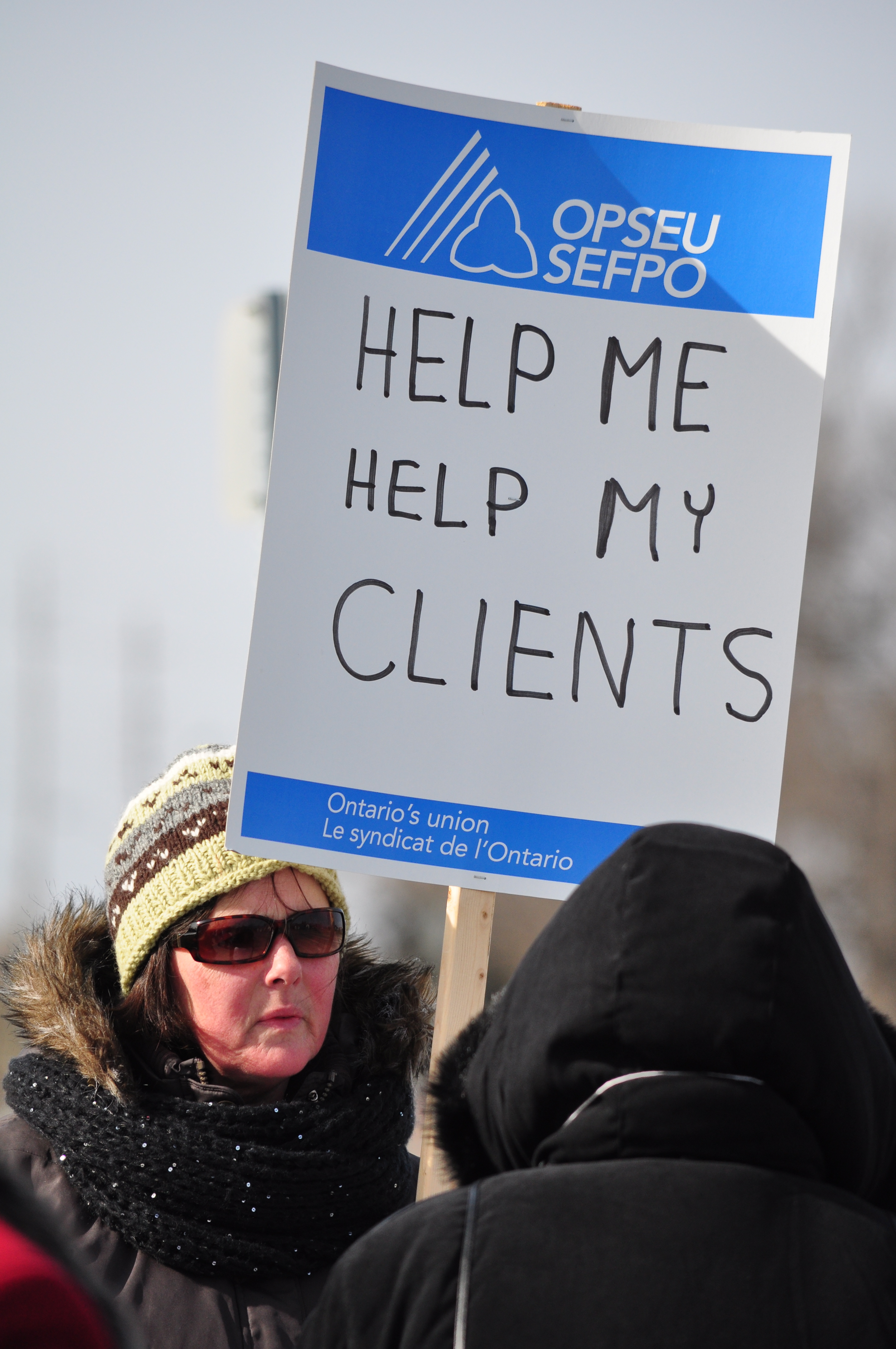
About 80 mental health workers and their supporters braved the bitter cold February 1 to raise concerns about the impact of cuts on Providence Care Mental Health Centre in Kingston.

While both Federal and Provincial governments have made promises about addressing Canada’s inadequate mental health care, the reality on the ground is that more beds are being cut and too few services are being established in the community.

When Providence Care Mental Health Care gets merged with St. Mary’s Of The Lake, the new privatized hospital will have 72 fewer beds than presently exist, yet demand for mental health care is rising.

Kingston workers brave the cold February 1 to stand up for mental health care.

Kingston workers brave the cold February 1 to stand up for mental health care.

OPSEU Regional VP Dave Lundy is interviewed by CKWS TV.

OPSEU Regional VP Dave Lundy is interviewed by CKWS TV.

Workers say units are overcrowded and too few resources are available.

Workers say units are overcrowded and too few resources are available.

Friday Kingston mental health workers to highlight volatile situation brought on by cuts

The formal recommendations around addressing the challenges of mental health always seem to get it right. So why is it that we never get beyond the nice words from politicians who claim to understand?

This Friday mental health professionals and support staff at Providence Care Mental Health Services – the former Kingston Psychiatric Hospital – will be taking their case public. The staff will be holding an information picket outside their hospital to let Kingston residents know of the volatile situation they face on a daily basis.

Overcrowding, program cuts, and understaffing – mental health services in this province weren’t supposed to be like this.

For all the talk of making things better, decisions still appear to be based on austerity-driven budgets, not on improving care for patients.

A provincial all-party select committee on mental health had unanimously agreed in 2010 that we need to do better so that all Ontarians get the mental health and addictions care they deserve. That includes regional assessments on the availability of a complete basket of mental health services, including acute inpatient treatment.

The all-party committee particularly noted that presenters had told them admission and discharge decisions were becoming motivated not by clinical need, but by the shortage of available beds.

Continue reading

Anti-tax business lobby is fed up with special interests (like us)

The Alberta Enterprise Group is a anti-tax business lobby, a good number of the corporate members  involved with that province’s oil patch. It’s board of directors is entirely made up of men – white men.

Speaking at a recent luncheon, AEG President Tim Shipton complained how it was difficult to develop the Canadian economy because of regulatory and political challenges.

He said “Canada is paralysed by special interests and complacency.”

The AEG doesn’t like things like taxes, although they claim they need to do away with regulations and all this opposition to their projects in order to make money so the same taxes they don’t like can pay for hospitals and schools and roads. It’s about public services they say. Yeah, right.

What they are really vexed about is communities not wanting energy pipelines running through their backyard. Apparently the people who live in the path of these pipelines are special interests, whereas the companies that want to profit from these pipelines are doing so in the national interest.

Continue reading

De-integrating home support services in Ontario

Ontario has promised three million new hours of home care personal support services over the next three years. While it sounds like a lot, keep in mind that about 32 million hours of public home care are delivered annually and another 20 million hours are paid for privately. Further, the province is leaning heavily on the sector to offload clients from Ontario’s hospitals. The province tells us that the new hours will assist 90,000 more seniors, or 30,000 more per year. In 2011/12 a total 637,727 clients were served by home care according to the Ontario Home Care Association.

Last year the province introduced a PSW Registry (Personal Support Worker), which sets qualification standards for these workers in order to be on the registry. Without the bother of creating a specific professional college for these workers, the registry was supposed to be a way of maintaining discipline among a group that is generally ill defined and whose duties can vary dramatically.

Just before the December holidays, the province quietly introduced regulatory changes to expand which agencies can provide PSWs to do this work.

The change in policy allows community support service agencies (CSS) to deliver personal support services, but will not require the PSWs hired by these agencies to be on the new registry – at least not yet.

These support agencies have traditionally carried out functions such as delivering meals on wheels, carrying out homemaking duties, running social day programs, and providing transportation services to the frail and elderly. While such services can include respite care, they are generally not the kind of agencies that would provide a bath or assistance with toileting or dressing, for example.

Continue reading

Numbers don’t lie: Cuts to hospital allied health professionals not showing up in community visits

Over the last number of weeks we have been debunking the myth that hospital cuts somehow represent service transfers to the community.

The data for 2012/13 is not yet available, but if we look at the volume of home care services delivered in 2011/12 we can see that for most clinical services, fewer visits –- not more — were delivered than in preceding years.

If hospital cuts truly represented a transfer to community-based services, shouldn’t these CCAC visits be rising, not declining?

The most obvious is physiotherapy. While Ontario hospitals are making significant cuts to outpatient physiotherapy, the actual number of physiotherapy visits delivered in the community by Community Care Access Centres (CCACs) and their agencies has dropped dramatically.

According to the Ontario Home Care Association, in 2005/06 there were 541,101 community physiotherapy visits. By 2011/12 that number had dropped by almost 100,000 visits to 444,054.

Continue reading

P3s for Dummies: Part III — Fool us once, twice, fool us some more

Ontario has been leading the country in pursuing private deals to finance, develop and maintain public infrastructure projects, including a significant number of major hospital redevelopments.

Last week we looked at how public-private partnerships turn projects away from the public interest. In Part I we looked at what P3s are and how the concept of risk has been used to overcome project costs that have been much higher than traditional public procurement. And along the way we poked some fun at the arguments put forward by the business community looking to get rich at our expense.

This week we debunk the myth put forward by the Conference Board of Canada that all is now well in the P3 world.

The Conference Board of Canada has suggested that Canadian P3s fall into two categories – Phase I, which we could summarize as the “we didn’t know what the heck we were doing and made a real mess of things but continued to deny it until the evidence was overwhelming” phase, and Phase II, post 2004, in which provincial and federal governments set up P3 infrastructure offices that, according to the Conference Board, now know what they are doing. Phew! Nothing to see here! Everybody go back to watching hockey.

Of course, when post 2004 P3s go off the rails, they blame it on municipalities, which apparently still don’t know what they are doing. P3s are still a great idea, they say. They just need more, well… rules. After all, this whole idea is not complicated enough already.

Continue reading

Dealing with an unfair funding formula, SBGHC cuts at the top (how novel!)

Here’s a story we don’t see every day: South Bruce Grey Health Centre is cutting two of its four senior management positions as part of its efforts to deal with a budget deficit.

Contrast that with hospitals such as Ontario Shores Centre for Mental Health Sciences, which carved out a new advisory position for its departing CEO at a time when front line staff are bracing for tough times ahead.

The decision may have been slightly easier to make at SBGHC given two senior managers are retiring. However, as most front line workers already know, when you cut vacant positions, it still has an impact on the workload of those left behind.

SBGHC is one of the few hospitals to have weathered the last decade without consistently running into deficit. The fact that they are now forced to trim their sails owes a lot to a punitive new funding formula emerging from Queen’s Park. Small rural hospitals weren’t supposed to be part of that formula, but because SBGHC combines resources from four small hospitals together, they do.

The irony is that by consolidating their resources these four small hospitals are being penalized. For the Hanover hospital, which has somehow managed to stay out of SBGHC despite being located within the same geographic area, they must be breathing a sigh of relief.

Continue reading

Image

Rally for a better Ontario early Saturday morning

rally