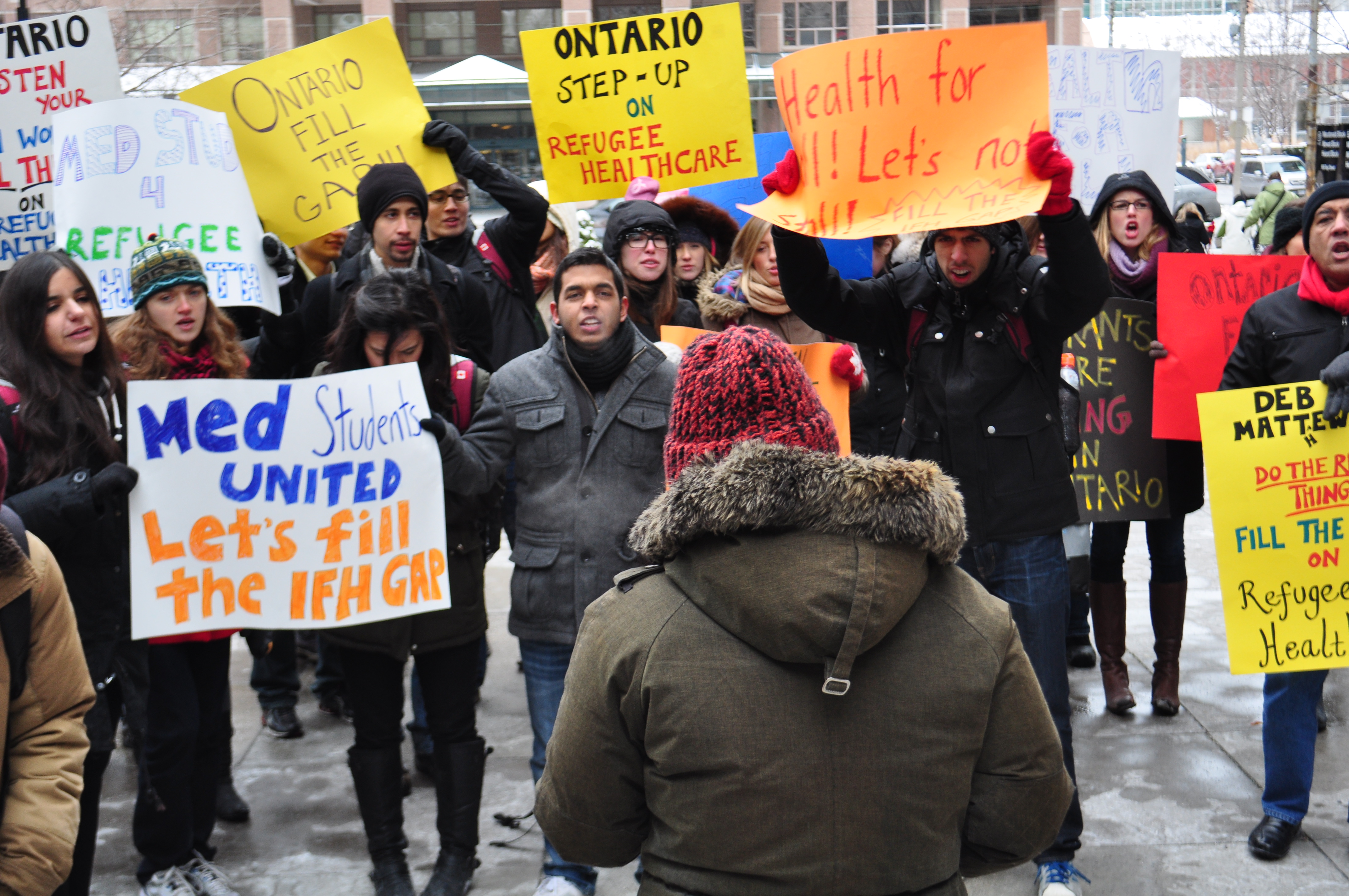
Refugee Health: Health care workers and students freeze outside waiting for Matthews

Protesters demand Deb Matthews fills the gap in health care coverage created by Federal cuts to refugees.

Protesters demand Deb Matthews fills the gap in health care coverage created by Federal cuts to refugees.

There were hard lessons learned today about how democracy is practiced in this province.

About 60-70 protesters, most young health care workers and students, spent more than an hour and a half today outside the downtown Toronto offices of the Ministry of Health. They waited in the bitter cold, hanging on for a possible meeting with Minister Deb Matthews. The size of the crowd varied as participants left and returned again in an effort to keep warm.

Upset about last year’s changes to the Interim Federal Health Plan that would deny many desperate refugees access to our health system, the protesters wanted Ontario to fill the gap left behind by the senior level of government. Several other provinces – including Saskatchewan, Manitoba and Quebec have already done as much. Manitoba said it would send the bills back to Ottawa.

So why is Ontario waiting?

Health Minister Deb Matthews had already provided the group with all the arguments they needed. She wrote to Federal Citizenship and Immigration Minister Jason Kenney back in December, suggesting that such cuts not only represent downloading to the provinces, but risked escalating the cost of care for these individuals as small problems turned into larger ones without access to reasonable health care coverage.

Continue reading

In Brief: Hospital cuts as transfers, Pupatello’s ego gets the better of her

Pop quiz: who wrote this: “Our government expects – as do health care providers – that this change will exacerbate the health conditions of patients with chronic conditions and those who are at risk of developing such conditions. In addition, given preventative care is less costly that emergency or acute care treatment, your policy represents a significant download to provinces and especially Ontario, where the vast majority of refugee claimants reside.” If you guessed Ontario Health Minister Deb Matthews, you’d be correct. Matthews’ wrote Federal Citizenship and Immigration Minister Jason Kenney in December over the impact of cuts to the Interim Federal Health Program for refugees. Tomorrow (Wednesday) opponents of the federal cuts will be meeting outside of Deb Matthews’ downtown Toronto office to ask Ontario to have a heart and provide stop-gap coverage for these disenfranchised refugees left without coverage. Demo starts at 11:30 am near Bay and Wellesley Streets in Toronto.

Windsor Regional Hospital is closing its long-standing Acute Injuries Rehabilitation and Evaluation Centre after the facility lost $300,000 last year. Once a revenue-generator for the hospital, the centre provides assessment and treatment services to people injured in automobile accidents or on the job. Revenues came from WSIB and other private insurance providers. The hospital claims two other private centres have meant that this insurance work done by the hospital has “dried up.” Curiously Windsor lawyer Suzanne Dajczak told the CBC that the closure would mean costs would shift to the patients. “When you’re injured, you’re under stress, finances generally are cut – in the cases that I see, substantially. They usually come when they’re denied and, yes, they’re going to struggle, and it’s going to be more difficult for injured workers” (Emphasis added). Is Ms. Dajczak suggesting that these private clinics may be less supportive of injured worker claims than the public hospital?

Continue reading

Visible tattoos and piercings on hospital staff okay — arbitrator

The Ottawa Hospital was attempting to fix a problem that didn’t exist when it unilaterally imposed a new dress code on employees according to a recent arbitration decision.

Most contentious was a requirement that workers at the hospital cover up large tattoos as well as prohibiting “visible, excessive body piercings.”

The Ottawa Hospital also stopped certain workers from wearing jeans and Bermuda shorts and insisted nurses wear lab coats in the hospital while off duty.

All of these restrictions were struck down in the January 14th decision following a 2010 policy grievance by CUPE Local 4000.

Arbitrator Lorne Slotnick stated in his ruling: “the employer’s argument is explicitly based on its willingness to accept and acquiesce to patients’ perceived prejudices and stereotypes about tattoos and piercings, even as it offers no evidence that these have any impact on health outcomes… The hospital could not and would not accede to the wishes of a patient who might be uncomfortable with a care provider based on the employee’s race or ethnic identity, even though some patients might harbour those types of prejudices.”

Slotnick said that no patient was being forced to “accept” tattoos, but instead were receiving care from many individuals who reflected the diversity expected in a big city.

Continue reading

P3s for Dummies Part II: Public infrastructure in the private interest

Last week we loosely defined public-private partnerships (a.k.a. PFI, AFP) and how the concept of risk was used to justify much higher costs to the public.

This week we look at private versus public interest.

You can just see it now. Around the board room of one of Canada’s big banks well-heeled business people are discussing how to help out government:

“Geez, that Dalton McGuinty has it tough. He’s overspent his wad trying to give all those striving common people things like health care and education, and now he’s got a big debt,” says the Chair.

Says the earnest new board member: “Didn’t our industry actually crash the world economy and create this mess in the first…”

“Johnson!” says the Chair. “We agreed not to talk about that ever again. It was people who are sending their grubby little children to school and old people who needed hospitals that did this, not our Wall Street friends. Practice that.”

“Yeah, Johnson – tow the line!” says another.

“Sorry, my Mom is in the hospital, I’m a little distracted today.”

“I hope it is not one of those public hospitals,” says the Chair empathetically. “We can give you the name of a good private facility in Florida.”

“I’d appreciate that,” says Johnson.

“Now that Dalton has this big debt, we got to thinking how can we help him out?”

“Lower our interest rates and bank charges?” asks Johnson. The room erupts in laughter.

“Oh, Johnson,” says the Chair with a big smile.

“Send our own people in to tell government how to run things?” proposes another board member.

“No, we’ve pretty much covered that off already,” says the Chair. “I was thinking we can help the government by facilitating all that infrastructure that we, um, the public still needs.”

“We can afford to do that?” asks Johnson earnestly.

“Can we afford not to?” asks the Chair. “There are huge returns on these projects, and once they are built, we continue to profit for years.”

“That sounds more like helping ourselves,” says Johnson.

“We like to portray it as being of mutual interest,” says the Chair.

“Of course, these infrastructure projects would have to serve our needs and those of our corporate friends. Now take this project here. They want to build a new school to service this growing community,” he says, tapping a map. “We could build it there and make some money, but our developer friends are building new housing way over here. A new school could bring up the value of those houses and we’d all make a killing.”

“But wouldn’t that be out of the way for all the kids that live back there in the other neighborhood?” asks Johnson.

“That’s what those orange buses are for,” says the Chair.

Think this is far fetched? There is a long history of P3s where the public interest was set aside to help the private consortiums stay profitable.

Take Nova Scotia’s Highway 104. The highway was to speed up traffic between Truro and the provincial border with New Brunswick by re-routing 45 kilometers of the Trans-Canada Highway through what is called the Cobequid Pass. The old route through the Wentworth Valley was slow and prone to accidents due to the volume of traffic on it.

That 45-kilometer stretch was developed as a public-private partnership and a toll established at the southern end of the route. What the public didn’t know at the time was the province agreed to prohibit trucks from using the old route and promised to maintain a 30-kilometer an hour difference in the speed limit to keep traffic volumes up on the new route.

Similarly Highway 407 (north of Toronto) was originally built to relieve traffic from the more southern Highway 401, but the private company that has a 99-year lease uses the price of the tolls to send drivers back to the already congested 401. Whose interest is that? On top of all that, the province serves a unique role as debt enforcer for the highway. Even if the amount you owe is in dispute, it may stop you from getting your car license plate renewed.

What about our school example? There have been numerous examples where developers insisted on moving the location of new P3 schools to “accelerate real estate sales” in their developments. This includes the P3 Auguston Traditional Elementary School in Abbotsford BC. The developer had lobbied the government to put the school in their new development, shaving $500,000 from the construction costs to win that concession on location. In the end, according to media reports, only 20 students from that new development attended the school, while more than 200 others had to come from neighbouring districts. If the school had been situated on the basis of the students who would attend, instead of what best benefited the private developer, the location would have been different. In 2003 the Alberta School Boards Association expressed concern that P3 schools will mean a loss of control where schools are built.

Next week: Fool us once, twice, fool us some more.

Frail, often elderly, and with nowhere to go

Nobody believes a hospital ward is a long-term solution for patients who have completed their acute care treatment but due to their medical frailty are unable to go home without support. The question is, where are the appropriate resources for these patients? Public home care and nursing homes have significant waits. Some nursing homes can take as long as seven years to get into.

Some hospitals are trying to push patients into retirement homes to wait until public services are made available, sometimes with threats of levying illegal and sizeable daily fees. If they do follow to a retirement home, the private costs may be prohibitive and there is no guarantee of receiving appropriate care. These are not nursing homes.

Often the frail and elderly are left with nowhere to go.

Jane Meadus says these individuals need to know their rights. A lawyer with the Advocacy Centre for the Elderly (ACE), Meadus says the legal clinic receives about 250 complaints per year.

Meadus spoke with Anna Maria Tremonti during this morning’s edition of CBC’s The Current. Click here to link to the audio interview.

Underwhelmed – First initiatives around seniors strategy more politics than transformation

Yesterday Health Minister Deb Matthews announced the first specific initiatives following the release of Dr. Samir Sinha’s summary of recommendations for Ontario’s Senior Strategy.

You may have missed the headlines largely because it mostly attracted a big shrug, aside from our colleagues at SEIU. They issued a news release to praise the offer of additional training for 200 personal support workers (PSWs) to help these workers provide support for seniors with dementia and challenging behaviors. There is no denying it is at least a step in the right direction. Nobody knows exactly how many PSWs there are in the province – estimates range from a low of 60,000 to a high of 100,000. There are said to be 26,000 PSWs working just in the home care sector. When we saw the offer to train 200, our first reaction was to wonder whether some zeros were missing?

The Minister did also make a less specific commitment to improve resident safety, quality of care and abuse prevention through new staff training and development. Let’s hope it’s on a much larger scale than their plan for PSWs.

The announcement also called for a 50 per cent expansion of the number of short-stay beds in long-term care to help transition seniors from hospital. While that may sound very impressive, the actual numbers amount to just 250 more beds, and we’re still waiting to find out whether these are new licensed beds or merely being carved out of the existing stock of about 76,000 long-term care beds in Ontario. Dr. Sinha had suggested to the Toronto Star that the number of nursing home beds needs to triple over the next 20 years. That means Deb Matthews needs to announce something more on the scale of 7,600 new beds per year to make that happen.

Earlier this week we reported Thunder Bay was in a bed crisis and was looking for alternate care for 86 ALC patients. That’s just one hospital out of more than 150 that may be looking for these 250 beds.

Continue reading

Sudbury and North Bay: Layoff a professional, hire a professional

Cuts to nursing positions in Southern Ontario do apparently have a silver lining.

Sudbury’s Health Sciences North says hard times for health care workers in the south are solving some of that hospital’s recruitment problems in the north.

Whereas the hospital normally maintains a vacancy rate for nursing positions of five percent, it has recently dropped to three per cent with new hires. Not only that, but they are having better luck filling allied health positions, including social workers, occupational therapists, physiotherapists, chiropodists, psychologists and speech language pathologists.

Rhonda Watson, VP of Human Resources at the hospital, told Northern Life that the only difficulty they presently have is in recruiting pharmacists.

Continue reading

Required reading: Monbiot on the failure of NeoLiberalism

You’ve got to love George Monbiot, the UK author, journalist and activist. His engaging BLOG is high on our list of regular must-reads.

This is how George describes his role:

“Here are some of the things I try to fight: undemocratic power, corruption, deception of the public, environmental destruction, injustice, inequality and the misallocation of resources, waste, denial, the libertarianism which grants freedom to the powerful at the expense of the powerless, undisclosed interests, complacency.

“Here is what I fear: other people’s cowardice.”

This week George leafs through the pages of the kind of UN report that most of us would require a big container of No-Doze to get through. The result is a great post highlighting evidence of how 30 years of neoliberalism has trashed our lives and made the super rich even richer.

While we spent the last year hearing how there is no money and witnessing the assault on our public services, Monbiot reminds us that the globe’s 100 richest people became $241 billion richer last year (yes, billion with a “b”).

Check it out by clicking here.

Smiths Falls and Perth communities tackle deep hospital cuts

Two community meetings around cuts to the Perth and Smiths Falls District Hospital drew significant crowds this week.

Cuts at the two-site rural hospital corporation are particularly severe. The Perth and Smiths Falls District Hospital is seeking to find 6 per cent in savings primarily through reductions to health resources used by the community, including a cut of 12 beds, six at each site.

This is only the beginning given every hospital is struggling with zero-based budgeting from the province that is expected to impact the bottom line to 2016-17. The situation is made worse at hospitals like Perth and Smiths Falls due to the simultaneous implementation of a new funding formula that doesn’t appear to appreciate the unique demographic demands of the region.

The Health Minister and local opposition MPP Randy Hillier say services are not being cut, but are being reallocated. But is this really true?

The cuts include physiotherapy where the equivalent of more than three full-time positions will be lost at the hospital.

Numerous provincial reports have acknowledged that seniors are having trouble connecting with publicly funded physiotherapy.

Last week it was the turn of Dr. Samir Sinha, the provincial lead on Ontario’s Seniors Strategy. Sinha called for more publicly funded physiotherapy in the community, but the last OHIP-licensed private physiotherapy clinic to open in Ontario was in 1964. Health Minister Deb Matthews has been silent on this issue despite cuts to physiotherapy in about half of Ontario’s hospitals during the past year. This is one more.

Continue reading

Psychiatric Hospitals: The food is terrible… and such small portions

Yum. Actual meal at one of Ontario's psychiatric hospitals.

Yum. Actual meal at one of Ontario’s psychiatric hospitals.

The nurse thought it was a mistake. A large patient at Ontario Shores Centre for Mental Health Sciences was given a plate with six pieces of ravioli on it as that day’s lunch. The nurse on the unit thought it was not going to be nearly enough. When she contacted the dietary department they said there was no mistake, these are proper portions.

Staff at Ontario Shores tell us that such portions mean the same patients are down at the canteen later on filling up on less healthy foods.

Recently we asked representatives from our mental health sector if they had similar experiences to their colleagues at Ontario Shores. The answer was yes.

By being strict about calorie counts, you would think that patients would be losing weight. However, when the evening meal leaves you hungry, there are other options, unhealthy options that result in patients actually gaining weight.

In another psychiatric hospital we were told of patients ordering in fast food to fill that hunger. While delivering a pizza or Chinese food to a public hospital may appear odd, it is not uncommon.

We were told these hospitals are taking it right to the line with regard to portion size and calorie count.

Continue reading