Parties respond to Alliance questionnaire on mental health

We’ve previously noted that all parties had little to say in their official platforms when it comes to mental health care.

The Ontario Mental Health and Addictions Alliance recently surveyed the four main parties asking a series of specific questions about mental health care. The Greens, Liberals and NDP answered the questions, the PCs instead sent a form letter about Tim Hudak’s widely discredited Million Jobs Plan, reiterated the PC health hubs plan and made some non-specific comments about integration. The official PC platform only says that mental health will be a priority. “We will take the fragmented services now offered and replace them with a comprehensive approach to help some of our most vulnerable citizens,” they say.
Continue reading

Two-thirds of Ontarians would vote for a strong health care platform — Nanos

It was a curious decision by the media conglomerate putting on the Tuesday’s leaders debate. Limiting viewer questions to six, you’d have thought one of them would have dealt with Ontario’s struggling health care system.

As it was, health care was raised only by NDP leader Andrea Horwath, when she noted the NDP’s wait time pledge in her final summary.

The Ontario Medical Association and Nanos suggest Ontarians were dealt a disservice by the way the conglomerate produced the program. According to a poll taken between May 22-26, more than two-thirds of Ontarians (67.6%) said a strong health care platform would have an impact on their vote.

Further 87.9 per cent said that health care is an important issue to them personally.

Continue reading

Beach Reads: Intersection between commerce and health care leads to murder

The intersection of health and commerce perpetually raises the question whether the impetus for change is motivated by good health practice or private greed?

Our pollster regularly reminds us that profit is not a dirty word, but when it comes to health care, you want to be sure that the prescribed treatment is safe and based on good evidence, not necessarily on the best rate of return for the prescriber.

U.S. publisher Astor + Blue have recently sent us two works of fiction – a thriller and a mystery – that both pivot on this intersection of commerce and health.

The first, Deadly Errors by Allen Wyler, is actually a reprint of 2005 thriller written by the Seattle-based neurosurgeon turned fiction-writer.

The novel deals with a Dr. Tyler Matthews who discovers a series of unexplainable medical errors that he suspects may be linked to a new Med-InDx electronic health record that is being piloted at the Seattle-based hospital where he works.
Continue reading

Paid Plasma Debate: The Atlantic describes how desperate donors deceive plasma screeners

When it comes to collection of plasma for pharmaceutical purposes, Canada appears to be on the verge of becoming more like the United States. That may not be a good thing.

The private for-profit Canadian Plasma Resources has a plan to operate paid plasma donations centers across Canada that would compete for donors with the volunteer Canadian Blood Services.

They have recently set up an Astroturf group with several patient groups that are backed by big pharma. The Ontario Plasma Coalition has even registered as a third party advertiser for the Ontario Election.

There is no question that the lobby efforts are on to stop the new government from reintroducing a bill that would prohibit paid plasma and blood donation in the province.

The last bill died when the election was called in May. Originally it had all-party support although the Tories appeared to be wavering just prior to the election call.

Now The Atlantic magazine has published its own expose of the state of plasma donation in the United States.

Written from the perspective of a “plasser” – a twice-weekly paid donor – it tells the story of desperate people who lie and seek means to deceive screeners in order to get payment for their plasma. It also talks about the donor’s own health being placed at risk through such frequent visits.

Continue reading

Kingston hospital project to cost $164.9 million more under privatized deal

Ontarians are paying a premium of $164.9 million to replace Kingston’s mental health and rehab hospitals with a public private partnership. That’s nearly 38 per cent more than the public alternative.

The figures come from Infrastructure Ontario’s own Value for Money (VFM) document recently posted on-line.

The VFM notes the basic costs of the new hospital would have been $435.9 million had the province pursued the more traditional public procurement processes. Instead contracts were signed to build the same hospital for $600.8 million under a scheme that bundles 30-year financing and maintenance with the project’s design-and-build contract. When inflation and ongoing maintenance costs are applied to the contract, that amount rises to $901 million over the life of the agreement.

Infrastructure Ontario justifies the higher price tag by arguing the P3 actually saves $152.5 million by transferring the risk of cost overruns to the private sector. They calculate that risk at a staggering 88 per cent of the cost of the publicly-procured model – or $383.6 million on the $435.9 million price tag.
Continue reading

Shocking police statistics show health restructuring targets for what they are – hopelessly outdated

If ever there were evidence to suggest its time the government abandon the mental health bed targets set out in the 1990s Health Restructuring Commission, it is the skyrocketing encounters between police and Ontarians with mental illness.

According to the Toronto Star this weekend, Mental Health Act apprehensions have skyrocketed in the Ontario capital from 520 in 1997 to 8,441 in 2013.

Police can apprehend someone with mental illness if they pose a threat to themselves or others or are unable to care for themselves.

The Star notes that mental health funding has declined since the 1970s when it represented 11.3 per cent of total public health care spending. Today Ontario sits at 7 per cent – slightly below the national average of 7.2 per cent and a great distance from the goal of the Mental Health Commission of Canada to increase the share to 9 per cent. Even that recommendation is presently below what many developed countries are spending.

It’s clear from the numbers that we didn’t substitute community care for institutional care – we mostly just eliminated mental health care.

Now the results are there for everyone to see.

Continue reading

New head of UK health system says centralization of hospital services a mistake

The Ontario government has frequently looked to England in setting the course of health care reform.

From public-private partnerships to “commissioning” of private clinics to deliver public care, the model has also given us a preview of what mistakes are about to be repeated here.

This week as Georgina Bay General Hospital announced it would be shuttering the tiny hospital serving Penetenguishene, the new head of England’s National Health System is saying his country should stop closing “cottage-style” hospitals and instead treat patients in their own communities.

UK’s The Telegraph reports that Simon Stevens has recognized that British hospitals are now among the worst in Western Europe at caring for local populations because too many services have been stripped and centralized.

“Most of western Europe has hospitals which are able to serve their local communities without everything having to be centralized.”

Stevens says the UK needs to abandon its fixation on “mass centralization.”

Continue reading

Liberals promise to cap hospital parking fees after pushing them upward

After years of telling hospitals to raise the price of parking to make ends meet, the Liberals are now saying they will cap such costs for frequent users should they be returned to office.

The cost of parking tends to get little attention by policy makers, but for someone with a chronic condition this can add up to a levy of thousands of dollars depending on how often they have to return to the hospital for appointments.

When the Rouge Valley Health System ended its discounted rates for frequent users of the hospital back in 2011, we calculated that cancer patients attending three times a week would experience $2,400 in additional yearly costs for their care. For those attending the weekly cardiac rehab program, it added up to $800 more per year.

Compare that to the much resented McGuinty health tax which topped out at $900 a year for the wealthiest of citizens.

Continue reading

Bell starts as deputy minister days before Ontario goes to the polls

Just days before an Ontario election Dr. Bob Bell is taking up the post of Deputy Minister of Health.

A former orthopaedic surgeon, Bell is likely most familiar to Ontarians for his place on the annual sunshine list. In 2012 Bell was top earner among Ontario hospital CEOs, drawing $753,992 in pay at Toronto’s University Health Network.

Now he will be the highest paid deputy minister, albeit earning $436,488 in salary and taxable benefits – or slightly more than half of his previous compensation.

Bell also recently waded into the controversy around Medical tourism, telling the Toronto Star that health care is a “potential source of wealth for Ontarians.”

The Star reports the UHN made $50 million over three years treating 380 international patients in Toronto as well as offering consulting services.

Continue reading

“We hope the OPP is taking note” — Meagher

Protesting cuts to the Cornwall Community Hospital lab Monday night.

Protesting cuts to the Cornwall Community Hospital lab Monday night.

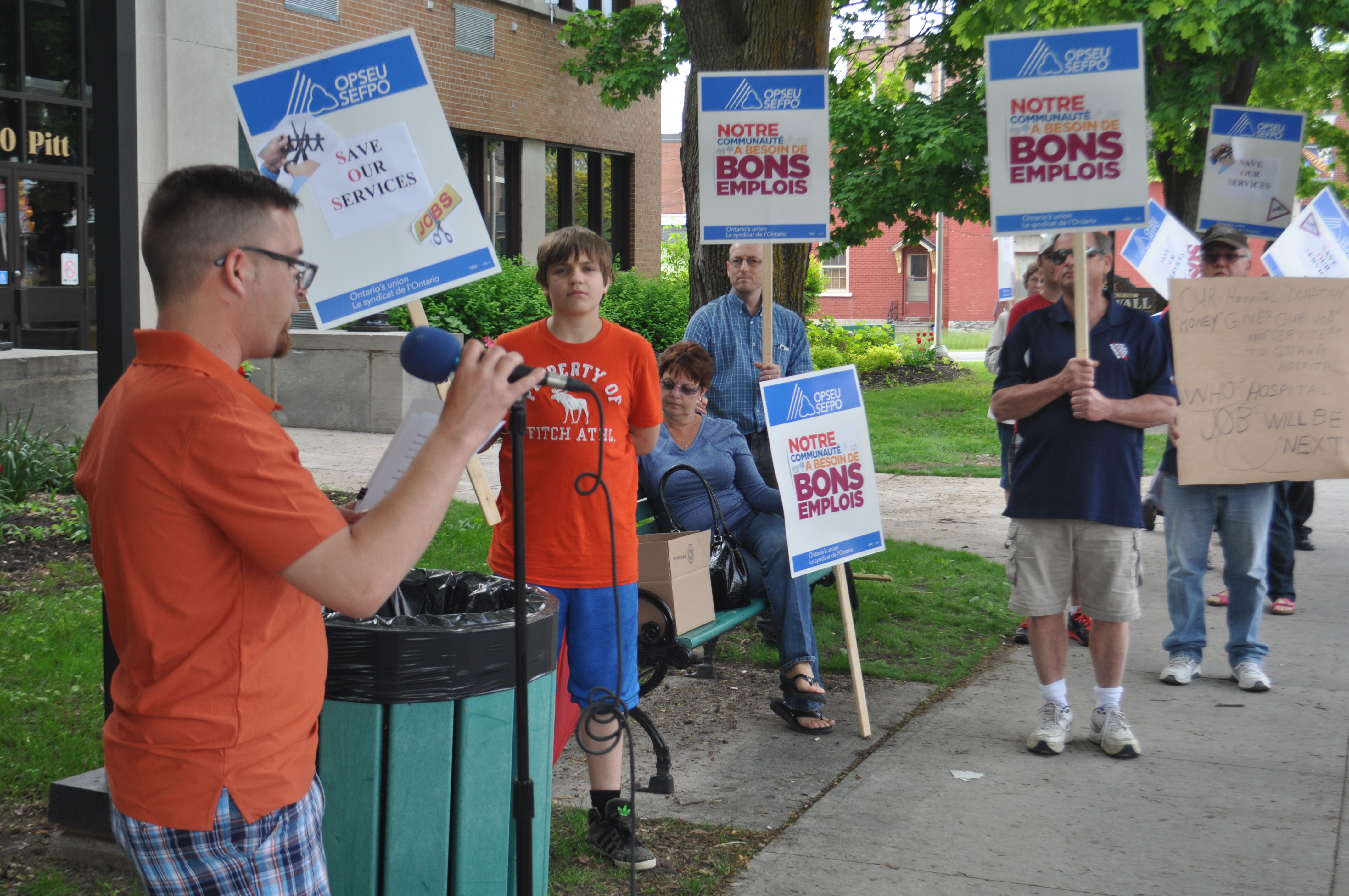
CORNWALL – Residents and laboratory staff at the Cornwall Community Hospital marched outside of city hall last night to try and save local histology services in the St. Lawrence Seaway community.

The Eastern Ontario Regional Laboratory Association is cutting four laboratory jobs in Cornwall and sending tissue samples to Ottawa to be prepared and then sent back to Cornwall for analysis. That’s a round trip of 212 kilometers.

Noting the hospital’s claims that the round trip will somehow speed up the process, OPSEU Local 475 President Richard Meagher says “EORLA must have some very fast drivers. We hope the OPP is taking note.”

The union is arguing the cuts are motivated by money, not by service quality.

Meagher questions the claims made by EORLA President Craig Ivany that preparing the tissue slides in Ottawa would be “better.”

“How so?” asks Meagher. “Is EORLA now saying there is a problem with the slide preparation here in Cornwall?”

The protesters were greeted last night by a number of Cornwall City Counsellors, including provincial NDP candidate Elaine MacDonald.

Council later decided to seek legal opinion on an injunction to stop the transfer of histology lab services out of the city. They continue to ask for a briefing by hospital CEO Jeanette Despatie. Despatie has to-date refused to meet with the Council.

See also: Cornwall: Tonight’s rally asks Despatie to stop hiding behind EORLA

OPSEU Local 475 President Richard Meagher addresses the group gathered outside Cornwall City Hall.

OPSEU Local 475 President Richard Meagher addresses the group gathered outside Cornwall City Hall.