Category Archives: Uncategorized

Stumped – Kingston’s Providence Care erases memorial to former staff

Terry Haffner with the stump of the tree planted in his father's memory.

Terry Haffner with the stump of the tree planted in his father’s memory.

“It felt like digging up his grave,” said Terry Haffner.

A housekeeper at Kingston’s Providence Care, Haffner was disturbed to find a memorial garden to long-serving staff had been cut down and the plaques removed by the hospital without any notice to the families of the deceased or the union who had represented them.

One of those deceased staff members was Terry’s dad Neil, who had worked at the former Kingston Psychiatric hospital from 1961 to his retirement in 1993. Neil passed away in 1996.

When Neil’s tree was planted, his son kept it watered and tended in the early days until it grew hardy enough to withstand the extremes in weather so close to the lake.

It was Terry’s father who told him to apply for a job at the mental health centre in the 1980s. His dad recognized that the heavy construction work his son was doing at the time would be difficult to maintain as he got older. For many years they travelled to work together.
Continue reading

You probably don’t want to read about this — but should

Nobody wants to talk about it yet 50 per cent of those who experience it are likely to lose their jobs. In Alberta one in five employees reported its impact on their workplace. That impact is said to cost employers $77.9 million per year. In Australia it’s estimated that it represents 8 per cent of the disease burden for women ages 18-44 and is greater than other recognized risk factors for poor health. 56 per cent of those who experience it are likely to come in late for work at least five days a month.

The two most high-profile cases of it in Canada both took place in hospitals.

Have you guessed yet?

It’s domestic violence.

Jan Reimer, Provincial Coordinator of the Alberta Council of Women’s Shelters (ACWS), spoke about what she calls a “hidden issue” at the Canadian Health Professional Secretariat meeting in Ottawa last Friday.

The Health Science Association of Alberta and the ACWS are undertaking a campaign to raise awareness in that province and encourage workers to take action by helping their colleagues who may be showing signs that they are living with domestic abuse. Working with the union, the ACWS has also developed a tool kit for employers.

Continue reading

Two-tier “Alberta Chaoulli” goes down to defeat in courts

The so-called “Alberta Chaoulli” challenge to single-tier health care has been defeated in the courts.

The Ultra-Conservative Justice Centre for Constitutional Freedom (JCCF) had sponsored two cases in that province that suggested Canada’s single tier health system represented a monopoly that deprived the plaintives of life, liberty and security of the person.

The two cases both involved Albertans who paid for treatment in the United States rather than wait for timely care in their home province.

In the first case involving a Calgary businessman, the issue became not one of delay but whether doctors felt the treatment he sought was an option for treating his back pain.

The second case involving Alberta dentist Dr. Darcy Allen failed to offer any proof that more timely care would have been accessible had two-tier private insurance been available.

Continue reading

Alexandra Hospital: Of truckers and outpatient labs

The Alexandra Hospital has a rather unique demographic. Located in Ingersoll, just off the 401 nestled between Kitchener and London, we’re told the hospital’s outpatient services are used frequently by truckers.

Recently hospital staff learned that the hospital lab would be closed to outpatients beginning July 1st. Local residents will instead be sent to the private CML lab in town. The truckers will likely find somewhere else to go.

The Alexandra Hospital is feeling the pinch of the government’s decision to starve hospitals as part of what they claim is a realignment of services. Classified as a small hospital, the Ingersoll facility received a modest one per cent increase last year. That’s better than the zeros facing their larger counterparts, but not enough to cover ongoing cost pressures.

Ingersoll would not be among the first of Ontario hospitals to shed outpatient lab services. They would be among the last.

OPSEU has been notified of reductions in hours for some of its members as a result. The impact on labour will be relatively small, although any loss of work in a small town is a big deal. (It’s a huge deal if its your job.) Here’s the rub: while Alexandra may save a small amount of money by making this decision, it will likely cost the Ontario government much more.

Continue reading

Was Monday really a tipping point?

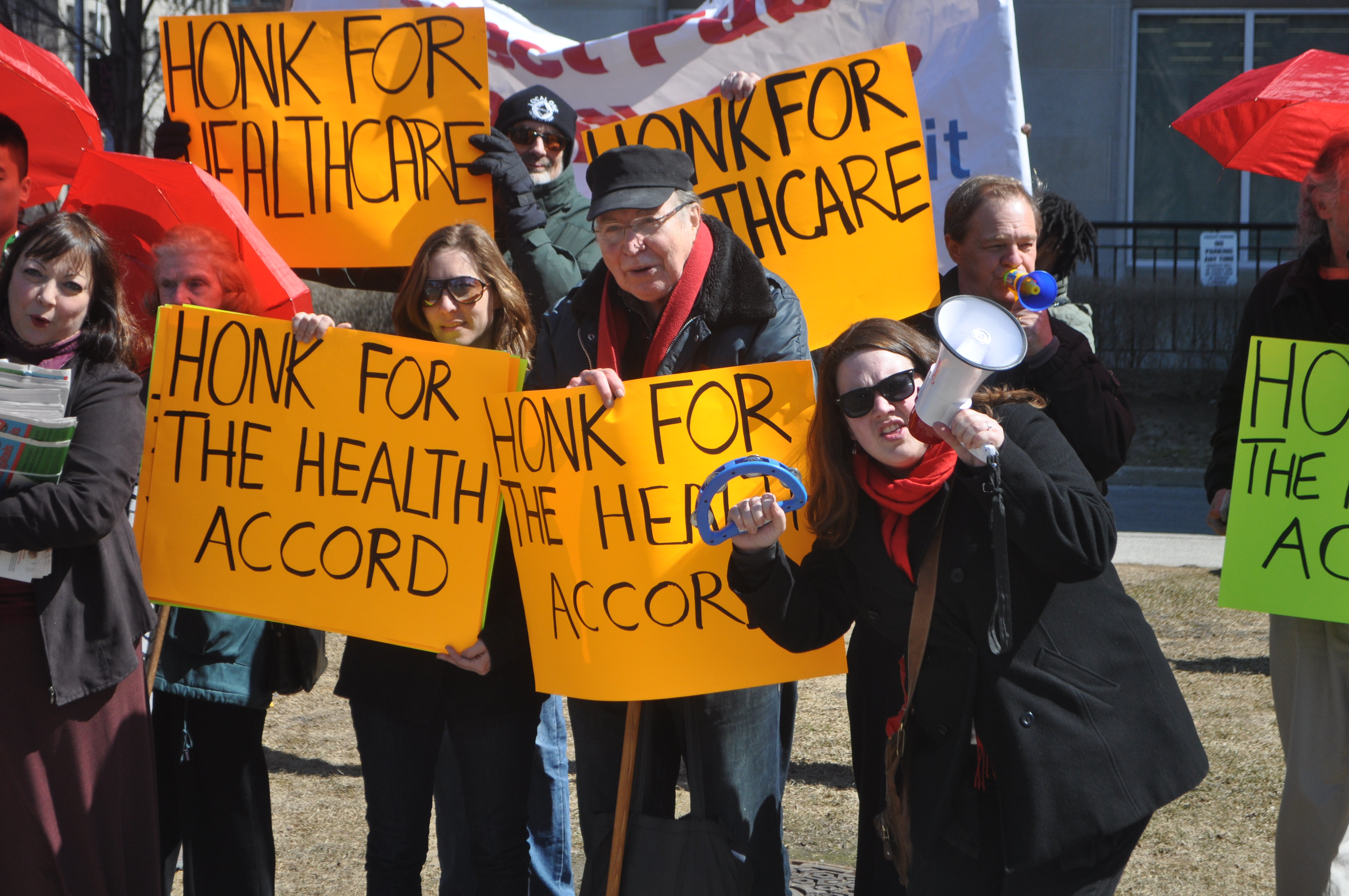
Honking for Health Care on University Avenue in Toronto.

Honking for Health Care on University Avenue in Toronto.

On Monday I saw Ontario Health Coalition Director Natalie Mehra at a noon-hour rally on University Avenue. As far as rallies go it wasn’t a big one. About 50 people showed up to hold up signs urging motorists to honk for a new health accord. So many motorists did just that it became, at times, hard to hear each other speak.

Mobilizing people around the health accord is not the easiest sell. The health accord is a complex issue about planning, standards and funding. When you really strip it down, however, it’s really about the future of Medicare in this country.

I was recently asked by a gas station attendant about a button I was wearing with a red umbrella and the text “Canada Needs A New Health Accord.” With customers waiting behind me I had to explain in 30 seconds what it was about. That’s not so easy and made me think if I found this difficult, what about a 10-second sound bite?

March 31st we all were wondering if we just bit off more than we can chew.

Mehra has been circling the province in recent weeks working on five regional campaigns intended to pressure the government to back off on a plan to contract selected hospital services to private clinics. The campaigns are due to culminate this weekend in Windsor, London, Kitchener, Sudbury and Peterborough. Her enthusiasm has been infectious as she tells us of all the cards that have been collected to date.

Continue reading

The wake for the Health Accord was great, but what’s next?

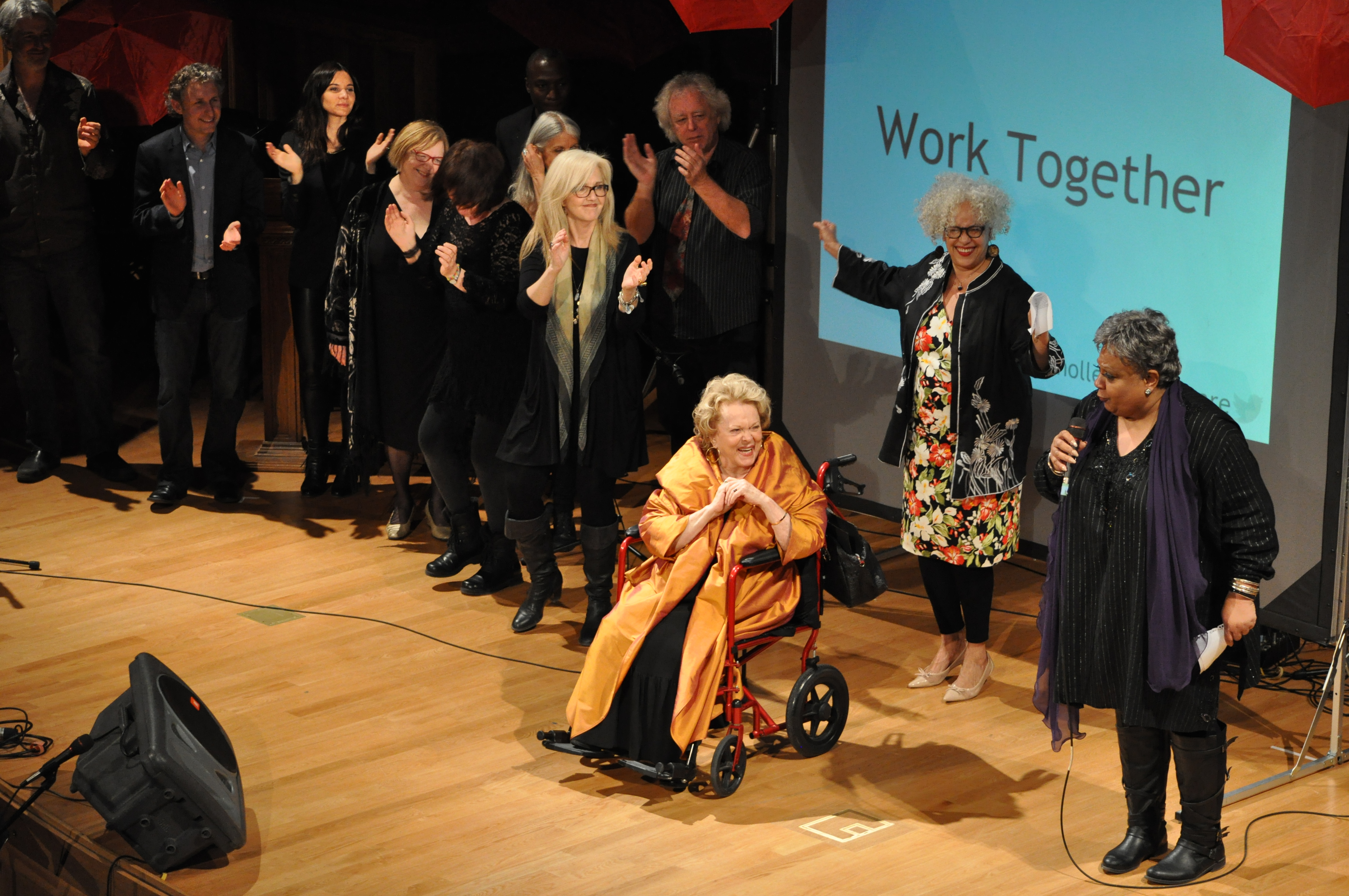
Actress Shirley Douglas shares the stage with Tabby Johnson, Jackie Richardson and other performers from Holler 4 Health Care.

Actress Shirley Douglas shares the stage with Tabby Johnson, Jackie Richardson and other performers from Holler 4 Health Care last night at the Trinity-St. Paul Centre in Toronto.

There’s got to be a morning after.

Yesterday more than 40 communities across Canada marked the end of the 10-year health accord between the provinces and the federal government.

Listening to actress Shirley Douglas speak last night at one of those events in Toronto, its clear many Canadians believe there is much more at stake than a framework agreement that trades health care objectives for cash.

Before the rally began last night, the daughter of Medicare founder Tommy Douglas told the Toronto Star that her father had warned of the slow strangulation of health care, telling her “if you don’t get up and fight for it, you are going to lose it.”

With her 80th birthday just a couple of days away, Douglas vowed to fight on for the next decade if necessary, pausing to add the caveat provided she’s still around.

Continue reading

Health Accord: End of 10-year agreement sad reflection on leadership

Protest on University Avenue in Toronto March 31st.

Protest on University Avenue in Toronto March 31st.

Today is it. It’s the last day in which we can claim to have a national plan towards health care reform.

Starting tomorrow the Harper government is simply cutting the cheques and walking away from the table, leaving the provinces and territories to work out the details of how we move forward – or backward – on the national health care file. Never mind that the Feds are the 5th largest direct health care provider in Canada.

The Harper government has always appeared much more comfortable involving itself in health care commercialization than in ensuring Canadians have public access to quality care.

If Canadians feel ambivalent, it may be because the 10-year agreement was never a resounding success.

Continue reading

Sunshine List overlooks thousands of private contractors: OPSEU

TORONTO – Ontarians aren’t getting a clear picture of government pay practices from the Public Sector Salary Disclosure Act, the president of the Ontario Public Service Employees Union says.

“Today’s release of the ‘Sunshine List’ doesn’t show tens of thousands of high-income-earners who get all or part of their pay from working for government,” Warren (Smokey) Thomas said. “If you really want to know how the government pays people, you should be including private contractors and those who work for them under the Public Sector Salary Disclosure Act.”

The percentage of government revenues that goes directly to the private sector has risen sharply since the late 1990s. A new analysis of Statistics Canada data by the Centre for Spatial Economics (C4SE) shows that in 1997, 27 per cent of provincial program spending went to the private sector. By 2010, that number was 38 per cent.

“With program spending this year budgeted at $117 billion, and 38 per cent of that going to the private sector, we are talking about a $44-billion ocean of money that is subject to very limited public scrutiny and, because it involves private contracts, considerable secrecy,” said Thomas.

“Making private contractors and their employees subject to the same rules as public employees would give the citizens of Ontario a whole new window into the actual workings of government – and where their money goes.”

Thomas first called for putting contractors on the Sunshine List on February 26.

The C4SE analysis is based on Statistics Canada’s input-output tables, information from which is only available for the 1997 to 2010 period.

High-profile line-up featured in Holler 4 Health Care March 31

You don’t want to miss this. More than 30 performers –including some of the most prominent actors in Canadian theatre and television – will be participating in Holler 4 Health Care March 31st in Toronto.

March 31st coincides with the end of the 10-year health accord between the provinces and the federal government. All across Canada citizens are calling on the federal government to sit down with the provinces to secure a plan for the future of health care.

Rick Mercer will appear via video at the event.

Rick Mercer will appear via video at the event.

The high-profile line-up for the evening includes Shirley Douglas, Fiona Reid, Brent Carver, Jayne Eastwood, Robin Duke, Art Hindle, Jackie Richardson, and Michael Therriault (who played Tommy Douglas in the CBC mini-series Prairie Giant). Videos of remarks made by Rick Mercer and Kiefer Sutherland will also be shown. Comedians Amy Matysio and Adrian Truss have recently been added to the line-up.

Other performers include John Alcorn, Ben Bass, Mary Lou Fallis, Kathryn Greenwood, David Huband, Tabby Johnson, Ray Landry, Jani Lauzon, Napalm-the-Magnificent, Judy Marshak, Nora McLellan, Andrew Moodie, Teresa Pavlinek, The Polka Dogs, Julian Richings, Rick Roberts, John Roby, Mike Ross, Viva! Youth Singers, David Warrick and Nancy White.

The organizers say the evening will be a “musical, comical, political rally filled with merry maladies and maladie melodies.” Once we figure out what that means, we’ll let you know.

The event takes place at the Trinity St. Paul’s United Church Centre, 427 Bloor St. W. beginning at 8 pm. Tickets are on a sliding scale from $12 to $20, $25 at the door.  To order tickets on-line, click here.

If the theatre is not your thing, the Ontario Health Coalition is also organizing a noon-hour rally at Queen’s Park on the same day. Come and make some noise to send a message that Canadians deserve better.

Both events are part of the Canadian Health Coalition’s call for a National Day of Action on the health accord March 31st.

Scarborough hospital CEO: “never say never” on merger

RVHS CEO Rik Ganderton with TSH CEO Robert Biron looking on during Wednesday's Central East LHIN Board meeting.

RVHS CEO Rik Ganderton with TSH CEO Robert Biron looking on during Wednesday’s Central East LHIN Board meeting.

The two CEOs representing the Scarborough and Rouge Valley hospitals appeared before the Central East LHIN this morning following news last week that their proposed merger was off – at least for now.

Both Rik Ganderton and Robert Biron looked nervous knowing at least in this venue the decision to pull back from the brink would be regarded as a disappointment. Had the two merged, they would have formed the seventh largest hospital corporation in the province.

The outcome of the meeting was predictable – the LHIN would work with the two hospitals to further an integration agenda and develop next steps. Both CEOs agreed to come back in April after meeting with the LHIN senior staff.

LHIN CEO Deborah Hammons tried to put the best face on the situation noting that the $3.8 million already invested in the merger was not entirely lost –getting the public to understand the position of the hospitals was “money well spent.”

Continue reading