Category Archives: Uncategorized

Nicaragua Day 2: A sense of persistence against tremendous odds

MANAGUA — The entire Managua tour bus erupted with laughter when the guide suggested that Canada was a balanced country.

The young Nicaraguan was trying to describe how Nicaragua had skittered from the “dictatorship” of Anastasio Somoza to the “dictatorship” of the Sandinistas. Canada was supposed to be a model of what his country truly needed – balance.

Yet he describes Daniel Ortega, recently re-elected in 2011 as Nicaragua’s President, as a champagne socialist who portrays himself as a “practical socialist.”

wordpress_flag_c

That practical side is raising eyebrows as the Sandinistas have a new slogan – Christianity, Socialism and Solidarity – a sign that the Sandinistas were finding new accommodation with the conservative Catholic Church. There is even a faith park near the National Palace with an obelisk commemorating the visit of Pope John Paul II.

Managua is an odd city. Scarred and scared by the 1972 earthquake that devastated the Nicaraguan capital, there are few high-rise buildings despite a population of 1.4 million people. The low-rise capital is spread out overlooking Lake Managua and a distant landscape of volcanos. The guide tells us that earthquakes are a regular part of life here, the ground under their feet rattling at least once a month.

The capital Managua.

The capital Managua.

It is also a young city, but different from our own. When wages are so low, the population doesn’t wander around staring at their smart phones. For most, things are decidedly low-tech here.

While the setting is dramatic, the city is far from attractive, much of the historic architecture that most cities exploit for tourism purposes lost to either natural disaster or revolution. While Nicaragua is a beautiful country, Managua is a visual blight in it.


Continue reading

Plan to radically remake Windsor hospitals

The Windsor Star suggests today that the city is likely to be reduced to one acute care hospital. Hotel Dieu and Windsor Regional have agreed to a partnership that will see all acute services delivered from the Regional. Hotel Dieu would be reduced to the status of an urgent care centre and primarily work on outpatient services. There will be no inpatient beds.

Hotel-Dieu will manage all non-acute programs and services currently offered by Windsor at its west-side Tayfour campus according to the newspaper.

It is interesting that the hospital is quick to note that this is not a hospital merger.

Eventually the two hospitals will be replaced by a large mega hospital. No worries about money when it comes to bricks and mortar. In Ontario this appears to be a bottomless supply.

Details of the proposal have been already sent to the LHIN and the province, which makes us question where the public fits into this scenario? Aren’t integration proposals supposed to show evidence of stakeholder consultation first? Yet clearly this announcement is coming as a big surprise.

Nicaragua Day 1: In the flash of this moment

“In the flash of this moment / you’re the best of what we are / don’t let them stop you now / Nicaragua.” – Bruce Cockburn (1984)

MANAGUA – Nearly 30 years ago I had lunch with Bruce Cockburn as preparation for a feature I was to write about the singer-songwriter’s tour of Guatemala and Nicaragua. Having lunch in the old Hotel Nova Scotian, I asked Bruce about his trip, and it was more than an hour before I got to ask the second question, not that I needed to ask any more.

While I did my best to tell his story of witnessing the early days of the Sandinista revolution and the horrors he learned of in Guatemala, he said it best himself with the album Stealing Fire. One minute he’s angrily pounding out “If I Had A Rocket Launcher,” the next stirring hope with “Nicaragua” or “Dust and Diesel.”

wordpress_flag_c

Cockburn was not the only pop culture artist to get swept up the aftermath of the Sandinista revolution. Rolling Stone magazine still considers the Clash’s “Sandinista” to be among the top 500 albums of all time. It seemed everyone was watching Nicaragua.

Thirty years on you don’t hear as much about this Central American nation wedged between Costa Rica to the south, El Salvador and Honduras to the north, bordered east and west by the Atlantic and Pacific Oceans. As part of my preparations to come here I spoke with someone at my bank, who wanted to know how one spelled ‘Nicaragua’ and where it was.

Continue reading

Hudak mental health white paper ignores existing national and provincial strategies

Earlier this week we were told that the Hudak PC’s were going to release a White Paper on Mental Health this Thursday.

While the paper is still not up on the PC website (as of Friday morning), the news media have suggested that the paper is primarily about building access to services for children and youth.

Wait a minute here – isn’t that exactly what Deb Matthews has been doing?

The headlines have so far been about a small percentage of children that are being treated out of country, amounting to about $5 million on a health budget of $47 billion. In fact, out of province treatments have been shrinking in recent years as Matthews and her predecessors at the Health Ministry have repatriated a number of health services, including increasing local access to bariatric surgery.

It’s not like we haven’t had any good advice about where to drive mental health.

After waiting years for the province’s 10-year mental health strategy, we instead got taken in by a bait and switch and ended up with a three-year plan around mental health for children and youth.

Has everyone forgotten, including MPP Christine Elliott, that all thee parties signed on to an all-party select committee report in 2010 that called for a series of actions, including creating Mental Health Ontario, a kind of Cancer Care Ontario clone that would drive both coordination and access to mental health care? That report also called for an assessment of the complete basket of mental health services in each region.

Has everyone forgotten that just last year that the Mental Health Commission of Canada released its own long anticipated national mental health strategy, that among other things, called for an increase in percentage funding that mental health should occupy?

Children and youth eventually become adults, and while we get it that early detection and treatment is a smart move, the reality is that mental health services for adults are struggling in this province.

We reported last week that the former Kingston Psychiatric Hospital is shedding 60 beds en route to its merger with St. Marys Of The Lake. While beds have been redistributed from Regional Mental Health London-St. Thomas, there are still about 70 beds missing when the new privately developed replacement facilities open there in 2014-15.

While the province likes to talk about services moving to the community, there are examples where these services are also on the chopping block. The latest battle is over keeping the West Toronto Community Legal Services clinic open. The service is best known for covering legal issues, housing and mental health support particularly to Toronto’s homeless community (a petition is on OPSEU’s main site). The clinic serves 1,500 homeless persons per year. Legal Aid Ontario is threatening to stop funding the clinic at the end of this fiscal year (March 31).

Health Minister Deb Matthews must have been amused over the content of the Tories mental health paper. She told the Canadian Press earlier this week that they are already doing “everything” the Tories are calling for in their paper.

While the Tories have borrowed “liberally” for their white papers from Don Drummond’s often contradictory recommendations, they really leave us wondering why they couldn’t have even looked at the all-party committee report they endorsed a little over two years ago for guidance on policy, or the strategy put forward under the sponsorship of their federal cousins.

Ottawa and Hamilton: Significant hospital cuts ahead despite rhetoric from Premier-designate

Dr. Jack Kitts, CEO of the Ottawa Hospital, says he plans to transfer about 5,000 endoscopies to community hospitals and clinics as part of an overall plan to find $31 million in savings towards balancing the hospital’s budget.

Kitts announced last week that 290 full-time equivalent positions would be eliminated at the hospital, including 90 positions in nursing, 100 in administration and support services, and a further 100 “other” health professionals. There is no word whether any senior managers will have to fall on their sword.

The impetus for the cuts are clear – The Ottawa Hospital is facing the long-term prospect of zero per cent annual change in the base funding while costs continue to rise with a growing and aging population. It has little to do with restructuring.

Divesting 5,000 endoscopies may save the Ottawa Hospital money, but it won’t necessarily save the provincial health budget as these costs get borne elsewhere. Then there’s the matter of The Ottawa Hospital facing direct costs related to severing employees. Kitts says it’s cheaper to do these endoscopies elsewhere, but he gives no evidence to back up his claims.

Calculating the human cost of such actions is always much more difficult. The Ottawa Hospital was subject to a major study in 2009 on role overload, suggesting workers at the hospital were already facing anxiety, fatigue, and burnout as a result of having to do too much with too little. For those left behind, the fear of having their workload become totally unmanageable is very real, raising questions about how safe the hospital will really be.

Continue reading

Braving the bitter cold for mental health

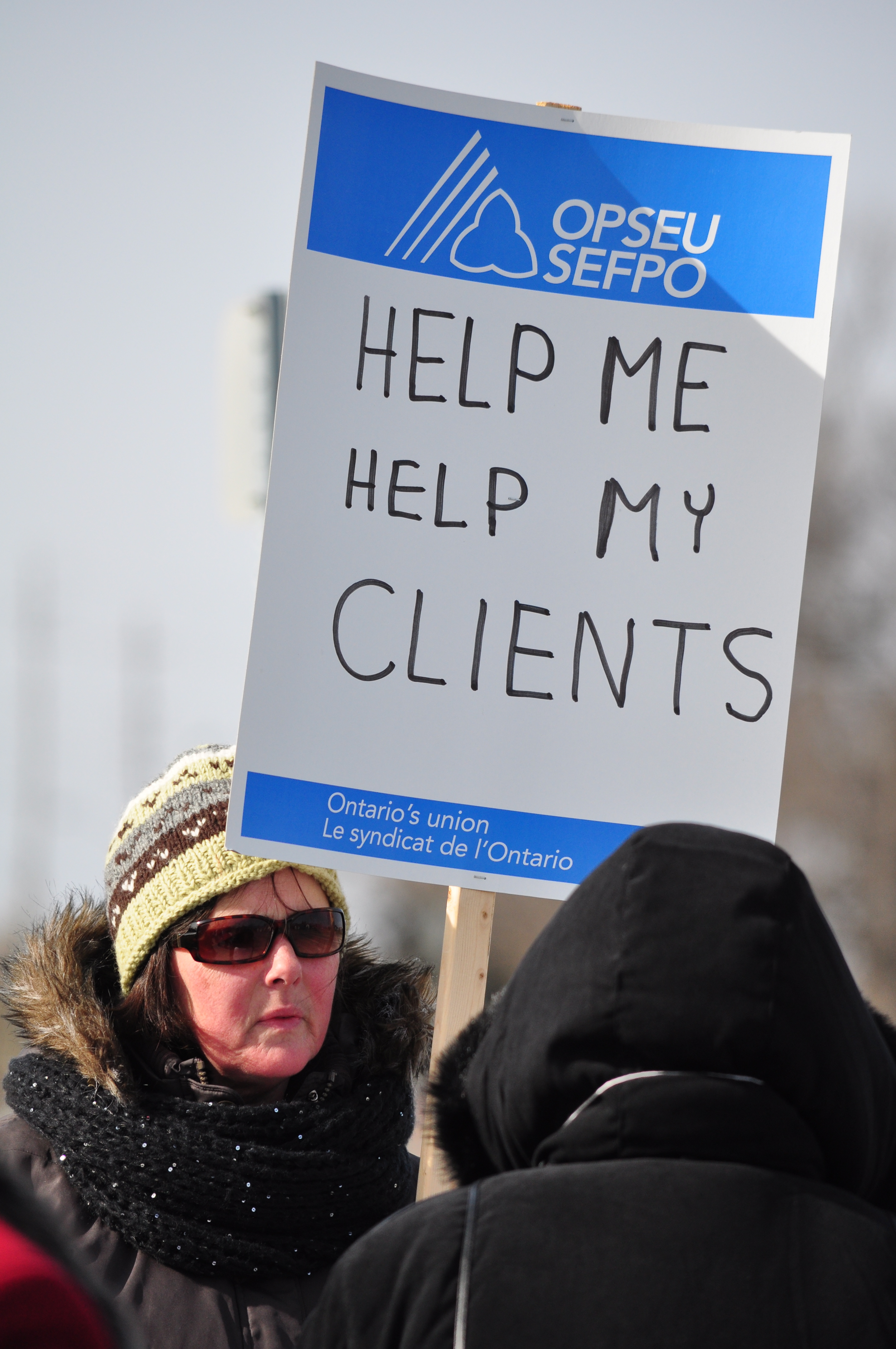
About 80 mental health workers and their supporters braved the bitter cold February 1 to raise concerns about the impact of cuts on Providence Care Mental Health Centre in Kingston.

While both Federal and Provincial governments have made promises about addressing Canada’s inadequate mental health care, the reality on the ground is that more beds are being cut and too few services are being established in the community.

When Providence Care Mental Health Care gets merged with St. Mary’s Of The Lake, the new privatized hospital will have 72 fewer beds than presently exist, yet demand for mental health care is rising.

Kingston workers brave the cold February 1 to stand up for mental health care.

Kingston workers brave the cold February 1 to stand up for mental health care.

OPSEU Regional VP Dave Lundy is interviewed by CKWS TV.

OPSEU Regional VP Dave Lundy is interviewed by CKWS TV.

Workers say units are overcrowded and too few resources are available.

Workers say units are overcrowded and too few resources are available.

Anti-tax business lobby is fed up with special interests (like us)

The Alberta Enterprise Group is a anti-tax business lobby, a good number of the corporate members  involved with that province’s oil patch. It’s board of directors is entirely made up of men – white men.

Speaking at a recent luncheon, AEG President Tim Shipton complained how it was difficult to develop the Canadian economy because of regulatory and political challenges.

He said “Canada is paralysed by special interests and complacency.”

The AEG doesn’t like things like taxes, although they claim they need to do away with regulations and all this opposition to their projects in order to make money so the same taxes they don’t like can pay for hospitals and schools and roads. It’s about public services they say. Yeah, right.

What they are really vexed about is communities not wanting energy pipelines running through their backyard. Apparently the people who live in the path of these pipelines are special interests, whereas the companies that want to profit from these pipelines are doing so in the national interest.

Continue reading

Numbers don’t lie: Cuts to hospital allied health professionals not showing up in community visits

Over the last number of weeks we have been debunking the myth that hospital cuts somehow represent service transfers to the community.

The data for 2012/13 is not yet available, but if we look at the volume of home care services delivered in 2011/12 we can see that for most clinical services, fewer visits –- not more — were delivered than in preceding years.

If hospital cuts truly represented a transfer to community-based services, shouldn’t these CCAC visits be rising, not declining?

The most obvious is physiotherapy. While Ontario hospitals are making significant cuts to outpatient physiotherapy, the actual number of physiotherapy visits delivered in the community by Community Care Access Centres (CCACs) and their agencies has dropped dramatically.

According to the Ontario Home Care Association, in 2005/06 there were 541,101 community physiotherapy visits. By 2011/12 that number had dropped by almost 100,000 visits to 444,054.

Continue reading

P3s for Dummies: Part III — Fool us once, twice, fool us some more

Ontario has been leading the country in pursuing private deals to finance, develop and maintain public infrastructure projects, including a significant number of major hospital redevelopments.

Last week we looked at how public-private partnerships turn projects away from the public interest. In Part I we looked at what P3s are and how the concept of risk has been used to overcome project costs that have been much higher than traditional public procurement. And along the way we poked some fun at the arguments put forward by the business community looking to get rich at our expense.

This week we debunk the myth put forward by the Conference Board of Canada that all is now well in the P3 world.

The Conference Board of Canada has suggested that Canadian P3s fall into two categories – Phase I, which we could summarize as the “we didn’t know what the heck we were doing and made a real mess of things but continued to deny it until the evidence was overwhelming” phase, and Phase II, post 2004, in which provincial and federal governments set up P3 infrastructure offices that, according to the Conference Board, now know what they are doing. Phew! Nothing to see here! Everybody go back to watching hockey.

Of course, when post 2004 P3s go off the rails, they blame it on municipalities, which apparently still don’t know what they are doing. P3s are still a great idea, they say. They just need more, well… rules. After all, this whole idea is not complicated enough already.

Continue reading

Dealing with an unfair funding formula, SBGHC cuts at the top (how novel!)

Here’s a story we don’t see every day: South Bruce Grey Health Centre is cutting two of its four senior management positions as part of its efforts to deal with a budget deficit.

Contrast that with hospitals such as Ontario Shores Centre for Mental Health Sciences, which carved out a new advisory position for its departing CEO at a time when front line staff are bracing for tough times ahead.

The decision may have been slightly easier to make at SBGHC given two senior managers are retiring. However, as most front line workers already know, when you cut vacant positions, it still has an impact on the workload of those left behind.

SBGHC is one of the few hospitals to have weathered the last decade without consistently running into deficit. The fact that they are now forced to trim their sails owes a lot to a punitive new funding formula emerging from Queen’s Park. Small rural hospitals weren’t supposed to be part of that formula, but because SBGHC combines resources from four small hospitals together, they do.

The irony is that by consolidating their resources these four small hospitals are being penalized. For the Hanover hospital, which has somehow managed to stay out of SBGHC despite being located within the same geographic area, they must be breathing a sigh of relief.

Continue reading