“False Positive” new book on Canada’s medical laboratories

Ross Sutherland, the Community Co-Chair of the Ontario Health Coalition, has just published a new book on Canada’s Medical Laboratories.

False Positive: Private Profit in Canada’s Medical Laboratories uses the history of laboratory services in Canada to demonstrate that ownership of health services matters. The history of medical laboratories is a cautionary tale: it is a warning to those who would allow private surgical clinics, for-profit MRIs and CT scans, corporate family medical practices and a variety of other private enterprises to provide services to patients at public expense.

In addition to the book, Ross has also set up a BLOG to begin a dialogue on medical laboratories — http://forprofitmedicallabs.wordpress.com.

You can order Ross’ book for $17.95 through Brunswick Books, 20 Maude St., Suite 303, Toronto, Ontario M5V 2M5 — orders@brunswickbooks.ca

Video: CSMLP produces commercial to highlight role of lab professionals

The 14,000-member Canadian Society of Medical Laboratory Professionals has produced a commercial to highlight the role lab professionals play in health care. Titled “Knowing Matters,” the CSMLP has posted the commercial on-line with an incentive for their members to click on the video: if it gets 25,000 views CBC’s The National will air the commercial during National Medical Laboratory Professionals Week (April 24-30). To see the video, and add to the count, click on the window below:

Tom Juravich Re-Releases Song in Support of U.S. Public Sector Workers

Ottawa-based singer-songwriter Tom Juravich is re-releasing his song “When Did I Become the Problem” in support of workers and unions fighting back against the attacks on public sector workers across the U. S. It is available as a download.

Juravich is one half of Healy & Juravich, who recently produced a music video with OPSEU for “What Will You Do When I’m Gone?” The song chronicles the struggle of home care nurses to maintain their jobs amid the insecurity of forced competitive bidding. (See http://www.opseu.org/bps/health/community/whatwillyoudo/index.htm )

“I have been shocked by the blatant attacks on public sector workers and their unions in Wisconsin, Indiana, Ohio and so many others states across the country,” says Juravich. “Without a doubt states are facing some difficult financial times, but our kids’ teachers, the people who pick up trash in our towns and the folks working at the social security office that take care of our parents didn’t cause this problem, and slashing their wages, cutting their benefits and destroying their unions isn’t the solution.”

In his song Juravich writes about a teacher, a state mental health worker and a national park ranger who all find themselves blamed for everything that is going wrong. They lament:

When did I become the problem?
How did the fault become all mine?
They all say they’re tightening their belt
But the only one they’re tightening is mine.

“The Problem” first appeared on Juravich’s CD Altar of the Bottom Line released by Finnegan Music in 2009. Juravich is joined by drummer Dave Mattacks (Fairport Convention, Paul McCartney, and Rosanne Cash), electric guitarist Duke Levine (Mary Chapin Carpeneter) and Richard Gates on bass (Paula Cole, Suzanne Vega, and Patty Larkin).

Pete Seeger says, “I was impressed by Tom’s wide variety of material and frankly jealous of his wonderful voice,’” Dirty Linen writes that “Tom Juravich is foremost a storyteller. He has been traveling the country, hearing and retelling his stories of American sweat and struggle for a long time.”

Give the song a listen at When Did I Become The Problem

The song is also available on iTunes.

Video: Natalie Mehra on P3 Hospitals

Natalie Mehra, Director of the Ontario Health Coalition, speaks about the high costs and secrecy of public-private partnership (P3) hospitals in this new Operation Maple video.  Operation Maple makes on-line videos about issues important to Canadians. Check it out below:

Video: Operation Maple focuses on Ontario Shores

Operation Maple makes on-line videos of issues important to Canadians. Recent they posted a video about the situation at Ontario Shores Centre for Mental Health Sciences. A parent speaks about taking her son out of the rehab program if the Child and Youth Workers are gone. At present 28 of these specialized and highly skilled workers will be out of a job by mid-April if the hospital doesn’t change course. See this video:

Lack of policy on surge capacity may come to bite us this flu season

Could this be the season where our reckless policy of removing all hospital surge capacity comes to bite us?

The Toronto Star recently reported of a Canadian man stuck in a St. Louis hospital because there are no beds available for him back in Toronto.

The man had a heart attack while in the US Midwest, where he has admitted to hospital in St. Louis. His wife has been trying to get him transferred back home without any luck. In fact, the stress was so much for her, that she was also felled by a heart attack in St. Louis, and wound up for three days in the same hospital.

“The flu season has overwhelmed hospitals and we have to take our patients who are in the emerg first,” Scarborough hospital spokesperson Tracy Huffman told the newspaper.

Dr. Ian Fraser, chief of staff at Toronto East General told the Star: “There is not a lot of surge capacity within the whole system and that is a challenge.”

Meanwhile, Windsor-area hospitals have declared a state of emergency, threatening alternate level of care (ALC) patients with charges of $600 per day if they refuse to take the first long term care bed available to them. Likely not many will be faced with that choice – only six beds are available in the region.

In Ottawa spouses are unable to be reunited with their partners in the city’s nursing homes despite a policy that makes such transfers a priority. Why? The city’s hospitals are filling up any available nursing home bed to move out their ALC patients.

Several years ago we asked an advisor with then Health Minister George Smitherman’s office what the government was doing about the shortage of acute care beds.

We had disclosure from the Rouge Valley Health System on a challenge we were taking before judicial review. The hospital provided us with a number of comparisons with peer hospitals to suggest they could close down more acute care beds to save money. Most of the peer hospitals in the comparison were well over 90 per cent capacity, and about 25 per cent were over 100 per cent capacity. When you exceed 100 per cent, it means you constantly have patients in your hallways.

The advisor admitted that the numbers were correct, and in fact, might even be a bit higher. However, he expressed no concern about the lack of surge capacity.

This is not how it works in other countries, where the possibility of a bad flu season or pandemic could throw the health system in crisis.

In the UK, the only G7 country that has fewer acute care beds per capita than Canada, they set a target of 82 per cent average occupancy. When a media report showed that there were a significant number of hospitals over 85 per cent, it was considered a scandal.

High occupancy rates have been proven to be linked to an increase in mortality rates, longer waits and a spread of hospital-borne infections.

In 2005 the average bed occupancy in 30 OECD countries was 75 per cent. The Australian Medical Association has warned that bed occupancy rates above 85 per cent negatively impact on the safe and efficient operation of a hospital.

The Irish Medical Association recognizes 85 per cent as an “internationally recognized measure” that should not be exceeded.

Yet here in Ontario we are over 90 per cent, and for many hospitals, they exceed 100 per cent.

In Canada we have 2.7 acute care beds per 1,000 population. In Japan it’s 8.2 and in Germany it’s 5.7 beds. Yet Germany spends about the same as Canada on public health care, and Japan spends less. Both rely less on private health care.

The present mania for emptying ALC beds raises an interesting question – once these patients are no longer in the hospital, and the beds are filled by acute care patients who cannot be moved elsewhere, where does the surge capacity come from in the event of a crisis? Without the options of moving these patients to alternate settings, there will simply be no room.

Having a hotel at 100 per cent capacity is efficient. Having a hospital at 100 per cent capacity is a recipe for disaster, as we are beginning to see this month.

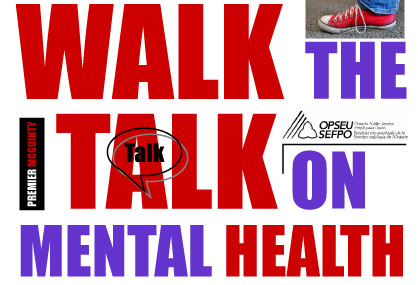
Walk The Talk on Mental Health – London Rally March 9

LONDON – Words are not enough. OPSEU members in London and St. Thomas are calling upon the community to help “walk the talk on mental health” in front of Local Health Integration Network (LHIN) offices on Wednesday, March 9 beginning at 1 pm.

The demonstration follows more cuts this winter at Regional Mental Health – London and St. Thomas (RMHC) as well as in other communities across Ontario.

“For the past two and a half years the government has been working on a 10-year strategy for mental health,” says Kim McDowell, President of OPSEU Local 152 (RMHC). “While they have been talking about improving the system, the reality on the ground has been one of program closures and layoffs.”

The union is concerned that residents needing mental health care will have no place to go after the regional center divests beds to other communities and downsizes in 2014.

Protesters are asked to gather in front of the Local Health Integration Network offices at 201 Queens Ave in London. After a brief rally there, the protest will march to Health Minister Deb Matthews’ constituency office at 242 Picadilly St.

Want to help? Contact Kim McDowell at 519-765-8660.

Election hyperbole building over health care

The provincial election may be slightly less than eight months away, but the hyperbole is already building.

At a nursing lobby day earlier this month, Health Minister Deb Matthews slammed the Tories for not explaining how they will find $3 billion to replace the health tax. Matthews suggested that a $3 billion shortfall would mean either closing every hospital in the north or ending drug coverage for seniors.

Tory leader Tim Hudak initially responded that the Tories had no plan to do away with the much complained-about tax. A statement from his office said: “Ontario PC Leader Tim Hudak has been very clear. If elected premier, he would not cut the health tax or Ontario’s health care budget.” PC MPP Sylvia Jones went further, saying Matthews “was clearly lying.”

A few days later Hudak was less clear about his support for the health tax. “We are considering all tax options and how to give families a break,” he told the media.

Hudak told the lobbying nurses that they would increase health care spending, “but it doesn’t mean we will spend every penny in the same way.”

The Tories have repeatedly said they would scrap the Local Health Integration Networks, which would save about $80 million on a $46 billion health budget.

However, Hudak has not said what his government would replace the LHINs with.

Matthews said eliminating the LHINs would see all local health care decisions made in Toronto.

Matthews also resurrected the spectre of former Premier Mike Harris, reminding the nurses that Harris had suggested they were no more than a fad, comparing them to the Hula Hoop.

In fact, Harris was talking about all workers impacted by hospital closures. In 1997 he said “just as Hula-Hoops went out and those workers had to have a factory and a company that would manufacture something else that’s in, it’s the same in government, and you know, governments have put off these decisions for so many years that restructuring sometimes is painful.”

While the health minister talks about dire consequences of having $3 billion taken out of the government’s revenue stream, the irony is the McGuinty Liberals are sticking by their plan to reduce corporate taxes by $2.4 billion per year. They are also substantially reducing the rate of funding increases for health care despite the fact that Ontario already has among the lowest per capita funding in Canada. It would take $3.5 billion just to bring Ontario hospitals up to the Canadian average in funding.

CMA/MacLeans forums raise eyebrows

Maclean’s Magazine and the Canadian Medical Association – representing more than 57,000 doctors across Canada – are hosting a series of town hall forums to engage the public on the issue of rebuilding Medicare.

The alliance should raise more than few eyebrows given Maclean’s continual advocacy for more private for-profit health care. In the on-line backgrounder, Maclean’s quotes the Frontier Institute, an extreme conservative think tank for which free market ideology is the answer to almost all questions. It also highlights the OECD’s call for more user fees, a clear violation of the Canada Health Act.

And, of course, they quote Brian Mulroney’s call for an adult conversation.

The reality is we have been having an adult conversation. The problem is, Mulroney, Maclean’s and the Frontier Institute are not getting the ear of Canadians for a good reason: there is no evidence to suggest that private for-profit delivery of health care works. If so, the United States would be the most efficient health system in the world. Instead, they’re dead last among modern industrialized countries in most key measurable categories. Canadians get that.

Maclean’s also raises the Frontier Institute’s nonsense argument that we could be more like the Europeans if we allowed two-tier private health care. The reality is a greater share of health care is publicly paid for in Europe than it is in Canada. Among the G7, Canada is second to the United States in per capita spending on private health care. It represents a little over 30 per cent of our total health spending. If we were to be more like the Europeans, we would make more of that 30 per cent public, not create even more private health care.

The CMA/Maclean’s tour comes to Toronto’s St. Lawrence Hall on March 1st from 7 to 9 pm. To attend the televised event you need to register by e-mailing events@mcleans.ca

Walk the Talk on Mental Health – Postcard Campaign

Fill out your postcard and return it to your nearest OPSEU regional office by March 3.

This week postcards are being distributed to OPSEU’s regional offices. The postcards ask Dalton McGuinty to “walk the talk” on mental health.

The Ontario government has spent the last two-and-a-half years developing their 10-year strategy for improving mental health. This has been against a backdrop of fiscal restraint that has resulted in cuts to front line jobs caring for Ontarians with mental illness.

Instead of making every door the right door, front line workers are telling us that the doors are simply closing. Their ability to provide real care, comfort and assistance to adults, youth and children with mental illness has been seriously jeopardized.

The postcard contrasts the $2.4 billion the government is spending on corporate tax cuts with the shortages faced by Ontarians with mental illness. It asks the premier to “walk your talk and keep your promise to Ontarians with mental illness.”

OPSEU Locals are being asked to pick up the cards they need from their regional office and return them to these offices by March 3rd. The postcards will then be sent to Toronto for a press conference and presentation on March 8th.

Ontario spends far less on mental health than most comparable international jurisdictions.

Recently layoffs have taken place at Toronto’s Centre for Addictions and Mental Health (CAMH), Ontario Shores Centre for Mental Health Sciences, and Regional Mental Health Centre – London and St. Thomas. Services have also been transferred out of North Bay and Brockville. The Salvation Army recently announced it was closing down its transition program in the west end of Toronto, although the decision has been placed on hold until the SA can appear before the Local Health Integration Network.

A recent Toronto Star story highlighted how CAMH’s schizophrenic unit was transferring to a building with a long history of criminal activity. One CAMH client described the building as infested with bed bugs.

Health Minister Deb Matthews has committed to releasing the final 10-year plan for mental health this spring.