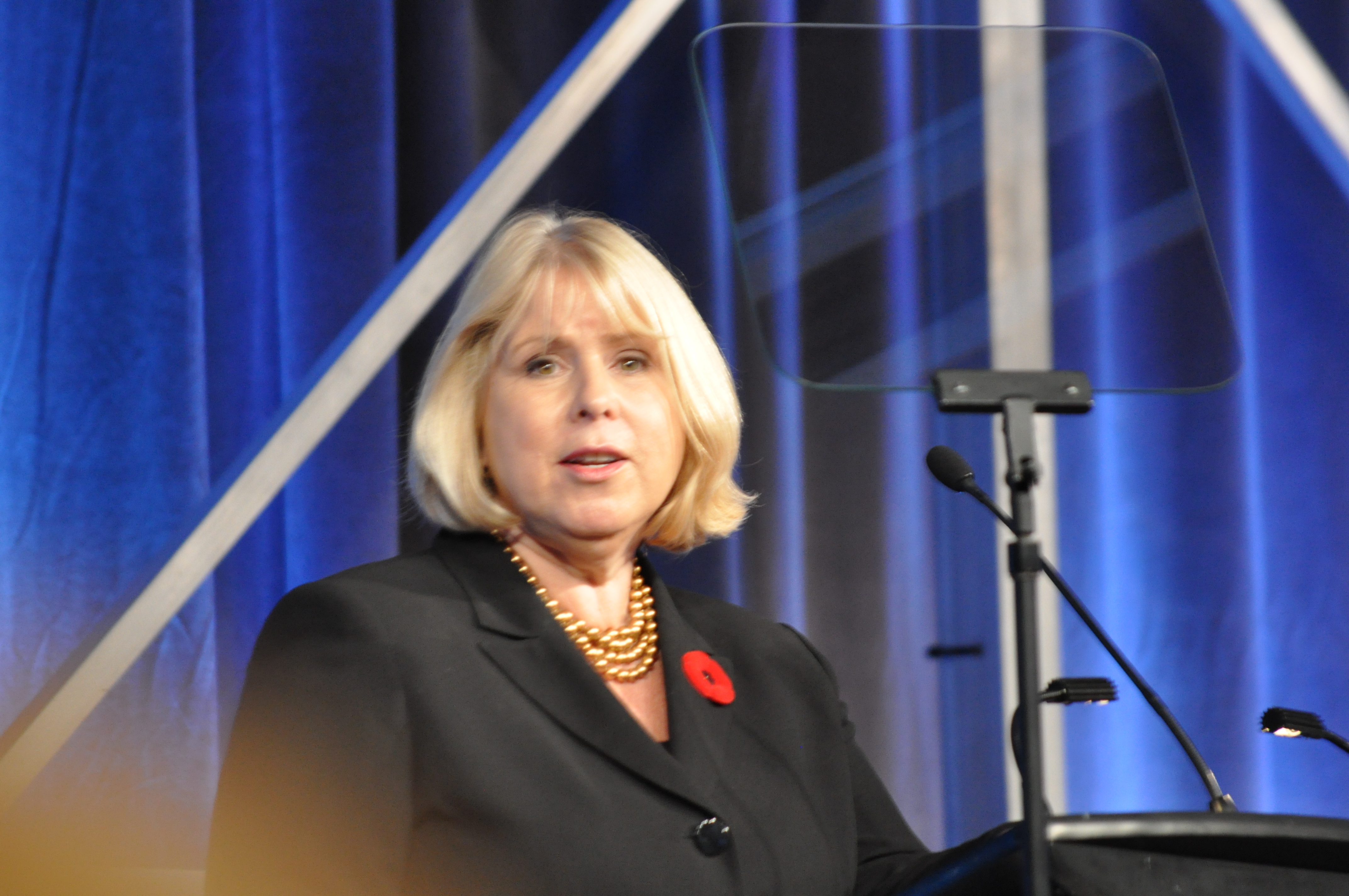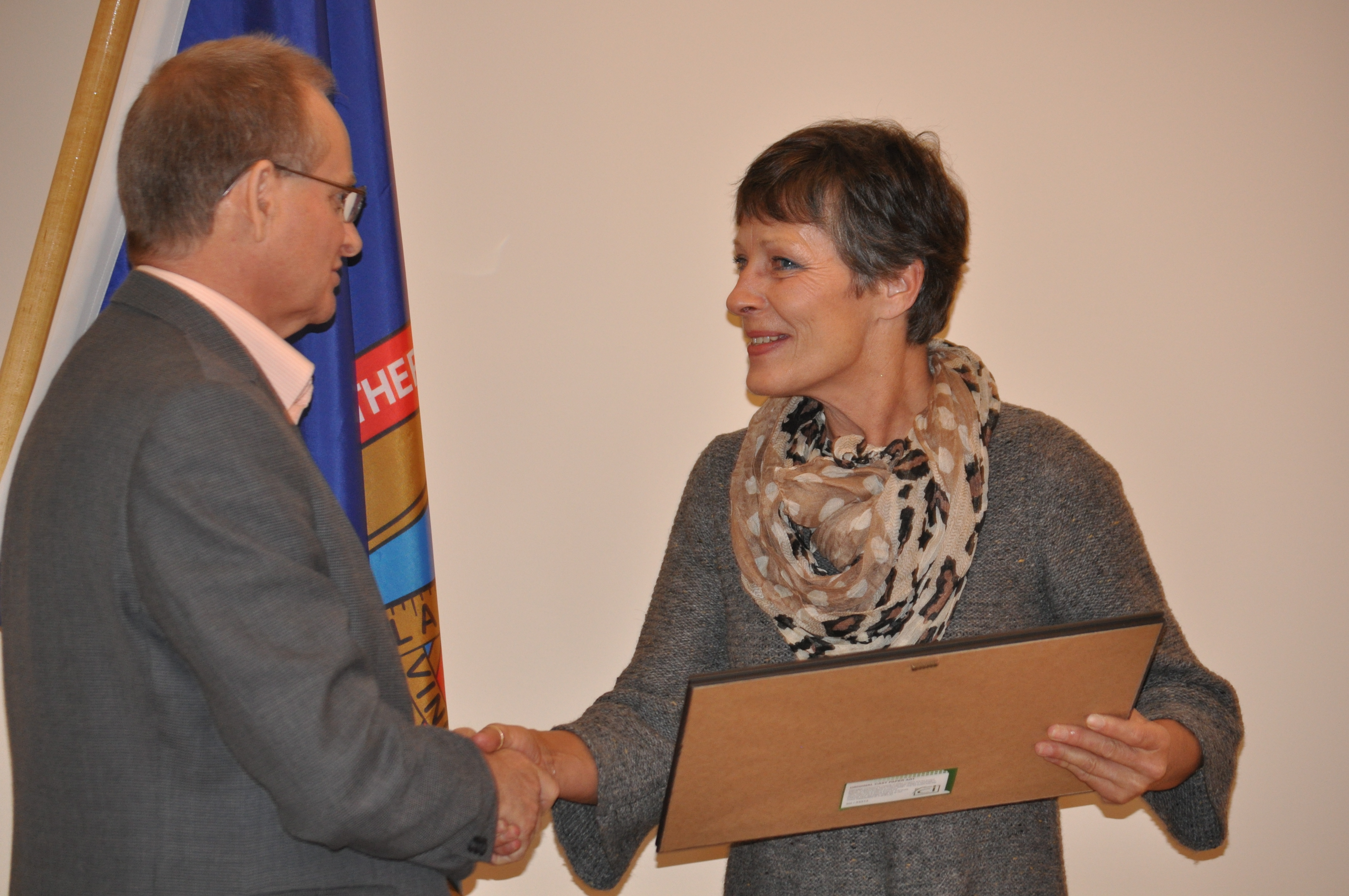
Gunn and Lewis receive awards in Port Hope

Norma Gunn receives the Ontario Federation of Labour 2012 Occupational Disability Advocacy Recognition Award in Port Hope November 15.
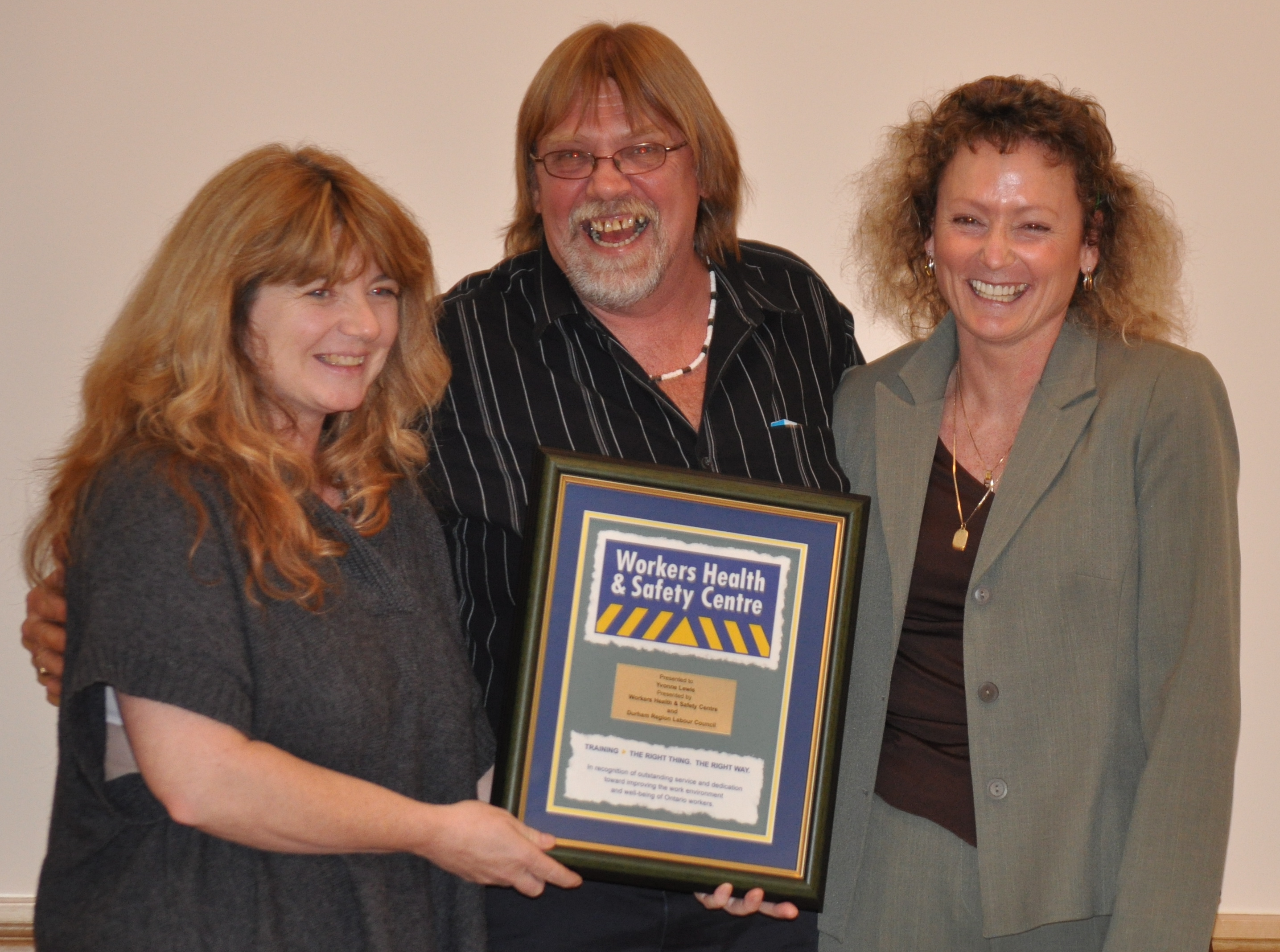
Local 331 Chief Steward receives the Workers Health and Safety Centre award on behalf of Yvonne Lewis. With her is Durham Labour Council President Jim Freeman and Kim Rushnell, Local 331 Secretary.

Local 331 Chief Steward Patti Lang receives the Workers Health and Safety Centre award on behalf of Yvonne Lewis. With her is Durham Labour Council President Jim Freeman and Kim Rushnell, Local 331 Secretary.

Two OPSEU advocates from Ontario Shores Centre for Mental Health Sciences received recognition last night in Port Hope for their health and safety work. Norma Gunn received a standing ovation when she accepted the Ontario Federation of Labour’s 2012 Occupational Disability Advocacy Recognition award for her work around post traumatic stress disorder. Gunn recently told her story in an Operation Maple video posted in October. The video was shown as part of the awards dinner. Local 331 Chief Steward (and Local President-elect) Patti Lang accepted the Workers Health and Safety Centre Award on behalf of Yvonne Lewis, who was unable to make the event at the last moment due to pressing family concerns. Lewis has been tireless in her fight to reduce incidents of workplace violence at Ontario Shores. Presently the Ministry of Labour is conducting a major investigation at the Whitby-based hospital.
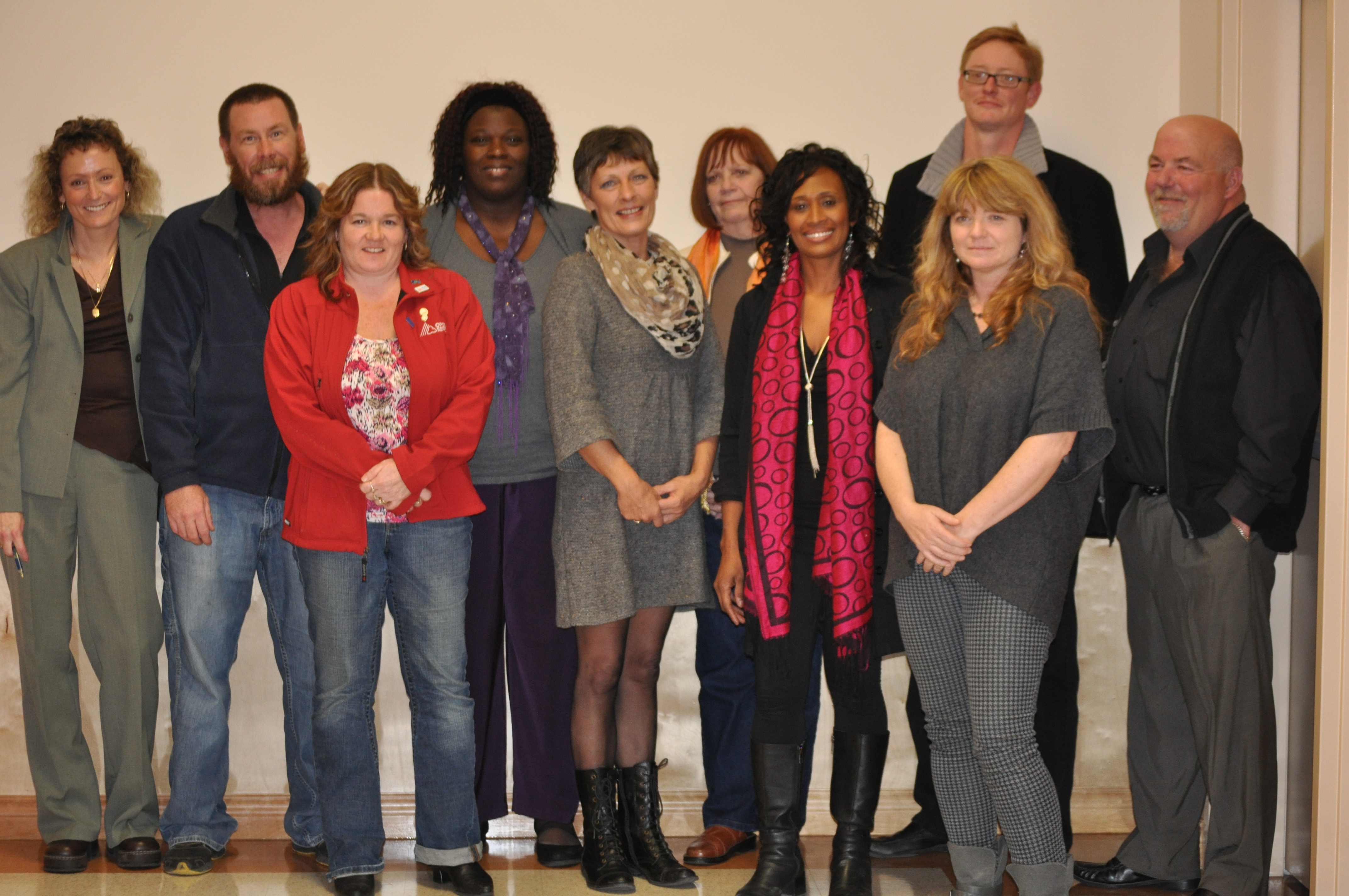
Members of OPSEU Local 331 and staff rep Sherry Weese were present to celebrate the awards.
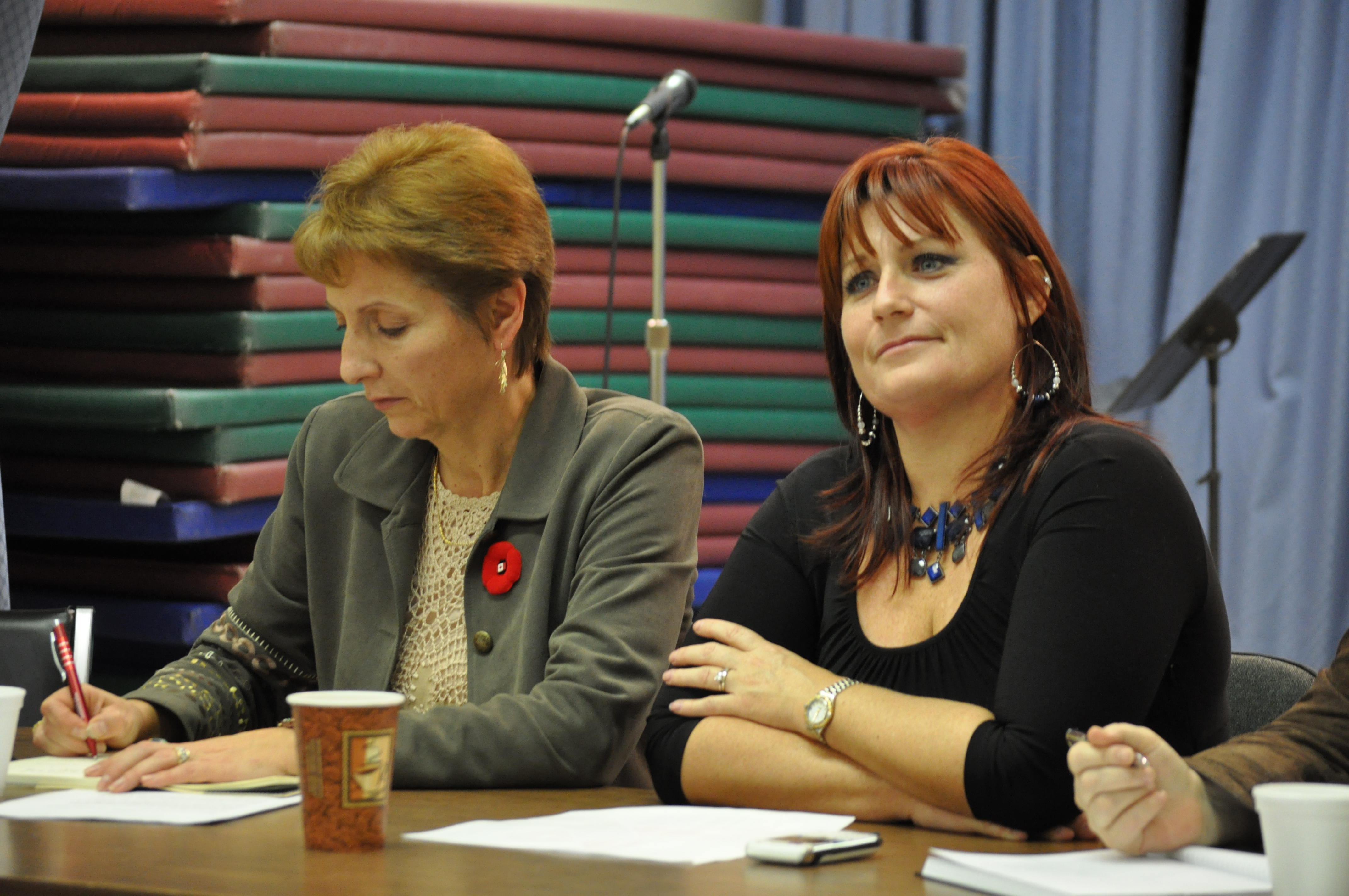
Why can’t you e-mail your doctor? Virtual health care is here, but will we accept it?

Dr. Ed Brown asked how many people in the audience were able to e-mail their family doctor? A small handful in the Mount Sinai hospital auditorium raised their hand. When asked who would like the ability to e-mail their doctor, everyone in the room raised their hands.

The situation is likely to change much sooner than we think. The question is, are health care providers ready, will the public participate, and will quality be more than an “acceptable second best?”

Brown, CEO of the non-profit Ontario Telemedicine Network, says Ontario is already one of the most advanced telemedicine environments in the world. Last year there were 204,058 telemedicine “events” in the province – a staggering 52 per cent growth over the previous year. There are slightly over a thousand regular users – this in a doctor population of 25,000.

Brown and Will Falk, a health care “leader” with PwC Canada, spoke at Longwood’s Breakfast With The Chiefs this morning on the growing virtualization of health care.

By conducting health care consultations virtually, Brown says that Ontarians have been spared travelling the equivalent of 275 trips to the moon and back. In Northern Ontario it has saved 108 million miles of travel. Given northern travel grants are available for citizens to access health care mostly in the south, that represents about $45 million in savings had all those trips actually taken place (likely not all would have).

Continue reading

50 Shades leading Windsor baby boom — Musyj

We don’t quite know what to make of this one.

Our most quotable of hospital CEOs is now saying that the erotic bestseller 50 Shades of Grey may be responsible for a mini baby boom in Windsor, Ontario.

Windsor Regional Hospital CEO David Musyj has been all over the media recently after speculating a 30 per cent jump in births over a six-day period may have something to do with the publishing nine months earlier of E. L. James’ steamy novel.

“If you back up the calendar, the book of 50 Shades of Grey was released worldwide and in Canada earlier this year,” he told the media. “There is talk around the hospital that it is possible that the release of that book has something to do with the increase in births.”

Our national broadcaster – the CBC — took this story very seriously, consulting a sexuality professor and a demographer. The professor suggests Musyj could be right while the demographer is more cautious given there is an overall “echo effect” – the children of boomers are now having kids of their own.

Of course, the question is, why only in Windsor? Are women there just particularly fast readers and subsequently ahead of the trend?  Is 50 Shades of Grey doing for the Windsor library’s circulation what the book is doing for that of its readers?

Musyj also suggests that blackouts and big collective agreements may also spur mini-baby booms at his hospital.

You might say the results are a secondary labour movement.

OMA Deal: Surprise! Bargaining works

It’s a sign of our times when a simple labour agreement can be framed as a political triumph.

The latest is news the Ontario Medical Association reached a deal with the provincial government this week on behalf of 25,000 doctors.

Here’s the shocker: there was some give and take. This wasn’t supposed to be possible in this new austerity landscape.

The government took two years of zeros. The docs got the government to reverse some of the unilateral fee cuts from earlier this year.

Don’t we all feel better now?

Continue reading

Mortality Rates: Report suggests hospitals may be gaming the system

Ranking the performance of a public hospital has always been fraught with danger. Hospitals have much at stake with the release of performance data, including everything from funding allocations to the bonuses received by top executives.

Let’s say there is much incentive to get creative in the public reporting of such metrics.

In recent years the media have made much about hospital standardized mortality ratios (HSMR), a measure imported from UK that looks at the number of unexpected deaths that take place in a hospital.

Now a study funded by Oshawa’s Lakeridge Health suggests that the HSMR may be subject to considerable gaming to improve the image of certain hospitals.

Continue reading

Updated: NDP health critic consults Oshawa community – no LHIN in sight

NDP Health Critic France Gelinas with OPSEU's Sara Labelle.

NDP Health Critic France Gelinas with OPSEU’s Sara Labelle.

The organizers had to put out more chairs as the audience filled the small room in the Oshawa Seniors Centre.

Upstairs they were playing Bingo, downstairs about 50 people came to talk about their frustrations with a health care system that is failing them.

NDP Health critic France Gelinas said there was a silver lining to the proroguing of the provincial parliament – it was an opportunity for her to get out and talk to citizens across Ontario about the care they are receiving.

Gelinas was part of a panel of three this night: OPSEU’s Sara Labelle and the Ontario Health Coalition’s Natalie Mehra rounded out the bill. An Oshawa civic politician, Amy England, did the facilitation. But most of the talking this evening would come from the audience, not the front of the room.

The owner of a supportive housing facility railed against a forced merger by the Local Health Integration Network.

Another complained about having to leave a crowded ER at Lakeridge Health because the noise was “like a rock concert.” He wanted to know what the statistics were on people who left the ER against medical advice.

One of the event organizers told the heartbreaking story of her lengthy struggle to reunite her elderly parents in the same long-term care facility.

“This is cruel – there is no reason for this,” Gelinas said.

Continue reading

10 revealing moments at this year’s OHA HealthAchieve

The Ontario Hospital Association’s HealthAchieve is one of the major health care conferences on our annual calendar. Here are 10 revealing moments from this year’s three-day event:

1. Metaphors really stick. Don Berwick, former administrator of the U.S. Medicaid/Medicare program, spoke about the Choleteka Bridge in Honduras. An engineering marvel, it was considered one of the strongest bridges in the world. The year after it was built, Hurricane Mitch struck and washed out more than 150 bridges in the country – but not the Choleteka. The only problem is, the hurricane actually moved the path of the river to render the bridge obsolete. Speaker after speaker picked up on this metaphor in relation to health care delivery.

2. Performance pay is a stupid idea. OHA hospitals have been moving towards “performance” or “at risk pay” in recent years. It essentially means that a portion of an executives’ pay is contingent on the hospital reaching certain pre-established goals. Not only does this demean the executive by suggesting they would not act in the organization’s best interests otherwise, but means the goals get dumbed down – or what Berwick says “makes timidity logical.” Berwick says he prefers goals that are difficult to reach. When Berwick said he is not a fan of performance based pay, a significant portion of the packed audience broke into spontaneous applause. The OHA may want to revisit this policy.

3. “Benchmarking is the cream of the crap.” – Mark Britnell, Chairman and Partner, KPMG Global Health Practice. Say no more.

4. Several speakers emphasized the importance of “Senior Friendly Hospitals,” including the importance of early mobilization. Getting seniors mobile in hospital can shorten the length of stay, shorten duration of delirium and improve the return to independent functioning. Nobody mentioned that many Ontario hospitals are presently eliminating physiotherapy positions to balance their budgets.

Continue reading

Worth repeating: We can do better — Matthews

Health Minister Deb Matthews at the OHA HealthAchieve.

Health Minister Deb Matthews at the OHA HealthAchieve.

At today’s Ontario Hospital Association HealthAchieve Minister Deb Matthews gave an illustration of how integrated health service delivery can save money and enhance patient care. She makes clear that we do need to do better. The question is, will all these interlocking parts receive the funding and coordination they need to transition to this new world? In Deb Matthews own words:

“I want to tell you a story about Bernice. This is a true story. And I say thank you to the HNHB LHIN for this story. This is one patient’s story, Bernice. Only the name has been changed.

Bernice lives at home. CCAC visits once a week and her kids are regular visitors. One day, she falls and gashes her arm. She calls the ambulance, goes to the hospital by ambulance. They fix her up, send her on her way. Her family doctor isn’t notified, and there’s no follow-up care. When the CCAC next comes, they’re surprised to that she’s been injured.

A year later, Bernice falls again, and breaks her hip. Another ambulance trip to the hospital. She waits three days in the ER, then gets transferred to another hospital where she has surgery. She spends six months recovering in the hospital, and got MRSA. She sells her house and moves to long-term care.

So you look at five years of care for Bernice, we spent close to half a million dollars.

Now, we have to ask ourselves, did it have to be that way? Were we doing our collective best for Bernice?

So let’s imagine what that journey could have looked like.

Bernice lives at home. CCAC comes once a week and her kids are regular visitors. One day, she falls and gashes her arm. EMS comes, fixes her up right on the spot, notifies her GP on the spot and makes a geriatric assessment referral. Her children go with her to the appointment, and learn how they can improve Bernice’s functional ability. Bernice is enrolled in a falls prevention program, where she makes new friends and starts going to Bingo.

One day, leaving Bingo, she slips and falls on the ice and breaks her leg. She is taken to her local community hospital. Staff there call the designated referral hospital. Bernice is transferred there, has her surgery right away, then is transferred back to the community hospital where she recovers. A week later, she is discharged to a transitional care program for a month. Then she goes back home, with on-going support to maintain her functional ability.

Now that care would cost about $100,000 for five years. So when you look at the needs of real people and ask ourselves, are we doing our collective best? I think we all have to agree that we can do better.”

Matthews bows out of leadership race, focus instead on health care “transitions”

Health Minister Deb Matthews says she is not seeking the Ontario Liberal leadership.

Matthews made the formal announcement at the Ontario Hospital Association HealthAchieve this morning, ending weeks of speculation.

Noting how rare it was for a health minister to be addressing her fourth OHA HealthAchieve, Matthews said she wanted to remain on as Health Minister.

Many believed that the entrance of Kathleen Wynne into the leadership contest meant that Deb Matthews would stay out.

She told the half-filled hall that the next step in “Matthews hierarchy of health care needs” is to work on transitions of care so that nobody falls between the cracks.

Continue reading

OHA speakers say transform health before it gets cut

KPMG's Mark Britnell at the OHA HealthAchieve

KPMG’s Mark Britnell at the OHA HealthAchieve

Speakers at this week’s Ontario Hospital Association HealthAchieve say it’s important to transform health care, not cut it.

Don Berwick, former Administrator for U.S. Medicare and Medicaid Services, told the OHA conference the U.S. presently spends 17.6 per cent of its economy (GDP) on health care and is headed for 24 per cent, or almost one dollar out of every four spent south of the border.

In a later session in the afternoon, the UK’s Mark Britnell, Chairman and Partner of KPMG’s Global Practice, spoke about advanced economies being “increasingly burdened” by rising health care costs, a situation “exacerbated by the fiscal crisis.”

Britnell called economist and banker Don Drummond’s report on how to get Ontario’s house in order one of the best he’s read, even though many of Drummond’s projections have already proven to be wrong.

Neither Berwick or Britnell ever mentioned that for three consecutive years now Canada’s health care spending has dropped not only as a share of GDP, but also as a percentage of provincial spending. Britnell still shows charts claiming that Canada’s health care costs are going to rise by a staggering 2 per cent of GDP.

Continue reading